George Plimpton’s 1966 nonfiction classic ‘Paper Lion’ revealed the bruising truths of Detroit Lions training camp
As the Green Bay Packers prepare to clash with the Detroit Lions on Thanksgiving Day, the excitement and nostalgia surrounding this storied rivalry are palpable. Football fans often fantasize about the thrill of being on the field, experiencing the adrenaline of calling plays and making game-time decisions. This sentiment harkens back to 1963 when George Plimpton, a writer and editor for *The Paris Review*, took the plunge into the world of professional football. With a contract from *Sports Illustrated*, Plimpton convinced the Lions to let him join their preseason training camp, masquerading as a rookie quarterback. His goal? To capture the essence of the sport for his readers through the lens of participatory journalism, a genre that blends immersive storytelling with firsthand experiences.
Plimpton’s resulting book, *Paper Lion: Confessions of a Last-String Quarterback*, published in 1966, became an instant classic, lauded by critics and readers alike for its unique blend of humor and insight into the world of professional sports. The narrative is peppered with anecdotes of Plimpton’s awkward attempts at football, revealing the stark contrast between his privileged background and the gritty reality of life on the field. Despite his lack of experience, Plimpton’s persistence earned him respect among the Lions, particularly as he faced the physicality of the sport head-on. His humorous misadventures, such as fumbling the ball during practice or being knocked down by his own teammates, serve to highlight the toughness required in professional football—a quality that Plimpton ultimately admires in the players he befriends, including Hall of Famer Alex Karras.
In addition to the book’s literary acclaim, *Paper Lion* was adapted into a film in 1968, further solidifying Plimpton’s legacy in sports journalism. His work not only entertained but also paved the way for future literary journalists who sought to explore the intersection of sports and culture. Plimpton’s engaging style and ability to weave personal narrative with broader themes of courage and camaraderie resonate with readers even today. As the Lions gear up for their Thanksgiving matchup against the Packers, Plimpton’s journey serves as a reminder of the human stories that lie behind the statistics and scores, enriching our understanding of what it truly means to be part of the game.
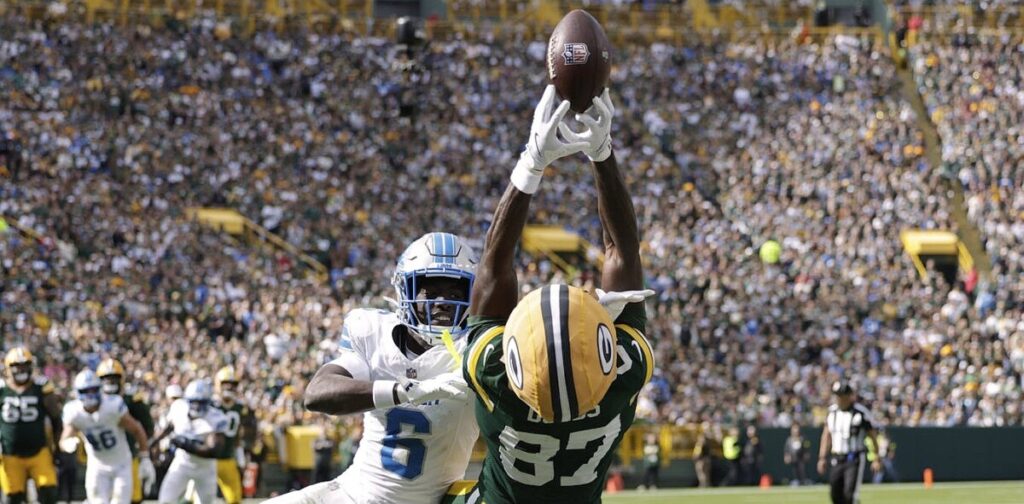
Green Bay Packers wide receiver Romeo Doubs (87) and Detroit Lions cornerback Terrion Arnold (6) show off their athleticism on Sept. 7, 2025.
AP Photo/Matt Ludtke
As the Detroit Lions barrel toward a Thanksgiving Day game with the Green Bay Packers, some die-hard fans may be fantasizing about what it would be like to be on the field themselves: calling plays from the Lions huddle, accepting the snap from between a crouching center’s thighs, and spinning to hand off the football before the defensive linemen come crashing down.
In 1963, Lions head coach George Wilson allowed writer and Paris Review editor George Plimpton to enact that fantasy.
With a Sports Illustrated contract in hand, Plimpton convinced Lions management to allow him to enter preseason
training camp at Cranbrook
, the private boys school in Bloomfield Hills, Michigan. His plan was to go undercover as a rookie quarterback for a magazine article that would reach dramatic culmination when he called a series of plays in a game of professional football.
No one expected the amateur athlete to survive for long on a field with real-life Lions. But in writing about the experience, Plimpton turned off-field fandom and on-field bumbling into literary gold.
Little, Brown reissued Paper Lion in 2016.
Little, Brown
His resulting 1966 book, “
Paper Lion: Confessions of a Last-String Quarterback
,” became a bestseller that was praised by The New York Times as “one of
the greatest books written on sports
, and the most thoroughly engaging book on any subject in recent memory.”
A
1968 movie
based on the book
starred Alan Alda
as Plimpton and members of the 1967 Lions team as themselves.
Decades before I became a
journalism professor at Miami University of Ohio
, I discovered Plimpton’s sportswriting from reading the paperback versions I found on my parents’ bookshelves. Plimpton was a leading member of a mid-20th-century class of literary journalists, including
Tom Wolfe
,
Truman Capote
,
Gay Talese
and
Norman Mailer
, who were becoming known for applying novelistic techniques and sometimes personal, subjective perspectives to nonfiction.
While the other literati tackled heavy topics, Plimpton’s engaging, conversational prose goofed around on the fringes of pro sports. Many of his books followed the same “participatory journalism” formula. He wrote about
pitching against MLB all-stars
,
traveling with the PGA tour
,
boxing a bout against Archie Moore
and
playing with the Boston Bruins
.
Those were just the full-length books. Other
television and magazine projects
had Plimpton competing in tennis and bridge; performing stand-up comedy; acting in a Western; playing with the New York Philharmonic; and attempting to be an aerialist with the circus.
However, he is best known for trying his hand quarterbacking for the Lions.
Posh writer meets the gridiron
In some ways, Plimpton seemed exactly the wrong person for this job. The possessor of a distinctively old money accent and patrician wealth and manners, he was
founding editor of The Paris Review
and in 1967 a mainstay of literary salons in Paris and New York. “Author, critic, interviewer, party-giver … friend of everybody, gifted, personable, energetic, bright, with-it, rich, a legend in his own time,”
The New York Times gushed
.
Just the kind of person whom your average football fan might enjoy seeing knocked flat.
American journalist and literary critic George Plimpton was no fan of pain, and that limited his ability on the football field.
Evening Standard/Hulton Archive/Getty Images
Plimpton joined a team he described as recovering from scandal. After ending the 1962 season with an 11-3 record and a Playoff Bowl victory for third place in the NFL, the NFL commissioner’s office fined six Lions for gambling on the championship game between Green Bay and New York. More significant on field, the commissioner suspended Lions great defensive tackle and future Pro Football Hall of Famer Alex Karras for one year. Without him, the Lions would end the
1963 season 5-8-1
.
Plimpton wrote his way onto the team by promising to “just hang around on the periphery of things and not bother anyone, just try to participate enough to get the feel of things.”
Wilson agreed, and Plimpton arrived at training camp a few months later with his own football, purchased from an army-navy store in Times Square, and a “mild fiction” about having played quarterback at Harvard and for the nonexistent Newfoundland Newfs.
Plimpton’s attempt at deception might raise ethical questions; however, the joke is always on him. The coaching staff seemed to have thought it would be hilarious if anyone on the team actually took the gangly 36-year-old with the nasal accent as a professional football player. It seems unlikely that anyone did.
“I never had the temerity to pretend I was something that I wasn’t,” Plimpton wrote. “The team caught on quickly enough.”
At camp, Plimpton hung around the dining hall and sat in the back of team meetings. A master of small talk, he lets the reader eavesdrop on conversations with Hall of Famers Karras, Dick “Night Train” Lane and Joe Schmidt.
Plimpton takes us with him one night to a bar frequented by coaches, where we listen in rounds of
liars’ poker
with Wilson, Scooter McLean and Les Bingaman. We tag along as he chats with Karras at
Lindell’s A.C.
, the bar the player owned in downtown Detroit at the time.
Lessons in grit
At training camp, Plimpton faced the teasing of players but earned respect by facing the brutality of sport and by persisting despite the inevitability of pain. He never played football in school, beyond a beery game between
Harvard Crimson
and
Harvard Lampoon
, and did not know the basics of playing quarterback.
Several days into camp, he was allowed to participate in a play where, as quarterback, he was supposed to quickly hand off the ball to another player.
“At ‘two’ the snap back came,” Plimpton wrote. “I began to turn without the proper grip on the ball, moving too nervously, and I fumbled the ball, gaping at it, mouth ajar, as it fell and bounced twice, once away from me, then back, and rocked back and forth gaily at my feet. I flung myself on it (…) and I heard the sharp strange whack of gear, the grunts, and then a quick sudden weight whooshed the air out of me.”
The same thing happened when Plimpton was allowed to take the field in an annual intra-squad game played in Pontiac. Over his first three plays he lost 20 yards by falling down, getting knocked over by his own teammates and being literally picked from the ground by a zealous defender. On the bus ride home, Plimpton admitted to Wilson that he didn’t like being hit.
The coach gently explained that “love of physical contact” was necessary to make it in pro football.
“When kids, out in a park, chose of sides for tackle rather than touch, the guys that want to be ends and go out for the passes, or even quarterback, because they think subconsciously they can get rid of the ball before being hit, those guys don’t end up as football players,” Wilson mused. “They become great tennis players, or skiers, or high jumpers. It doesn’t mean they lack courage or competitiveness.”
“But the guys who put up their hands to be tackles or guards, or fullbacks who run not for daylight but for trouble – those are the ones who will make it as football players.”
This quality of great football players – an irrational enthusiasm for bruising physical contact – is celebrated by Plimpton in the veteran Lions who take him into their orbit. He becomes friends with Karras and offensive lineman John Gordy, in particular, and shoots the breeze on topics ranging from the NFL commissioner to Adolf Hitler.
In
a subsequent book
, Plimpton goes with the pair to a madcap golf tournament and starts a ridiculous business venture, suggesting the on-field madness necessary to succeed in football bleeds into off-field life as well.
But it is not Plimpton’s way to delve into the psychology of his idols. Rather, he listens as they spin tales that show how reckless the grown men who run toward trouble really are.
Stephen Siff does not work for, consult, own shares in or receive funding from any company or organization that would benefit from this article, and has disclosed no relevant affiliations beyond their academic appointment.


