As US hunger rises, Trump administration’s ‘efficiency’ goals cause massive food waste
In recent years, particularly during President Donald Trump’s second term, U.S. government policies have inadvertently led to a staggering increase in food waste, while simultaneously leaving millions of Americans hungry. The combination of aggressive immigration raids, tariff changes, and cuts to food assistance programs has created a perfect storm for farmers and consumers alike. With over 47 million Americans facing food insecurity, the irony is stark: approximately 40% of food produced in the U.S. goes to waste, translating to around 120 billion meals annually—more than enough to feed the hungry three times a day for an entire year. This waste not only represents a significant economic burden but also contributes to environmental issues, as rotting food emits over four million metric tons of methane, a potent greenhouse gas.
The impact of immigration policy on food production has been particularly severe. The Trump administration’s crackdown on undocumented workers has resulted in widespread fear among farmworkers, leading to a dramatic decrease in labor availability. Reports indicate that by mid-2025, up to 70% of individuals responsible for harvesting and processing food had stopped showing up for work due to fears of deportation. This labor shortage has left crops unharvested and rotting in fields, jeopardizing the national food supply. The U.S. Department of Labor has even warned that these aggressive raids pose a risk of supply shocks that could lead to food shortages. Additionally, the administration’s cuts to foreign aid have compounded the issue, with tons of food aid sitting unused in warehouses, ultimately wasted.
Moreover, tariff policies have further strained the agricultural sector. In early 2025, the imposition of tariffs severed trade relationships, particularly with China, resulting in mountains of unharvested soybeans that could have been used to feed both livestock and humans. The cancellation of programs that supported local farmers and food banks, along with cuts to disaster recovery funding, has left many farmers without critical revenue sources, exacerbating the cycle of waste. As the Thanksgiving season approaches, it is essential to recognize that food waste is not merely a logistical issue but a reflection of broader systemic failures within the food system. The policies of the past few years have highlighted the need for a reevaluation of how food resources are managed, especially in a country where hunger and waste coexist in such stark contrast.
https://www.youtube.com/watch?v=2J4VjqpswWo
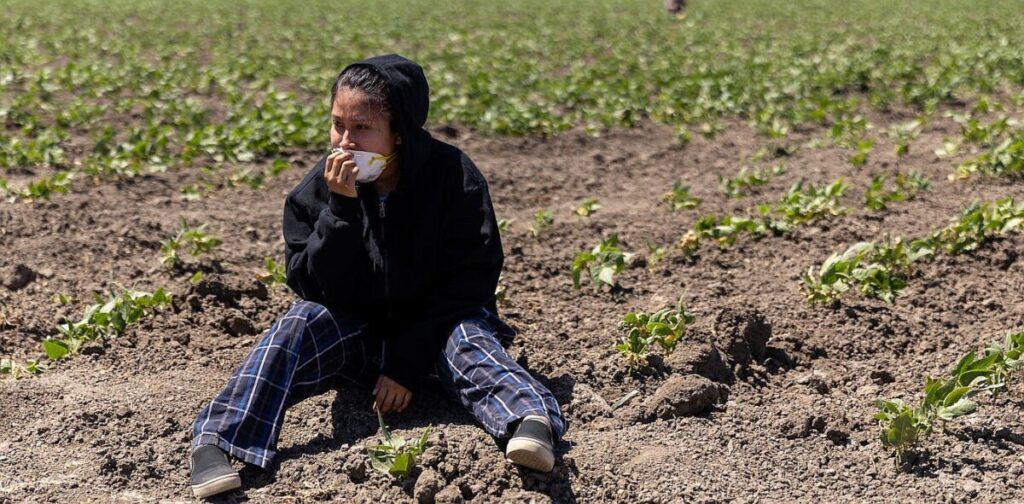
A person sits in a field of crops after a raid by U.S. immigration agents.
Blake Fagan/AFP via Getty Images
The U.S. government has caused massive food waste during President Donald Trump’s second term. Policies such as immigration raids, tariff changes and
temporary
and
permanent cuts to food assistance
programs have left farmers short of workers and money, food rotting in fields and warehouses, and millions of Americans hungry. And that doesn’t even include the administration’s actual destruction of edible food.
The U.S. government estimates that
more than 47 million people
in America don’t have enough food to eat – even with federal and state governments spending
hundreds of billions of dollars
a year on programs to help them.
Yet, huge amounts of food – on average in the U.S.,
as much as 40% of it
– rots before being eaten. That amount is
equivalent to 120 billion meals a year
: more than twice as many meals as would be needed to feed those 47 million hungry Americans three times a day for an entire year.
This colossal waste has
enormous economic costs
and renders useless all the
water and resources used to grow the food
. In addition, as it rots,
the wasted food emits in the U.S. alone over 4 million metric tons of methane
– a heat-trapping greenhouse gas.
As a
scholar
of
wasted food
, I have watched this problem worsen since Trump began his second term in January 2025. Despite this administration’s claim of streamlining the government to
make its operations more efficient
, a range of recent federal policies have, in fact, exacerbated food wastage.
A farmworker raises her hands as armed immigration agents approach during a raid on a California farm in July 2025.
Blake Fagan/AFP via Getty Images
Immigration policy
Supplying fresh foods, such as fruits, vegetables and dairy, requires skilled workers on tight timelines to
ensure
ripeness
, freshness and
high quality
.
The Trump administration’s widespread efforts to
arrest and deport immigrants
have sent Immigration and Customs Enforcement, the Border Patrol and other agencies into hundreds of agricultural fields, meat processing plants and food production and distribution sites. Supported by
billions of taxpayer dollars
, they have arrested thousands of food workers and farmworkers –
with lethal consequences
at times.
Dozens of raids
have not only violated immigrants’ human rights and torn families apart: They have jeopardized the national food supply. Farmworkers already work
physically hard jobs for low wages
. In
legitimate fear
for their lives and liberty, reports indicate that in some places 70% of people harvesting, processing and distributing food
stopped showing up to work
by mid-2025.
News reports have identified many instances where
crops have been left to rot
in
abandoned fields
. Even the U.S. Department of Labor declared in October 2025 that aggressive farm raids drive farmworkers into hiding, leave substantial amounts of food unharvested and thus pose a “
risk of supply shock-induced food shortages
.”
Food specially formulated to feed starving children is marked for disposal in a U.S. government warehouse in July 2025.
Stephen B. Morton for The Washington Post via Getty Images
Foreign aid cuts
When the Trump administration all but shut down the U.S. Agency for International Development in early 2025, the agency had
500 tons of ready-to-eat, high-energy biscuits
worth US$800,000
, stored to distribute to starving people around the world who had been displaced by violence or natural disasters. With no staff to distribute the biscuits, they expired while sitting in a warehouse in Dubai.
Incinerating the out-of-date biscuits
reportedly cost an additional $125,000
.
An additional
70,000 tons of USAID food aid
may also have been destroyed.
Tariffs
In the late 20th century, as globalized trade patterns grew, U.S. farmers struggled with
agricultural prices below their production costs
. Yet tariffs in the first Trump administration
did not protect small farms
.
And the tariffs imposed in early 2025, after Trump regained the White House,
severed U.S. soybean trade
with China for months. Meanwhile, there’s
nowhere to store the mountains of soybeans
. An October 2025 agreement may resume some activity, but at
lower price levels and a slower pace
than before, as China looks to Brazil and Argentina to meet its
vast demand
.
Though the soybeans were intended to feed the Chinese pig industry, not humans, the
specter of waste looms
both in terms of the potential spoilage of soybeans and the actual human food that could have been grown in their place.
Mature soybeans sit unharvested in an Indiana field in October 2025.
Jeremy Hogan/Getty Images
Other efforts lead to more waste
Since taking office, the second Trump administration has taken many steps aimed at efficiency that actually boosted food waste. Mass
firings of food safety personnel
risks even more outbreaks of foodborne diseases,
tainted imports
, and agricultural pathogens – which can erupt into crises requiring mass destruction, for instance, of
nearly 35,000 turkeys with bird flu in Utah
.
In addition, the administration canceled a popular program that
helped schools and food banks buy food
from local farmers, though many of the crops had already been planted when the cancellation announcement was made. That food had to find new buyers or risk being wasted, too. And the farmers were
unable to count on a key revenue source
to keep their farms afloat.
Also, the administration slashed funding for the Federal Emergency Management Agency that helped food producers, restaurants and households recover from disasters – including restoring power to
food-storage refrigeration
.
The fall 2025 government shutdown left the government’s major food aid program, SNAP, in limbo for weeks,
derailing communities’ ability
to meet their basic needs. Grocers, who
benefit substantially
from SNAP funds, announced discounts for SNAP recipients – to help them afford food and to keep food supplies moving before they rotted. The Department of Agriculture ordered them not to, saying
SNAP customers must pay the same prices
as other customers.
Food waste did not start with the Trump administration. But the administration’s policies – though they claim to be seeking efficiency – have compounded voluminous waste at a time of growing need. This Thanksgiving, think about wasted food – as a problem, and as a symptom of larger problems.
American University School of International Service master’s student
Laurel Levin
contributed to the writing of this article.
Garrett Graddy-Lovelace received funding from the NSF Multiscale RECIPES for Sustainable Food Systems project.


