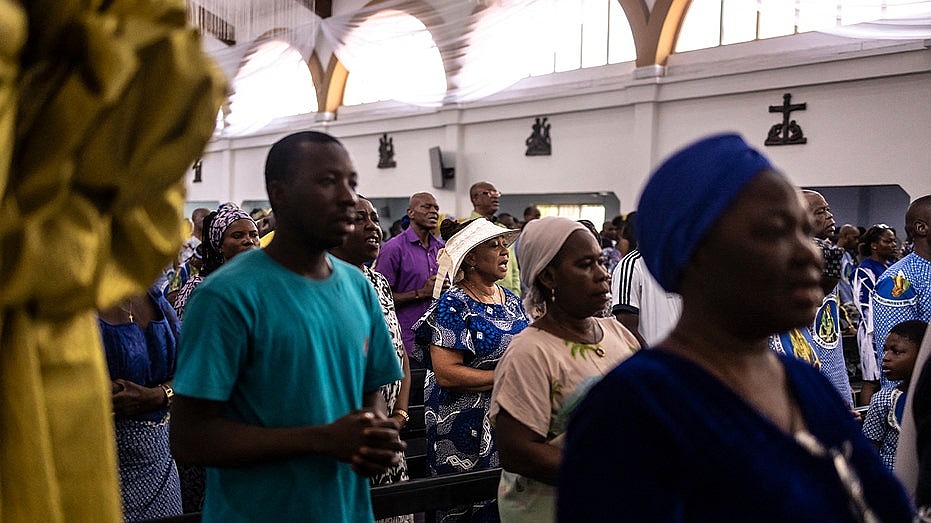
Experts dispute Nigerian government’s claims amid congressional probe of escalating attacks on Christians
On Tuesday, House appropriators and foreign affairs leaders held a significant joint briefing to address the alarming rise in violence against Christians in Nigeria, a situation that has garnered increasing attention from lawmakers and human rights advocates. This meeting, led by House Appropriations Vice Chair Mario Díaz-Balart, R-Fla., is part of a broader congressional investigation prompted by President Trump, who has directed Congress to examine the persecution of Christians in Nigeria and propose potential policy actions. The urgency of this investigation is underscored by harrowing reports of massacres, abductions, and systematic attacks on Christian communities, with Vicky Hartzler, chair of the U.S. Commission on International Religious Freedom, highlighting a stark disparity in violence: Christians are reportedly targeted at a rate of 2.2 to 1 compared to Muslims.
The briefing revealed a grim picture of the situation in Nigeria, where extremist groups like Boko Haram are accused of deliberately targeting Christians. Dr. Ebenezer Obadare from the Council on Foreign Relations challenged the Nigerian government’s narrative that the violence is not religiously motivated, asserting that these groups act primarily on religious grounds. He criticized the Nigerian military’s inability to effectively combat these jihadist networks, calling for increased U.S. pressure to dismantle armed groups enforcing Islamic law and to tackle corruption within the security forces. Additionally, Sean Nelson from Alliance Defending Freedom International asserted that Nigeria is the deadliest country for Christians, with more Christians killed there than in all other nations combined. He emphasized the need for tighter U.S. oversight of aid to Nigeria, advocating for routing assistance through faith-based organizations to mitigate corruption.
While Nigeria has made some initial steps toward addressing the violence, such as redistributing police forces to enhance security, lawmakers like Hartzler caution that these measures are insufficient. She noted that recent acknowledgments from Nigerian officials about the severity of the violence are promising but must be accompanied by concrete actions to ensure accountability and transparency. The session concluded with a commitment from U.S. lawmakers to pursue further oversight and to prepare a comprehensive report for the White House, signaling a critical moment in U.S.-Nigeria relations regarding religious freedom and human rights. As the situation evolves, the international community watches closely, hoping for meaningful progress in protecting vulnerable populations in Nigeria.
https://www.youtube.com/watch?v=p9U0-_5xJ7E
House appropriators and foreign affairs leaders convened a rare joint briefing Tuesday as part of a broader
congressional investigation
into what lawmakers and experts describe as escalating and targeted violence against Christians in Nigeria.
The session — led by House Appropriations Vice Chair and National Security Subcommittee Chairman Mario Díaz-Balart, R-Fla. — is feeding into a comprehensive report ordered by President Trump on recent massacres of Nigerian Christians and potential policy steps the U.S. could take to pressure Abuja to respond.
Trump directed Congress
, led by Reps. Riley Moore, R-W.Va., and Appropriations Chairman Tom Cole, R-Okla., to probe Christian persecution in Nigeria and produce a report for the White House to review. He has floated the idea of taking direct military action against Islamists who kill.
Vicky Hartzler, chair of the U.S. Commission on International Religious Freedom, told lawmakers that “religious freedom [is] under siege,” citing the abduction of more than 300 children and attacks in which “radical Muslims kill entire
Christian villages
[and] burn churches.” She said violations are “rampant,” “violent,” and disproportionately affect Christians, who she argued are targeted “at a 2.2 to 1 rate” compared with Muslims.
ARMED ATTACKERS IN NIGERIA KIDNAP 25 GIRLS FROM BOARDING SCHOOL
Hartzler said Nigeria has taken some initial corrective steps — including reassigning about 100,000 police officers from VIP protection details — but warned the country is entering a “coordinated and deeply troubling period of escalated violence.” She recommended
targeted sanctions
on Nigerian officials “who have demonstrated complicity,” visa restrictions, blocking U.S.-based assets, and conditioning foreign and humanitarian aid on measurable accountability.
She also urged Congress to direct the Government Accountability Office to conduct a review of past U.S. assistance and said Abuja should retake villages seized from Christian farming communities so widows and children can return home.
Dr. Ebenezer Obadare of the Council on Foreign Relations offered the sharpest challenge to the Nigerian government’s claim that the violence is not religiously motivated. He said the idea Boko Haram and other militant groups target Christians and Muslims equally is a “myth,” arguing the groups “act for one reason and one reason only: religion.” Any higher Muslim casualty count, he said, reflects geography, not equal targeting.
‘GENOCIDE CAN’T BE IGNORED’: GOP LAWMAKER BACKS TRUMP’S THREAT OF MILITARY ACTION IN NIGERIA
Obadare described Boko Haram as fundamentally opposed to democracy and said the Nigerian military is “too corrupt and incompetent” to dismantle jihadist networks without strong external pressure. He urged the U.S. to press the Nigerian government to disband armed groups enforcing Islamic law, confront corruption inside the security forces, and demonstrate genuine intent to curb religious violence. He added that Washington should insist Nigerian officials respond immediately to early warnings of impending attacks.
Sean Nelson of Alliance Defending Freedom International added that Nigeria is “the deadliest country in the world for Christians,” claiming more Christians are killed there than in all other countries combined and at a rate “five times” higher than Muslims when adjusted for population. He said extremists also target Muslims who refuse to embrace their extreme ideology, which he argued further undercuts Abuja’s narrative that the crisis is driven mainly by criminality or local disputes.
With a population of more than 230 million, Nigeria’s vibrant and often turbulent cities and villages are home to people of strikingly diverse backgrounds. The nation’s roughly 120 million-strong Muslim population dominates the north, while some 90 million Christians are centered in the southern half of the country.
Nelson urged tighter U.S. oversight of assistance to Nigeria, including routing some aid through faith-based organizations to avoid corruption. He called for greater transparency in how Abuja handles mass kidnappings and ransom payments and said sustained U.S. and international pressure is essential because “without transparency and outside pressure, nothing changes.”
Díaz-Balart criticized the Biden administration for reversing the Trump administration’s designation of Nigeria as a “country of particular concern” in 2021, arguing the change has had “clearly deadly consequences.” Lawmakers on the Appropriations, Foreign Affairs and Financial Services committees signaled additional oversight actions in the months ahead as they prepare the Trump-directed report to Congress.
Hartzler noted that Nigeria has recently begun taking several steps that could signal a shift toward confronting the crisis more directly. She pointed to President Bola Tinubu’s decision to pull about 100,000 police officers from VIP bodyguard assignments and redistribute them across the country, calling it “a promising start after years of neglect.” She said the move reflects growing recognition inside Nigeria’s political leadership that the violence has reached an intolerable level.
She also highlighted comments last week from Nigeria’s speaker of the House, who acknowledged the country is facing a “coordinated and deeply troubling period of escalated violence.” Hartzler said that acknowledgment — coupled with a push from the Nigerian House majority leader for more intensive legislative oversight — suggests the government may finally be admitting the scale and severity of the attacks.
Even with these developments, Hartzler warned the measures are far from sufficient. She emphasized that the Nigerian government must show clear intent to “quell injustice,” act quickly when early warning signs of attacks appear, and commit to transparency and accountability if the recent steps are going to amount to meaningful progress.
The Nigerian Embassy did not immediately respond to a request for comment.