What Robert F. Kennedy Jr. didn’t tell you about ‘Operation Northwoods,’ the false flag operation he loves to denounce
In the shadow of the Cuban missile crisis, Robert F. Kennedy Jr. has frequently invoked “Operation Northwoods” to illustrate his views on military overreach and the moral failings of U.S. military leadership. However, his accounts frequently overlook a crucial element: the involvement of his father, Robert F. Kennedy, during a pivotal moment in U.S. history. As the Attorney General under President John F. Kennedy, Robert F. Kennedy played a significant role in discussions about potential military actions against Cuba, including the controversial idea of fabricating an attack on the U.S. naval base at Guantánamo Bay as a pretext for war. This suggestion came during the failed Bay of Pigs invasion in April 1961, when RFK proposed that if Castro’s forces were falsely portrayed as attacking U.S. interests, it could galvanize support for military intervention.
The origins of “Operation Northwoods,” a series of proposed false flag operations aimed at justifying U.S. military intervention in Cuba, can be traced back to the very discussions that Robert F. Kennedy was a part of. In March 1962, as the U.S. government grappled with the failure of covert operations to unseat Fidel Castro, RFK’s Special Group (Augmented) requested the Joint Chiefs of Staff to draft scenarios that could serve as pretexts for military action. The resulting document, later misnamed “Operation Northwoods,” outlined various deceptive tactics, including the potential sinking of a U.S. ship to blame Cuba. While these plans were ultimately not acted upon, they highlight the precarious balance of power and the moral dilemmas faced by leaders during a time of heightened Cold War tensions.
Interestingly, the narrative surrounding “Operation Northwoods” has evolved, with Robert F. Kennedy Jr. focusing on military culpability while neglecting to acknowledge his father’s role in these discussions. As the centennial of Robert F. Kennedy’s birth approaches, it serves as a reminder of the complexities of leadership and the ethical implications of war. The historical context reveals that the military’s proposals were in direct response to the directives from the Kennedy administration, underscoring the need for accountability not just among military leaders but also among those in positions of political power. This nuanced understanding of the events surrounding “Operation Northwoods” and the Cuban missile crisis challenges the simplified narratives often presented in political discourse today.
https://www.youtube.com/watch?v=c5zw1eOIW9M
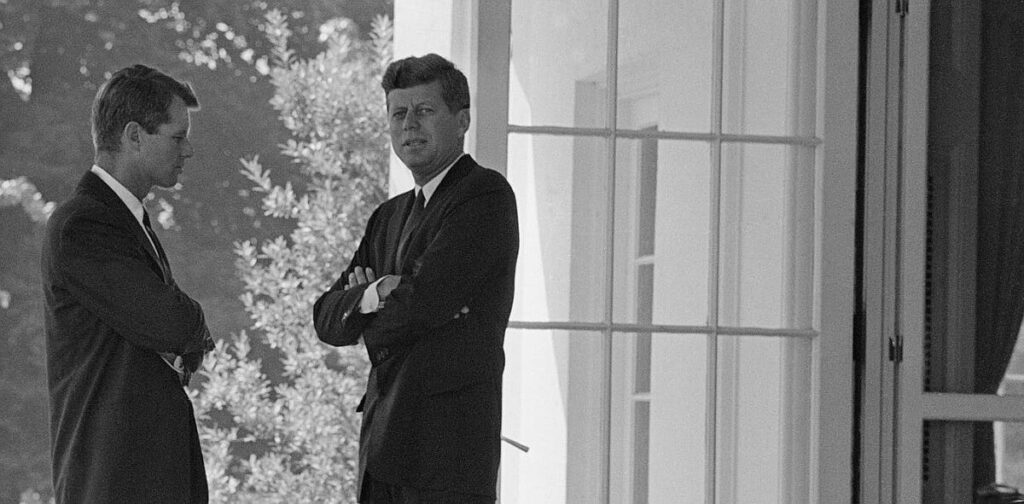
U.S. President John F. Kennedy, right, confers with his brother, Attorney General Robert F. Kennedy, at the White House on Oct. 1, 1962, during the buildup of military tensions that became the Cuban missile crisis later that month.
AP Photo
Something’s missing from Robert F. Kennedy Jr.’s accounts of “Operation Northwoods.” Something that explains the origins of
this menu of false flag operations
– pretexts for war with Cuba – drafted by the Pentagon in March 1962.
Something about his father.
Most people remember Robert F. Kennedy as President John F. Kennedy’s
closest confidant, campaign manager and attorney general
, the tough but idealistic younger brother who helped him through the Cuban missile crisis and later waged an antiwar campaign for president, before becoming the second Kennedy brother
slain by an assassin
.
During
Robert F. Kennedy Jr.’s political rise to his current position
as Secretary of Health and Human Services, he capitalized on the story of “Operation Northwoods,” giving
his version of it in
speeches
,
interviews
, and two
separate
books
.
Kennedy Jr. pinned the blame for the pretexts solely on “the highest officials in the U.S. military,” accusing them of “lethal zealotry,” decrying “how badly the American military leadership had
lost its moral bearings
.”
To illustrate the point, he cited one pretext at length: “A
‘Remember the Maine’
incident could be arranged in several forms: We could blow up a U.S. ship in
Guantánamo Bay
and blame Cuba.”
In each of these accounts, Kennedy Jr. omitted the most important part of the “Operation Northwoods” story: his father’s role. I learned of that role from documents declassified by the
JFK Assassination Records Review Board
, in the
Kennedy Library
and in other archives while researching a book I’m writing, “Clandestine Camelot.”
Robert F. Kennedy aimed to use false flag operations as a pretext to go to war with Cuba and depose its communist leader, Fidel Castro, seen here in 1963.
Keystone-France/Gamma-Keystone via Getty Images
Debacle with a chaser of deceit
In the first foreign policy memo he dictated, Attorney General Kennedy broached the idea of fabricating an attack on the U.S. naval base at Guantánamo Bay in Cuba, one of the
spoils of the Spanish-American War
.
It was April 19, 1961, and the
Bay of Pigs invasion
was in mid-collapse. Roughly 1,500 CIA-trained and -financed Cuban expatriates were mounting a doomed attempt to overthrow Fidel Castro, the Cuban revolutionary-turned-tyrant. Castro had the invaders pinned down on the beach under fire from Moscow-furnished MiG fighter jets.
It was then that the attorney general asked the president if they could get Central and South American nations “to take some action” to stop the flow of Russian arms to Cuba “if it was reported that one or two of Castro’s MiGs attacked Guantanamo Bay and the United States made noises like this was an act of war and that we might very well have to
take armed action ourselves
.”
Castro, of course, had not attacked the U.S. naval base. That would have meant war with America and the end of his regime.
President Kennedy didn’t act on his brother’s suggestion, but began including him regularly in foreign policymaking. Newspapers started calling RFK “the
second most important man
in the Western World.”
From subversion to military intervention
During the 1960 presidential campaign, JFK called Cuba a “
Soviet satellite
” and a “
potential enemy missile or submarine base
only 90 miles from our shores.” In November 1961, hoping to undo the Bay of Pigs failure, he created his own covert operation “to help Cuba
overthrow the communist regime
.” He put his
brother Robert in charge
of the secret program of subversion, code-named “Operation Mongoose.”
Fomenting revolution in Cuba faced an insurmountable obstacle: Castro was already powerful enough to crush any purely internal uprising.
CIA
,
State Department
, and
Defense
Department officials agreed that the only way to overthrow Castro was a U.S. invasion.
Under Robert Kennedy’s leadership, the “
Special Group (Augmented)
,” the interagency group JFK charged with overseeing Mongoose, proposed to change the covert operation’s goal from orchestrating subversion to justifying U.S. military intervention.
On
March 5, 1962
, the group asked Deputy Under Secretary of State for Political Affairs U. Alexis Johnson “to have a list prepared of various situations which would serve as a
plausible pretext for intervention
.” In the minutes of that meeting, someone crossed out “plausible pretext” and wrote “valid basis.”
The minutes of a March 5, 1962, meeting show that Robert F. Kennedy’s group asked a State Department staffer to prepare a list of various situations ‘which would serve as a plausible pretext for intervention’ in Cuba.
National Archives
The origin of ‘Operation Northwoods’
After the meeting, “
in response to direction
,” Mongoose operations chief Edward G. Lansdale asked the Joint Chiefs of Staff for “a
brief but precise description of pretexts
which the JCS believes desirable for direct military intervention.”
The Joint Chiefs of Staff responded by drafting the document now known as “Operation Northwoods.”
Fun fact: No one called it “Operation Northwoods” at the time.
“Northwoods” was just a code word the Joint Chiefs of Staff used on Mongoose documents. In the 21st century, however,
historians
mistook
the code word for a code name and gave the pretexts their unhistorical handle. There was no “Operation Northwoods,” but that didn’t stop it from getting its own
Wikipedia page
.
The Special Group (Augmented) voted on
March 13, 1962
, to alter the Mongoose guidelines to state “that final success will require decisive
U.S. military intervention
.”
Three days later, the group briefed the president on the revised guidelines, including secret “
plans for creating plausible pretexts to use force
, with the pretexts either attacks on U.S. aircraft or a Cuban action in Latin America for which we would retaliate.”
President Kennedy said “
bluntly
” that they were not then able to make a decision on the use of military force.
But he did tell the group to “go ahead on the guidelines.” Since the revised guidelines said that Cubans “will be used to
prepare for and justify this [U.S. military] intervention
, and thereafter to facilitate and support it,” the revision transformed Mongoose into a secret program to furnish the president with a pretext to invade Cuba if he so chose.
Fortunately, he didn’t.
Apocalyptic advice
The last recorded time Robert Kennedy urged his brother to consider a false flag operation was on Oct. 16, 1962, the first day of the
Cuban missile crisis
.
The president’s secret White House recording system captured Robert Kennedy advising him to consider fabricating a pretext for U.S military intervention: “Can I say that one other thing is whether we should also think of whether there is some other way we can get involved in this, through Guantánamo Bay or something. Or whether there’s some ship that … you know,
sink the Maine again
or something.”
JFK ignored the suggestion. Taking it would have, in all likelihood,
started a nuclear war
.
This year marks
the centennial of Robert Kennedy’s birth
, the perfect occasion to stop scapegoating the military for his darkest deeds. In drafting pretexts for war, the Pentagon was complying with instructions it received through the command structure the president established for Operation Mongoose. Generals have little choice but to comply with such instructions unless and until Congress outlaws false flag operations.
Robert F. Kennedy Jr. wrote that the “Operation Northwoods memo should serve as a warning [to] the American people about the dangers of allowing the military to set goals or standards for our country.”
In reality, it reveals the dangers of letting someone like Robert F. Kennedy use the power of the U.S. government to deceive Americans about life-or-death matters.
Ken Hughes is a research specialist with the Presidential Recordings Program of the University of Virginia’s Miller Center, whose work is funded in part by grants from the National Historical Publications and Records Commission.


