
Red Spider Nebula
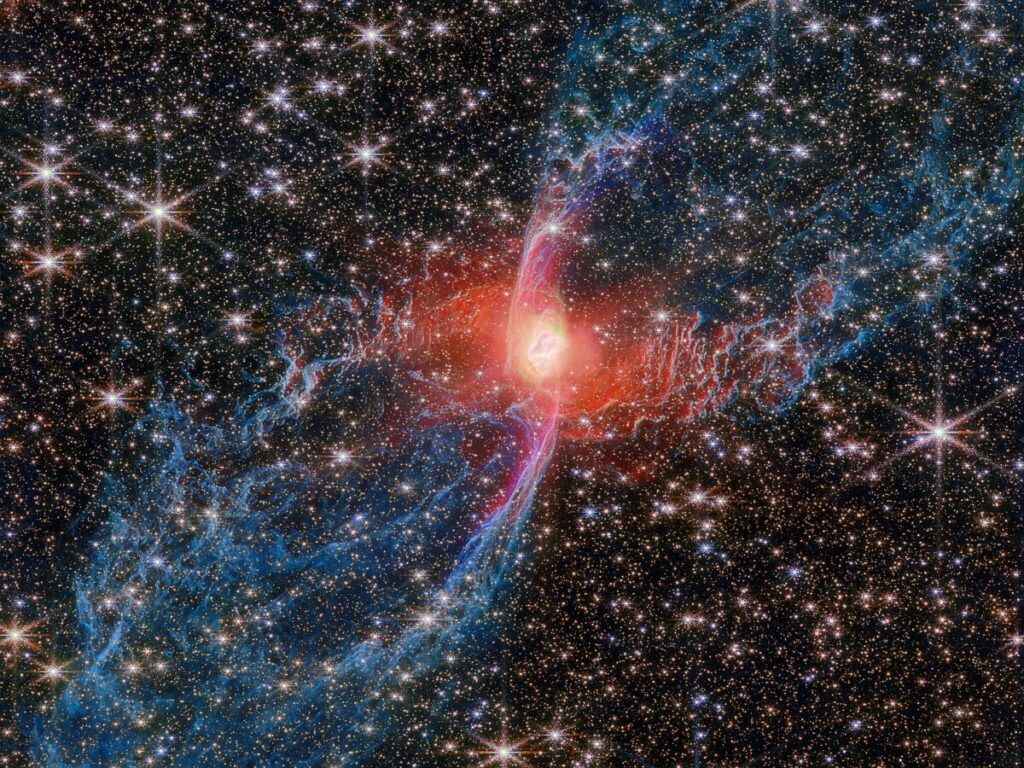
On October 26, 2025, the James Webb Space Telescope (JWST) unveiled a stunning new perspective of the Red Spider Nebula, a planetary nebula located approximately 2,500 light-years away in the constellation of Scorpius. Utilizing its advanced Near-InfraRed Camera (NIRCam), Webb captured intricate details that have never been seen before, revealing the nebula’s striking outstretched lobes, which resemble the legs of a spider. This groundbreaking image showcases the full extent of these lobes, which are illuminated by light emitted from hydrogen molecules (H2) and stretch across Webb’s expansive field of view, each extending approximately 3 light-years into space.
The Red Spider Nebula is a fascinating object of study, particularly because it is a product of stellar evolution. As stars like our Sun exhaust their nuclear fuel, they shed their outer layers, creating such nebulae. The gas and dust expelled by the dying star in the center of the Red Spider Nebula have inflated these bubble-like structures over thousands of years, producing a visually captivating spectacle. The clarity and detail provided by Webb’s NIRCam allow astronomers to gain deeper insights into the physical processes at play in this nebula, including the dynamics of gas outflow and the interactions between the star and its surrounding material. This new image not only enhances our understanding of the Red Spider Nebula but also exemplifies the capabilities of the JWST in exploring the cosmos and revealing the hidden wonders of the universe.
In addition to its scientific significance, the image serves as a reminder of the beauty and complexity of celestial phenomena. The vibrant blue hues of the lobes, contrasted against the darker backdrop of space, create a mesmerizing visual that captures the imagination. As NASA, the European Space Agency (ESA), and the Canadian Space Agency (CSA) continue to collaborate on the JWST mission, discoveries like this one pave the way for advancing our knowledge of stellar life cycles and the vast universe beyond our planet. The Red Spider Nebula stands as a testament to the power of modern astronomy and the intricate processes that govern the life and death of stars.
ESA/Webb, NASA & CSA, J. H. Kastner (Rochester Institute of Technology)
Using its
Near-InfraRed Camera
(NIRCam), NASA’s James Webb Space Telescope captured never-before-seen details of the Red Spider Nebula, a planetary nebula, in this image
released on Oct. 26, 2025
. NIRCam is Webb’s primary near-infrared imager, providing high-resolution imaging and spectroscopy for a wide variety of investigations.
Webb’s new view of the Red Spider Nebula reveals for the first time the full extent of the nebula’s outstretched lobes, which form the ‘legs’ of the spider. These lobes, shown in blue, are traced by light emitted from H2 molecules, which contain two hydrogen atoms bonded together. Stretching over the entirety of NIRCam’s field of view, these lobes are shown to be closed, bubble-like structures that each extend about 3 light-years. Outflowing gas from the center of the nebula has inflated these massive bubbles over thousands of years.
Image credit: ESA/Webb, NASA & CSA, J. H. Kastner (Rochester Institute of Technology)



