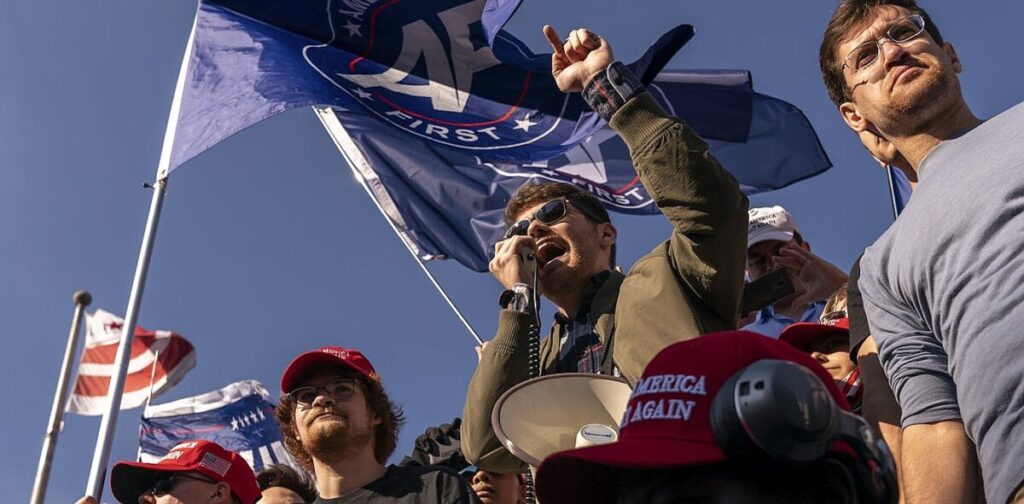
Nick Fuentes is a master of exploiting the current social media opportunities for extremism
In a recent analysis of the evolving landscape of far-right extremism in America, the spotlight has turned to Nick Fuentes, a controversial right-wing influencer known for his openly antisemitic views and association with the “America First” movement. His recent appearance on Tucker Carlson’s show has reignited debates about the normalization of extremist ideologies within mainstream conservatism. Critics decry the platforming of individuals like Fuentes, who openly idolizes Adolf Hitler, while supporters defend the interview as an exercise in free speech. This incident highlights a significant shift in how fringe ideologies operate today compared to the mid-20th century, showcasing the challenges faced by traditional gatekeepers such as political parties and the media in containing extremist narratives.
Historically, extremist movements in America, such as the Columbians in the 1940s, were characterized by clear organizational structures that could be dismantled by authorities. The Columbians, for instance, were swiftly suppressed after a brief but brazen campaign of Nazi sympathies in Atlanta. However, the rise of digital communication has transformed the nature of far-right extremism into a more diffuse and culturally embedded phenomenon. Fuentes and his followers, known as the Groypers, have successfully leveraged social media to spread their ideologies, creating a pervasive atmosphere that is difficult to combat through traditional means. Unlike their predecessors, who wore uniforms and marched openly, the Groypers utilize irony and plausible deniability to mask their extremist beliefs, allowing them to infiltrate mainstream conservative discourse more effectively.
The implications of this shift are profound, as evidenced by the mixed reactions within Republican circles to Fuentes and the Groypers. While some party leaders attempt to distance themselves from this faction, others, including former President Donald Trump, have shown a troubling ambivalence towards Fuentes and his ideology. The resignations from the Heritage Foundation illustrate the internal conflicts within the conservative movement regarding the acceptance of far-right elements. As the Groypers continue to gain cultural traction among younger conservatives, it becomes increasingly clear that they represent a new form of extremism that is uniquely adapted to the digital age, challenging the effectiveness of traditional methods of suppression and raising critical questions about the future of American political discourse.
https://www.youtube.com/watch?v=y8AjxRiRD8o
Right-wing influencer Nick Fuentes, center, speaks in front of flags that say ‘America First’ at a pro-Trump march on Nov. 14, 2020, in Washington.
AP Photo/Jacquelyn Martin, File
When
Tucker Carlson
hosted Nick Fuentes on his show last month, the response followed a familiar script.
Critics condemned the platforming of a white nationalist
.
Defenders invoked free speech
. Social media erupted.
“We’ve had some great interviews with Tucker Carlson, but you can’t tell him who to interview,”
President Donald Trump
said on Nov. 17, 2025. “Ultimately, people have to decide.”
Fuentes is a 27-year-old livestreamer with openly antisemitic views. He has called
Adolf Hitler
both “awesome” and “right.” But he has become
impossible for the Republican Party to banish
, despite repeated attempts by
some party leaders
.
This dynamic reveals how fringe ideologies operate differently today compared to the mid-20th century, when institutional gatekeepers – political parties, law enforcement, the media – could more effectively contain extremist movements.
And through their 21st-century methods of communication and operation, Nick Fuentes and his followers – the “Groypers” – have managed to get what their 20th-century predecessors could not: widespread awareness and political influence.
Atlanta, 1940: Brazen but brief fascist group
As a
historian of the American far right
, I have spent years examining how fascist movements adapted to the conditions of postwar America. The trajectory from the 1940s until today shows a fundamental shift: from defined organizational structures that could be dismantled to diffuse cultural movements that spread through social media.
Let me offer an example.
In 1946, barely a year after Hitler’s defeat, young men in khaki shirts marched through Atlanta, Georgia, performing Nazi salutes and promising racial vengeance.
Led by Homer Loomis Jr.
– a Princeton dropout who called Hitler’s manifesto “
Mein Kampf
” his “bible” – this group, known as the Columbians, offered Atlanta a glimpse of explicit fascism. They conducted armed patrols, held uniformed drills and even drew up blueprints for blowing up City Hall.
Their brazenness, however, was matched by their brevity. Ten months after forming, Atlanta authorities revoked their charter and jailed the ringleaders.
The swift suppression seemed to prove that explicit fascism had no future in postwar America. And for decades that held true. Open Nazi sympathizers remained marginal, their organizations small and easily ostracized.
In the 1970s, when a group of
American Nazis
planned to march in Skokie, Illinois, a predominantly Jewish suburb of Chicago, the event was most notable for the counterprotests it triggered.
Mainstreaming fascism
But the Columbians’ failure, it turned out, was organizational, not ideological. The government could revoke a charter and convict leaders. They could not repress a mood.
In the digital age, Fuentes represents that mood as a diffuse sensibility rather than a structured organization. Where the Columbians wore uniforms that advertised their fascist allegiance, Fuentes wears suits and frames his
worldview in the rhetoric of “America First
.”
The difference is strategic. In a 2019 livestream, Fuentes explained his approach openly: “Bit by bit we start to break down these walls … and then one day, we become the mainstream.”
This packaging marks a deliberate shift. Fuentes treats plausible deniability – of fascism, of antisemitism – not as a weakness but as a central feature. The content of his message remains extreme, but the ironic wrapping enables something the Columbians never achieved – cultural saturation.
Fuentes’s followers,
Groypers
, have in turn mastered this diffusion strategy.
For many conservatives under 40, exposure to Groyper-style content isn’t in meetings.
They absorb it through
social media feeds, Discord servers and group chats. A tone of grievance and ironic provocation becomes prominent background noise, moving the marginal toward the mainstream. A generation raised on anti-woke content, 4chan and transgressive memes
now shapes the neofascist movement’s tone
.
At the same time, institutional authority has in many ways effectively collapsed. The Columbians faced united opposition from media, prosecutors and politicians. Those gatekeepers no longer control conservatism or the white nationalists who are adjacent to it.
In late 2022, former President Donald Trump issued this social media post after having dinner with Nick Fuentes.
X
Achieving what predecessors could not
The Carlson-Fuentes interview has instead exposed a rift within MAGA circles.
Several
board members of the Heritage Foundation
, a conservative think tank with deep ties to the Trump administration, have resigned over the controversy, including one this week.
They were angered that Kevin Roberts, the foundation’s president, released
a video defending the interview
. Roberts has apologized for some of its contents but not retracted it.
Republicans aren’t all in agreement about whether Groypers represent a threat or an important constituency.
Members of Congress
have given speeches at Fuentes’ conferences;
Trump dined with him
at Mar-a-Lago in 2022.
Last year,
JD Vance
, now the vice president, called Fuentes a “total loser.” Fuentes attempted, without success, to mobilize Groypers against Trump in 2024 and called the president a “
scam artist
” earlier this year for failing to release the files in the Jeffrey Epstein case.
Yet the broader Groyperfication of conservative youth culture proceeds apace. Trump
reversed his stance
on the Epstein files. In defending Carlson’s interview with Fuentes, Trump said, “
I don’t know much about him
.”
Trump said roughly the same thing when he
sat down to dinner with Fuentes at Mar-a-Lago
in November 2022. Still, that event showed that the Groypers, now six years into their existence, have achieved what their predecessors could not:
genuine cultural penetration and political influence
.
The old remedies no longer function. Authorities cannot ban an atmosphere or revoke the charter of a meme. Social media platforms designed to maximize engagement often maximize anger. Fuentes and imitators exploit this frustration.
They remain controversial, and the Groypers’ lack of formal institutions could mean they will at some point fade like other far-right youth movements. Trump’s eventual exit from politics may also deprive them of a central reference point.
But they might represent something new: a post-organizational extremism uniquely adapted to digital life.
The Columbians once promised to control Atlanta in six months and America in 10 years. They lasted 10 months. The Groypers have already long outlasted them. That endurance signals a new, far more successful approach.
Alex McPhee-Browne does not work for, consult, own shares in or receive funding from any company or organization that would benefit from this article, and has disclosed no relevant affiliations beyond their academic appointment.


