Just follow orders or obey the law? What US troops told us about refusing illegal commands
In a controversial move, six Democratic members of Congress recently urged U.S. military personnel to refuse what they described as illegal orders from the Trump administration, particularly regarding military strikes against vessels in the Caribbean allegedly involved in drug smuggling. This assertion, made in a video released on November 18, 2025, has ignited a fierce backlash from President Trump, who labeled the lawmakers’ statements as “seditious behavior, punishable by death.” The lawmakers, all of whom have military or intelligence backgrounds, expressed concerns that active-duty troops are grappling with the legality of their orders, particularly given the ethical implications of military engagement in domestic law enforcement and immigration issues.
The situation highlights an ongoing ethical dilemma faced by military personnel under the current administration, which has been accused of pushing legal boundaries with actions such as deploying the National Guard in cities to manage protests and enforcing immigration laws. A survey conducted by the Human Security Lab at the University of Massachusetts Amherst revealed that a significant number of service members are aware of their duty to disobey unlawful orders, with only 9% of respondents indicating they would obey any order without question. The survey also uncovered that many troops recognize the distinction between legal and illegal orders, with a notable percentage willing to refuse commands that could lead to violations of human rights or international law, such as harming civilians or torture.
This dilemma is compounded by a military culture that traditionally emphasizes obedience, making it difficult for service members to navigate the complexities of legality and morality in their orders. The survey indicated that while many troops are conditioned to follow commands, a substantial number are contemplating their moral obligations and the potential consequences of disobedience. As the political and legal landscape continues to evolve under the Trump administration, the tension between military duty and ethical responsibility remains a pressing concern, prompting discussions about the future of military engagement and the principles that govern it.
https://www.youtube.com/watch?v=JuovEO1UiV0
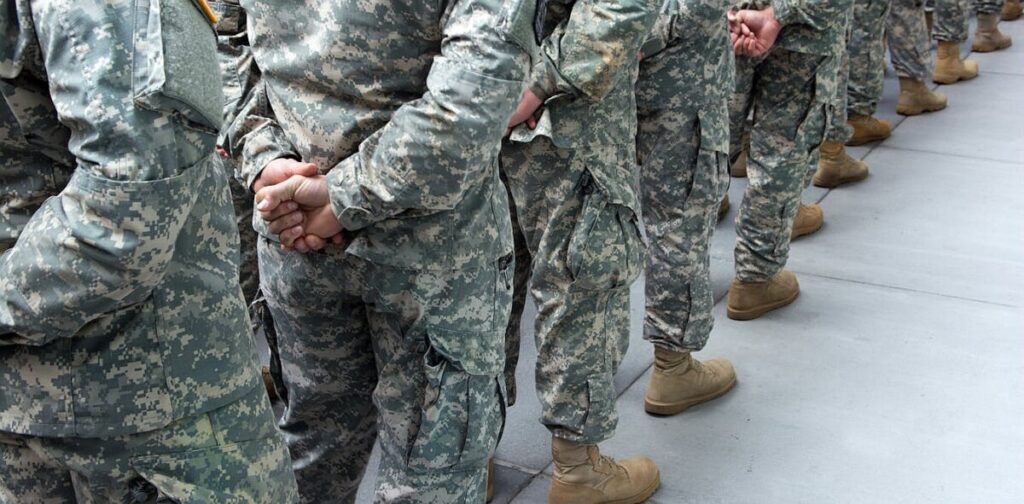
There are certain situations in which the military should not fall in line.
Bo Zaunders/Corbis Documentary via Getty Images
As the Trump administration carries out what many observers say are
illegal military strikes against vessels
in the Caribbean allegedly smuggling drugs, six Democratic members of Congress
issued a video
on Nov. 18, 2025, telling the military “You can refuse illegal orders” and “You must refuse illegal orders.”
The lawmakers have all served either in the military or the intelligence community. Their message sparked a furious response on social media from President Donald Trump, who called the legislators’ action “
seditious behavior, punishable by death
.”
One of the lawmakers, Sen. Elissa Slotkin,
told The New York Times
that she had heard from troops currently serving that they were worried about their own liability in actions such as the ones in the Caribbean.
This is
not the first time
Trump has put members of the military in
situations whose legality
has been questioned
. But a large percentage of service members understand their duty to follow the law in such a difficult moment.
We are scholars
of
international relations
and international law. We conducted survey research at the University of Massachusetts Amherst’s
Human Security Lab
and discovered that
many service members do understand the distinction between legal and illegal orders, the duty to disobey certain orders, and when they should do so.
The ethical dilemma
With his Aug. 11, 2025, announcement that he was
sending the National Guard
– along with federal law enforcement – into Washington, D.C. to fight crime, Trump edged U.S. troops closer to the kind of military-civilian confrontations that can cross ethical and legal lines.
Indeed, since Trump returned to office, many of his actions have
alarmed international human rights observers
. His administration has
deported immigrants without due process
,
held detainees in inhumane conditions
, threatened the
forcible removal
of Palestinians from the Gaza Strip and deployed
both the National Guard and federal military troops
to Los Angeles, Portland, Oregon, Chicago and other cities to quell largely peaceful protests or enforce immigration laws.
When a sitting commander in chief authorizes acts like these, which many assert are
clear violations of the law
, men and women in uniform face an ethical dilemma: How should they respond to an order they believe is illegal?
The question may already be
affecting troop morale
. “The moral injuries of this operation, I think, will be enduring,” a National Guard member who had been deployed to quell public unrest over immigration arrests in Los Angeles told The New York Times. “This is not what the military of our country was designed to do, at all.”
Troops who are ordered to do something illegal are put in a bind – so much so that some argue that
troops themselves are harmed
when given such orders. They are not trained in legal nuances, and they are
conditioned
to obey. Yet if they obey “
manifestly unlawful
” orders, they can be prosecuted. Some analysts
fear that U.S. troops are ill-equipped
to recognize this threshold.
President Donald Trump, flanked by Secretary of Defense Pete Hegseth and Attorney General Pam Bondi, announced at a White House news conference on Aug. 11, 2025, that he was deploying the National Guard to assist in restoring law and order in Washington.
Hu Yousong/Xinhua via Getty Images
Compelled to disobey
U.S. service members
take an oath
to uphold the Constitution. In addition, under Article 92 of the Uniform Code of Military Justice and the U.S. Manual for Courts-Martial, service members must obey lawful orders and
disobey unlawful orders
. Unlawful orders are those that clearly violate the U.S. Constitution, international human rights standards or the Geneva Conventions.
Service members who follow an illegal order
can be held liable
and court-martialed or subject to prosecution by international tribunals. Following orders from a superior is no defense.
Our poll, fielded between June 13 and June 30, 2025, shows that service members understand these rules. Of the 818 active-duty troops we surveyed, just 9% stated that they would “obey any order.” Only 9% “didn’t know,” and only 2% had “no comment.”
When asked to describe unlawful orders in their own words, about 25% of respondents wrote about their duty to disobey orders that were “obviously wrong,” “obviously criminal” or “obviously unconstitutional.”
Another 8% spoke of immoral orders. One respondent wrote that “orders that clearly break international law, such as targeting non-combatants, are not just illegal — they’re immoral. As military personnel, we have a duty to uphold the law and refuse commands that betray that duty.”
Just over 40% of respondents listed specific examples of orders they would feel compelled to disobey.
The most common unprompted response, cited by 26% of those surveyed, was “harming civilians,” while another 15% of respondents gave a variety of other examples of violations of duty and law, such as “torturing prisoners” and “harming U.S. troops.”
One wrote that “an order would be obviously unlawful if it involved harming civilians, using torture, targeting people based on identity, or punishing others without legal process.”
A tag cloud of responses to UMass-Amherst’s Human Security Lab survey of active-duty service members about when they would disobey an order from a superior.
UMass-Amherst’s Human Security Lab
,
CC BY
Soldiers, not lawyers
But the open-ended answers pointed to another struggle troops face: Some no longer trust U.S. law as useful guidance.
Writing in their own words about how they would know an illegal order when they saw it, more troops emphasized international law as a standard of illegality than emphasized U.S. law.
Others implied that acts that are illegal under international law might become legal in the U.S.
“Trump will issue illegal orders,” wrote one respondent. “The new laws will allow it,” wrote another. A third wrote, “We are not required to obey such laws.”
Several emphasized the U.S. political situation directly in their remarks, stating they’d disobey “oppression or harming U.S. civilians that clearly goes against the Constitution” or an order for “use of the military to carry out deportations.”
Still, the percentage of respondents who said they would disobey specific orders – such as torture – is lower than the percentage of respondents who recognized the responsibility to disobey in general.
This is not surprising:
Troops are trained
to obey and face numerous social, psychological and institutional
pressures
to do so. By contrast, most troops receive relatively little training in the laws of war or human rights law.
Political scientists have found, however, that having information on international law
affects attitudes about the use of force
among the general public. It
can also affect
decision-making by military personnel.
This finding was also borne out in our survey.
When we explicitly reminded troops that shooting civilians was a violation of international law, their willingness to disobey increased 8 percentage points.
Drawing the line
As my research with another scholar
showed in 2020
, even thinking about law and morality can make a difference in opposition to certain war crimes.
The preliminary results from our survey led to a similar conclusion. Troops who answered questions on “manifestly unlawful orders” before they were asked questions on specific scenarios were much more likely to say they would refuse those specific illegal orders.
When asked if they would follow an order to drop a nuclear bomb on a civilian city, for example, 69% of troops who received that question first said they would obey the order.
But when the respondents were asked to think about and comment on the duty to disobey unlawful orders before being asked if they would follow the order to bomb, the percentage who would obey the order dropped 13 points to 56%.
While many troops said they might obey questionable orders, the large number who would not is remarkable.
Military culture makes disobedience difficult: Soldiers can be court-martialed for obeying an unlawful order, or for disobeying a lawful one.
Yet between one-third to half of the U.S. troops we surveyed would be willing to disobey if ordered to shoot or starve civilians, torture prisoners or drop a nuclear bomb on a city.
The service members described the methods they would use. Some would confront their superiors directly. Others imagined indirect methods: asking questions, creating diversions, going AWOL, “becoming violently ill.”
Criminologist Eva Whitehead researched actual cases of troop disobedience of illegal orders and
found that when some troops disobey
– even indirectly – others can more easily find the courage to do the same.
Whitehead’s research showed that those who refuse to follow illegal or immoral orders are most effective when they stand up for their actions openly.
The initial results of our survey – coupled with a recent
spike in calls to the GI Rights Hotline
– suggest American men and women in uniform don’t want to obey unlawful orders.
Some are
standing up loudly
. Many are thinking ahead to what they might do if confronted with unlawful orders. And those we surveyed are looking for guidance from the Constitution and international law to determine where they may have to draw that line.
This story, initially published on Aug. 13, 2025, has been updated to include a reference to a video issued by Democratic members of Congress.
Zahra Marashi, an undergraduate research assistant at the University of Massachusetts Amherst, contributed to the research for this article.
Charli Carpenter directs Human Security Lab which has received funding from University of Massachusetts College of Social and Behavioral Sciences, the National Science Foundation, and the Lex International Fund of the Swiss Philanthropy Foundation.
Geraldine Santoso does not work for, consult, own shares in or receive funding from any company or organization that would benefit from this article, and has disclosed no relevant affiliations beyond their academic appointment.


