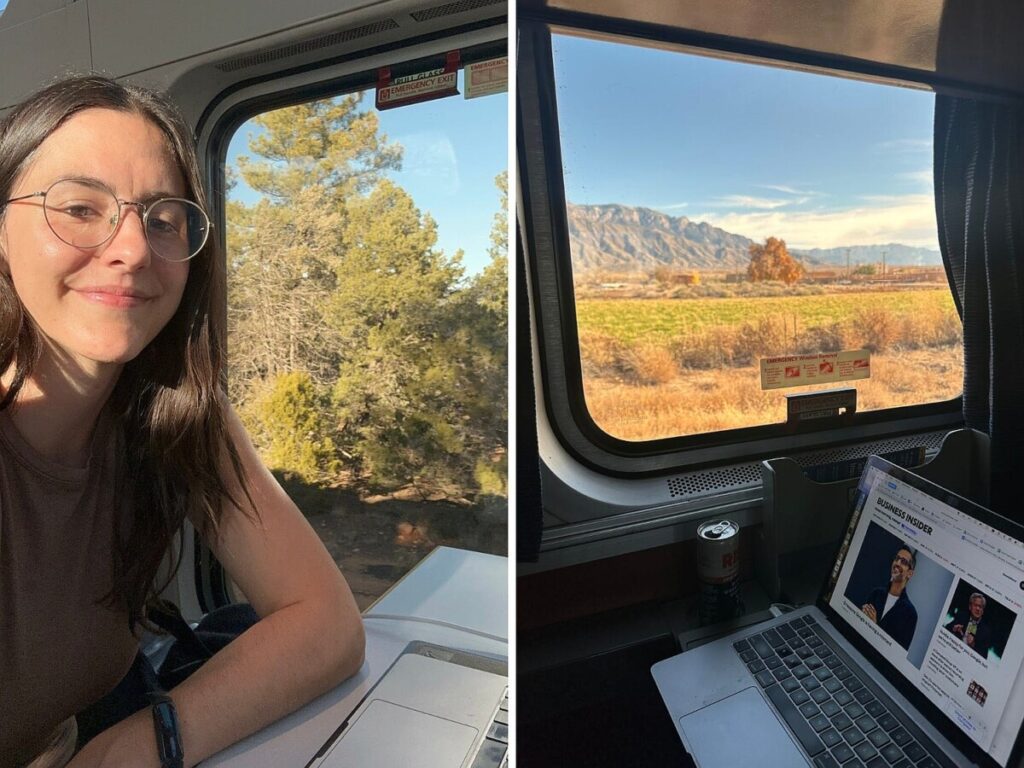
I paid $1,963 for a 43-hour Amtrak train to avoid Thanksgiving travel chaos. It felt like stepping back in time.
In a recent article, Kelsey Vlamis recounts her 43-hour journey aboard Amtrak’s Southwest Chief from Los Angeles to Chicago, highlighting the unique experience of train travel amidst the chaos of holiday air travel. With Thanksgiving approaching, Vlamis and her husband opted for the train to evade the usual airport turmoil, particularly given the looming threat of a potential government shutdown. They paid $1,963 for a spacious Family Room in a sleeper car, which provided them with ample space to work and relax while enjoying the scenic views of the American West. As they traversed through states including Arizona, New Mexico, and Colorado, they were treated to breathtaking landscapes, historic train stations, and a sense of community that is often lost in modern air travel.
The article emphasizes the charm of Amtrak’s communal dining experience, where passengers share meals and stories with fellow travelers. Vlamis describes dining alongside a diverse group of individuals, including a couple on a lengthy vacation and a woman with a lifelong connection to railroads. The food, while not gourmet, exceeded her expectations, with highlights including a surprisingly delicious breakfast quesadilla and chocolate spoon cake. The absence of WiFi on the train encouraged passengers to engage with one another, leading to games and conversations rather than screen time. Vlamis notes that while the train journey was longer and more expensive than flying, it provided a refreshing antidote to the fast-paced, impersonal nature of air travel, allowing her to slow down and appreciate the journey. She concludes that while she may not choose the train for every trip, she has already added several long-haul Amtrak routes to her travel bucket list, eager to embrace the adventure and camaraderie that train travel uniquely offers.
I worked from our sleeper car and the community observation car during the 43-hour train ride.
Kelsey Vlamis
I took a 43-hour Amtrak train ride to avoid chaos at airports ahead of Thanksgiving.
The Southwest Chief from Los Angeles to Chicago had scenic views and a community vibe.
It costs more and takes longer than flying, but I want to do more long-haul Amtrak rides.
If the plagues of our modern age are
screen addiction
, anti-social behavior, and a desire for immediate gratification, all driven by the supercomputers constantly affixed to our hands, then Amtrak may be the antidote.
On a 43-hour, 2,265-mile cross-country journey from Los Angeles to Chicago on Amtrak’s Southwest Chief, I stared out the window at deep red mesas and Midwest farmland. I shared meals with strangers. I played chess with my husband while others watched before playing a game of their own.
We decided to take the train for two reasons. First, to avoid the
airport chaos
that often accompanies Thanksgiving, typically the busiest time of year for air travel (especially because there was a possibility the government shutdown would still be ongoing). Second, for the adventure of it.
We paid $1,963 for a two people in a large
sleeper car
room. While it was a lot more expensive and took much longer than flying, it delivered on the promise of an adventure across the American West. And, after my ride, it’s no surprise to me that
Amtrak has reached
record ridership and revenue, with 34.5 million customer trips in the fiscal year that ended in September.
The Amtrak Family room had two lower beds and two upper bunks that folded down.
Kelsey Vlamis
We pulled out one bed that we shared and left the benches up on the other side.
Kelsey Vlamis
Whereas plane rides have increasingly become an impersonal, stress-inducing experience that often feels like a glorified commuter bus, the Amtrak feels a bit stuck in time, but in a good way — slower, more communal, less rigid.
We had a large, cozy room with plenty of space for 2
We left from Los Angeles’s Union Station the Monday before Thanksgiving shortly after 5 p.m. local time. From there, the Southwest Chief would take us through Arizona,
New Mexico
, Colorado, Kansas, Missouri, a bit of Iowa, and Illinois. Along the way, there’d be historic train stations, ghost towns, and gorgeous terrain.
The bench before we pulled it out into a bed.
Kelsey Vlamis
We booked a “Family Room,” which sleeps up to 2 adults and 2 children. It spanned the width of the train, with a bench that expanded into a bed slightly wider than a twin. There were a couple benches facing each other that also expanded into a kid’s bed, as well as two upper bunks that could be folded down from the ceiling.
The room was spacious for two people, allowing each of us to sprawl out during the day and work on our laptops. There were windows on both sides of the room and fold-down tables we could work from.
The observation car was all windows.
Kelsey Vlamis
We had access to several bathrooms and a shower shared by others in our sleeper car. The bathrooms were clean and well-maintained, and a bit larger than an airplane bathroom, while the shower was surprisingly spacious with solid water pressure.
The attendant for our sleeper car brewed a fresh pot of coffee for all of us every morning, and had a sign-up sheet so we could flag when we were ready for our bed to be made up or folded away each morning and evening.
Community spaces are an essential part of taking the train
When it was time to eat, we ascended to the dining car, as our tickets came with breakfast, lunch, and dinner.
Amtrak’s traditional dining cart includes communal seating.
Kelsey Vlamis
Amtrak offers a traditional dining service, also known as shared dining. That means, unless you’re in a group of four, you’re going to be sat next to strangers. While
communal dining
in general is a divisive trend, it was a key part of the charm of taking the Amtrak.
The sleeper car came with every meal in the dining car.
Kelsey Vlamis
For our first dinner, we sat with a couple who take six weeks of vacation every year and were taking two trains from California to catch a
cruise in Florida
. Another meal we sat with a man from upstate New York who took the train to Las Vegas because he was worried about government shutdown flight delays and wanted to see the Southwest. An older woman we sat with said her dad worked for the railroad, and she’d been taking trains her whole life.
Breakfast with a view and chocolate cake.
Kelsey Vlamis
The food itself was also better than I expected. It wasn’t something you’d get at a nice restaurant in Los Angeles or Chicago, but rather standard banquet food: steak, chicken, pasta, and so on. I had mac n cheese (from the kids’ menu) and a salmon dish that were both solid. The breakfast quesadilla was genuinely very good. The best surprise was the chocolate spoon cake, which was delicious.
There’s no WiFi, but cell service was reliable, and lots of passengers talked or played games
Past the dining car was the observation car, a community space lined with windows for optimal viewing of the surrounding environment. During the day, I posted up at a table here and worked on my laptop, often forcibly peeling my eyes away from the views passing by.
The views across the Southwest were stunning.
Kelsey Vlamis
One surprising thing that made the train feel like a remnant of a bygone past? No WiFi. Amtrak has added WiFi to some of its trains and stations, but not on this one. That left me to rely on my phone’s hotspot.
Cell service was mostly reliable, though there were times when it would disappear or weaken, but often that would last for minutes. There was only one time, somewhere in New Mexico, where I would’ve liked internet but went without it for about half an hour, give or take.
Chess and drinks in the observation cart.
Kelsey Vlamis
The
observation car
was also full of people talking, playing games, and yes, watching content on their phones, though there were far fewer people glued to their screens than you might expect.
In the evenings after dinner, we’d grab drinks from the café cart ($9 for a whisky) and sit in the observation cart playing games. During a particularly close
game of chess
, a couple of people who didn’t know each other asked if they could watch, and then started playing each other on their phones.
The observation car at golden hour.
Kelsey Vlamis
Take the train for the views and the vibes
There’s a feeling of lawlessness on the Amtrak, which adds to the sense that you’ve stepped back in time. No one checked our IDs when we boarded. There are routines, but mostly you’re free to wander the train as you please. There’s a lot of time killing.
There are also designated “fresh air stops” or “smoke breaks,” where passengers can get off to smoke a cigarette, as the staff will frequently remind over the loudspeaker — one of the only instances in this day and age where it feels like smokers are actively accommodated.
Working from the observation car.
Kelsey Vlamis
We finally pulled into
Chicago’s Union Station
at around 4:20 p.m. local time on Wednesday, about an hour and a half behind schedule due to a couple of holdups along the route. But what’s a 90-minute delay after almost two days on the train?
It’s not the cheapest or the fastest way to travel. I’m not going to choose Amtrak over flying most of the time. However, I’ve already added several routes to my bucket list, which I’ll take when I have enough time to slow down and enjoy getting to where I’m going.
Read the original article on
Business Insider


