50 years after Franco’s death, giving a voice to Spanish dictator’s imprisoned mothers
As Spain approaches the 50th anniversary of Francisco Franco’s death on November 20, 2025, the left-leaning Spanish government is leading a vigil to honor the countless victims of his oppressive regime. Historical estimates suggest that Franco’s regime was responsible for the deaths of up to 100,000 people during the Spanish Civil War and tens of thousands more during his dictatorship from 1939 until his death in 1975. The impact of Francoism extended far beyond the grave, with hundreds of thousands imprisoned, exiled, or subjected to severe political persecution. Among these victims were women and children, whose experiences of trauma and abuse have often been overlooked in the broader narrative of Spain’s struggle to confront its past.
Recent research highlights the gendered nature of Franco’s repression, illustrating how women were uniquely targeted not just for their political beliefs but also for their identities as mothers. Many women were imprisoned for their association with Republican ideals, while others faced persecution simply for being related to dissidents. Their testimonies reveal a harrowing “double punishment,” where they were subjected to brutal treatment in prisons that emphasized their perceived inferiority. This included horrific practices such as forced head shaving, sexual violence, and the loss of custody of their children, who were often placed in orphanages or adopted by loyalist families. Such actions were not merely acts of cruelty; they were part of a calculated strategy to reinforce Francoist ideology, which portrayed Republican women as morally corrupt and unworthy of motherhood.
Despite the trauma, many women displayed remarkable resilience and resistance within the confines of their suffering. Acts of care, such as sharing food and telling stories to their children, became forms of quiet defiance against the regime. However, the scars of their experiences lingered long after the dictatorship ended, with many survivors and their descendants grappling with intergenerational trauma. The legacy of Franco’s regime continues to haunt Spain, as the 1977 Amnesty Act has largely prevented accountability for those responsible for the atrocities committed during this dark chapter of history. As Spain prepares to commemorate Franco’s death, the stories of these women serve as a poignant reminder of how authoritarian power can infiltrate the most intimate aspects of life, shaping the collective memory of a nation still in the process of healing.
https://www.youtube.com/watch?v=DjZEG4wpVP4
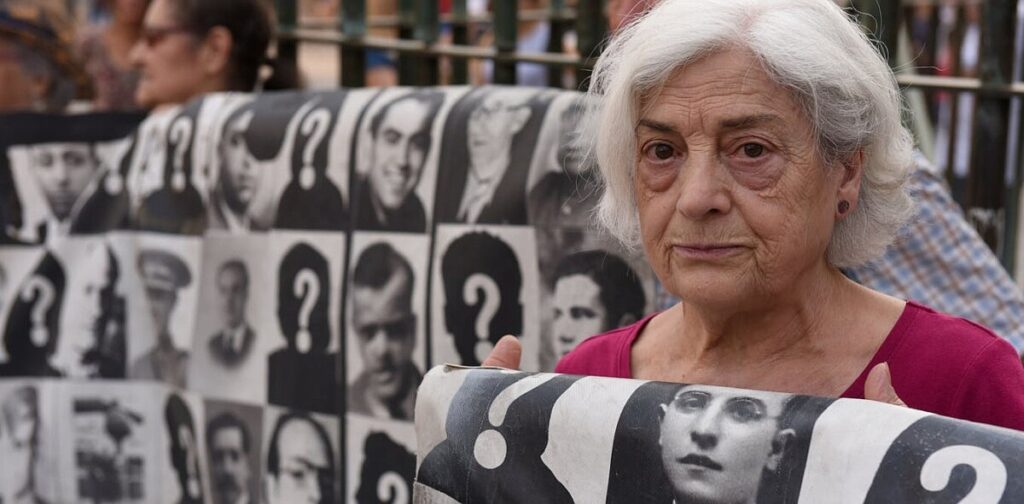
A protester holds a banner with pictures of people who went missing during the Spanish dictatorship of Francisco Franco.
John Milner/SOPA Images/LightRocket via Getty Images
In the run-up to the 50th anniversary of Francisco Franco’s death on Nov. 20, 2025, the left-leaning Spanish government
led a vigil honoring the many victims
of the dictator’s regime.
While the exact numbers remain impossible to determine, historians estimate that Franco’s men
killed up to 100,000
people during the brutal Spanish Civil War, and tens of thousands were
executed during his dictatorial rule
from 1939 until his death in 1975. Hundreds of thousands more were imprisoned, sent to labor camps or subjected to political persecution. To these figures, we must add the roughly half a million people who
fled or were forced into exile
.
Among the multitudes of Francoism’s victims were women and children who endured psychological and physical abuse in prisons, orphanages and asylums. Yet for decades their experiences have remained marginal in the public narrative – highlighting the uneven acknowledgment of different groups of victims amid Spain’s broader struggle to confront its past.
Still, their stories remain alive in the testimonies of the women who were imprisoned by the regime. In the summer of 2024, I conducted research at
the Documentation Center of Historical Memory in Salamanca
, collecting documented written accounts of traumatic experiences suffered by Spain’s female population under Franco. They reveal the extent to which Francoist repression was structured through gender, framing women as inherently subordinate and subjecting those who resisted the regime’s patriarchal order to especially severe punishment.
Franco’s gendered violence
My study explores the testimonies of
women imprisoned during the civil war or subsequent decades
, all of whom endured suffering related to their motherhood. While some were detained for their ideological allegiance to the republic that preceded Franco’s ascent, others had no formal partisan affiliations or were merely related to men who did.
These women suffered what many survivors and historians
have described as a “double punishment
” – targeted not only for their beliefs or associations but
just for being women and mothers
.
The earliest testimony I came across was from a woman detained in 1939, just three years after Franco, a military general,
led an uprising
against the democratically elected government of the Second Republic that precipitated the civil war and his subsequent reign.
Franco gives a fascist salute as he and his Nationalist forces enter Barcelona in March 1939.
AP Photo
Under Franco’s dictatorial regime, women’s roles were rigidly controlled by the
ideology of National Catholicism
, which linked femininity, motherhood and loyalty to the state. The church reinforced this vision, “dictating that women served the fatherland through self-sacrifice and dedication to the common good.”
Those who defied the patriarchy were criminalized and subjected to “
re-education
” focused on religious values.
Women’s so-called “redemption” under this reeducation was
no less violent than their confinement
. As one witness described, in May of 1939 the auditorium of Las Ventas prison was prepared to celebrate “two girls and a boy (… recently) born in prison.” During the ceremony, a choir “composed of forty inmates, including opera singers, music teachers, violinists, and amateurs,” had to perform the national anthems with the fascist arm-raised salute.
Yet confinement itself was particularly brutal.
According to Josefina García, a woman imprisoned during the 1940s, guards regularly insulted and beat inmates. “If you were at home behaving like decent women, you wouldn’t be here,” she recalled one saying. García continued: “Of course, they used a crude, sexist language. The police ‘used words’ in a way that sometimes leave a mark deeper than a bruise.”
Gender also played a role in the type of punishment prisoners received. Following their arrest, women were subjected to
head shaving, forced ingestion of castor oil
and the subsequent public humiliation of being made to walk in circles while defecating. In addition, they were often subjected to sexual violence by prison guards or interrogating officers.
Recounting her experience, another witness reported the case of an 18-year-old sister of a guerrilla fighter in Valencia who “was subjected to terrible torture, stripped naked in a room with several Civil Guards who pricked her breasts, genitals, and stomach with … needles.”
A protester holds a banner with an image of an unknown woman – a victim of the Franco regime.
AP Photo/Paul White
Motherhood as battleground
One of the most painful aspects of Franco’s repression was the forced separation of mothers and their children.
Upon incarceration, women frequently lost custody of their sons and daughters, who were placed in orphanages or adopted by families loyal to Franco and his regime. Such violent ruptures of the maternal bond were more than an act of personal cruelty – they were a calculated political strategy rooted in the broader Francoist ideology.
Since Francoism promoted an
image of women as obedient wives and self-sacrificing mothers
devoted to the Catholic family model, Republican women were demonized as immoral, dangerous and unworthy of motherhood.
By stripping women of their children, the regime both punished them and reinforced its narrative that only “loyal” women could be true mothers.
Meanwhile, child-rearing or birth during incarceration was marked by fear and uncertainty. In certain cases, newborns were allowed to stay with their mothers for a short time. However, a lack of proper nourishment and mental exhaustion made breastfeeding an impossible task.
At times, women who began to lactate were denied the possibility of nursing their infants, leading to physical pain and emotional torment.
More often, babies were permanently taken away altogether, deemed at risk of being “contaminated” by their mothers’ ideological values.
“When I was arrested, my son was five days old,” one victim, Carmen Caamaño, reported. “About a year later, they said I no longer needed to breastfeed him and took the child out of the prison. Some friends had to take him in because I had no family there.”
Women pay tribute to victims of the Franco regime in front of a flag of the Spanish Republic.
P Photo/Alvaro Barrientos
There were also countless cases in which children were imprisoned alongside their mothers. With no other relatives to care for them, these children suffered from hunger, disease and a lack of basic hygiene in their overcrowded cells. For mothers, the psychological burden was immense as they were forced to watch their children suffer, yet they had no power to protect them.
In the summer of 1941, about six or seven children died daily in these prisons from starvation and diseases, according to accounts of survivors.
Trauma and resistance
Alongside trauma, there were also moments of resistance.
Mothers in prison looked for ways to nurture their children despite scarcity and fear. Testimonies I reviewed relate cases of inmates sharing food, telling stories and protecting children as best they could. These small acts of care were a quiet but powerful form of defiance.
Yet for many women, the trauma of these losses never healed. Survivors often speak of the pain of separation as an open wound that lasted a lifetime. Children raised in prisons or separated from their families carried the scars into adulthood.
Even decades after the regime ended, many descendants still struggle with the weight of this silenced past. Yet because of
Spain’s Amnesty Act of 1977
, which was granted for past political crimes, those responsible for atrocities committed under Franco have seldom been held accountable.
Histories of the Franco years often leave the grief of the intergenerational trauma in the shadows. And for the victims themselves, the traumatic motherhood experiences under his dictatorship reveal more than just personal suffering – they expose how authoritarian power can reach into the most intimate parts of life.
Zaya Rustamova received funding to conduct this study from Radow J. Norman College of Humanities and Social Sciences, Kennesaw State Unviversity.


