
Red Spider Nebula
On October 26, 2025, NASA’s James Webb Space Telescope (JWST) unveiled stunning new details of the Red Spider Nebula, a captivating planetary nebula located approximately 3,000 light-years from Earth. Utilizing its Near-InfraRed Camera (NIRCam), Webb has provided astronomers with a groundbreaking view that reveals the intricate structure of this cosmic wonder. This image marks a significant milestone in our understanding of the Red Spider Nebula, showcasing its unique features and the dynamic processes at play within it.
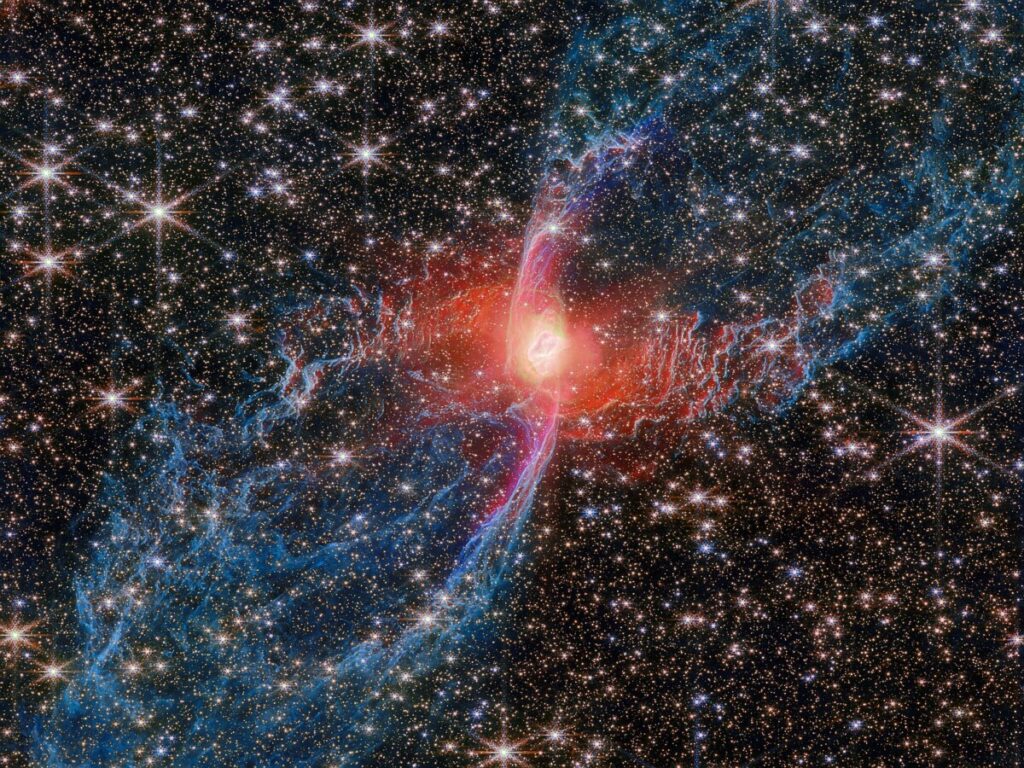
The newly released imagery highlights the nebula’s striking outstretched lobes, which resemble the legs of a spider, a fitting name for this celestial body. The lobes, depicted in vibrant blue, are traced by light emitted from hydrogen molecules (H2), showcasing the nebula’s complex chemistry and the energetic processes occurring within. Each of these lobes extends nearly 3 light-years across, forming bubble-like structures that have been inflated over thousands of years by outflowing gas from the nebula’s central star. This discovery not only enhances our visual appreciation of the Red Spider Nebula but also deepens our understanding of the lifecycle of stars and the intricate interactions that occur during their evolution.
The NIRCam’s high-resolution imaging capabilities have allowed scientists to investigate the nebula’s features in unprecedented detail, offering insights into the mechanisms that drive such phenomena. As the JWST continues to explore the universe, it promises to reveal even more wonders, enhancing our knowledge of stellar formation and the complex tapestry of the cosmos. The Red Spider Nebula serves as a reminder of the beauty and complexity of the universe, inviting both scientists and enthusiasts alike to ponder the mysteries that lie beyond our planet.
ESA/Webb, NASA & CSA, J. H. Kastner (Rochester Institute of Technology)
Using its
Near-InfraRed Camera
(NIRCam), NASA’s James Webb Space Telescope captured never-before-seen details of the Red Spider Nebula, a planetary nebula, in this image
released on Oct. 26, 2025
. NIRCam is Webb’s primary near-infrared imager, providing high-resolution imaging and spectroscopy for a wide variety of investigations.
Webb’s new view of the Red Spider Nebula reveals for the first time the full extent of the nebula’s outstretched lobes, which form the ‘legs’ of the spider. These lobes, shown in blue, are traced by light emitted from H2 molecules, which contain two hydrogen atoms bonded together. Stretching over the entirety of NIRCam’s field of view, these lobes are shown to be closed, bubble-like structures that each extend about 3 light-years. Outflowing gas from the center of the nebula has inflated these massive bubbles over thousands of years.
Image credit: ESA/Webb, NASA & CSA, J. H. Kastner (Rochester Institute of Technology)



