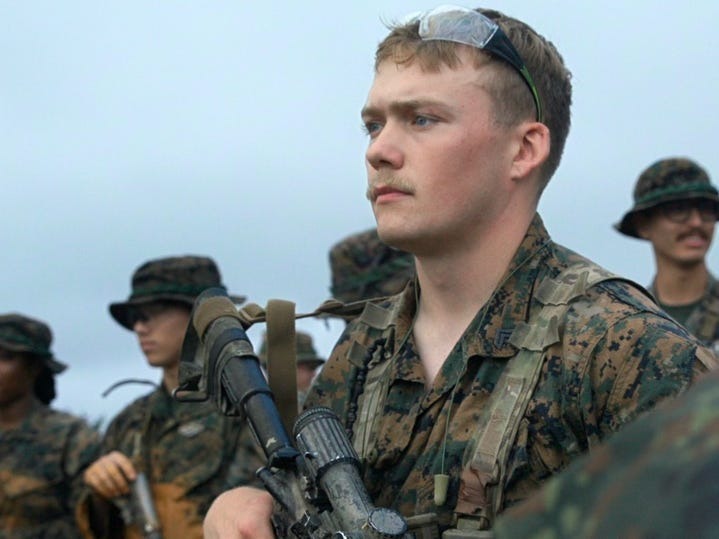
Netflix’s ‘Marines’ captures Pacific troops searching for purpose in preparing for a war that may never come
Netflix’s new docuseries “Marines” offers a compelling glimpse into the lives of U.S. Marines stationed in Japan, focusing on their rigorous deployment training amidst rising tensions in the Pacific. The series centers on the 31st Marine Expeditionary Unit (MEU), a group of approximately 2,000 Marines who prepare for potential conflicts while stationed aboard Navy ships. Unlike many military-themed productions that dramatize combat, “Marines” highlights the often-overlooked reality of military life, emphasizing the psychological and logistical challenges that service members face during their extensive training. Executive producer Sebastian Junger, a respected journalist known for his focus on the human costs of war, aims to portray the unvarnished truth of military preparation, illustrating the stress and uncertainty that accompany a life dedicated to readiness for a conflict that may never materialize.
The docuseries delves into the experiences of various Marines, including a senior enlisted infantryman, a pilot honing his skills, and a naval officer balancing command duties with personal challenges. Through their stories, viewers witness the complexities of military life in a post-Global War on Terror era, where many younger Marines grapple with a lack of combat experience. The series also sheds light on the harsh living conditions aboard Navy vessels, where close quarters and limited amenities pose additional challenges to the troops. As the Marines conduct training exercises—such as planning a large-scale beach landing—the backdrop of escalating geopolitical tensions with China looms large, adding urgency to their preparations. The show captures the meticulous planning that goes into military operations, often overshadowed by the more glamorous portrayals of combat in popular media.
Director Chelsea Yarnell emphasizes that the psychological toll of preparation is as significant as the physical demands of training, revealing a side of military service that is rarely showcased. Junger hopes that “Marines” will encourage viewers to reconsider their perceptions of military life, moving beyond simplistic portrayals of soldiers as either heroes or villains. As tensions in the Pacific continue to rise, understanding the human element of military service becomes increasingly vital. By sharing the stories of these Marines, the series invites audiences to empathize with the sacrifices made by service members and to recognize the complex realities of their commitment to national defense. Ultimately, “Marines” serves as a poignant reminder of the personal stakes involved in military service, urging viewers to reflect on the implications of potential conflict and the lives that hang in the balance.
https://www.youtube.com/watch?v=yAvXwZsiRc8
A new Netflix documentary series follows US Marines based in Japan throughout their deployment training.
Netflix
Netflix’s ‘Marines’ explores US Marines in Japan preparing for uncertain Pacific conflict.
The series highlights the daily reality and stress of military deployment training.
‘Marines’ offers insight into modern military life amid US-China tensions in the Pacific region.
A new Netflix mini-docuseries released this month turns its lens on an unusual part of military life: not the heat of battle, but the long, grinding calm that can precede it.
The series “Marines”
follows a handful of service members with the 31st Marine Expeditionary Unit, a roughly 2,000-member Marine contingent that deploys aboard
a trio of Navy ships
, floating sea bases that can be rapidly moved into global hotspots. The 31st MEU is based in Japan, home to one of the Corps’ three major bases, with others in California and North Carolina.
Marines go through intense training in preparation for such deployments, certifying for missions ranging from disaster response to amphibious assaults. The Netflix show centers on the planning behind a large-scale beach landing, a classic Marine Corps mission. If the exercise fails, the entire unit could lose its deployment certification.
Unlike most military-themed television, “Marines” focuses on the tension of preparation rather than combat itself in four 45-minute episodes. Executive producer Sebastian Junger, a well-known wartime journalist who focuses on the human costs of war, told Business Insider that he hopes to show viewers the unromanticized — and stressful — reality of a force that spends years
preparing for a war
that may never happen.
“When people sign up for the military, they’re thinking, ‘I will prove myself to myself, that I’m worthy, that I’m courageous, that I’m brave, that I’m strong,'” he said. “But in order to do that, you have to kind of want to wind up in combat.”
A Marine with the 31st Marine Expeditionary Unit fires an M320 grenade launcher during a training event at Camp Fuji, Japan, Oct. 10, 2025.
Lance Cpl. Victor Gurrola/US Marine Corps
Yet combat, especially the kind that the US could face in the Pacific, home to
near-peer rival China
, could be devastating. Junger said he also hopes his series serves as a way for Americans to think critically about the human cost behind any future conflict.
“I think the American public would be absolutely shocked at the price tag of a full-scale war,” he said. The cost in lives in Ukraine has been catastrophic. A war in the Pacific could be worse.
The new series is a narrow but revealing lens into the urgency many troops in the Pacific feel, and traces the experiences of a group of real Marines as they train their teams for deployment: a senior enlisted infantry Marine and his officer, a pilot still mastering his flight skills, and a naval officer balancing command duties with the guilt familiar to many working mothers. There’s also a pair of lifelong best friends serving as a machine gun team.
All of them are navigating the struggle of belonging to a generation of Marines with little or no combat experience. Most hardened veterans of Iraq and Afghanistan have cycled out of service, leaving mostly younger troops who sometimes yearn for the kind of battlefield tests they’ve only heard about.
For many Marines in the post-Global War on Terror era, deployments, the opportunities for which are often highly coveted, are often limited to the maritime MEU deployments. It’s not combat, but it’s not without its hardships.
“Life on the ship is tough,” said director Chelsea Yarnell of Marines’ experiences
aboard Navy warships
. “The living conditions on the ships are really severe, like extremely close quarters,” she said. “No creature comforts, plumbing didn’t always work. If you forgot your shower shoes, you would live to regret it.”
All of the training seen in the series unfolds against a backdrop of rising geopolitical tensions. Stationed in Japan, the Marines and sailors of the 31st MEU sail with the Navy on the front lines of
uneasy American tensions
with China, a palpable dynamic throughout the show. At various points, a Chinese spy vessel appears to be shadowing the Navy ships carrying the MEU.
Marines with the 31st Marine Expeditionary Unit, test their jungle survival skills on Okinawa, Japan, Sept. 14, 2025.
Lance Cpl. Victor Gurrola/US Marine Corps
Not everyone in the series is shown storming beaches or flying aircraft. Much of “Marines” dwells on the ‘staff officer’ side of military life, the meticulous,
painstaking planning
that underpins every operation. It’s the modern version of watching old-timey generals moving battlefield figurines around a map of Europe, but now, it’s all done with PowerPoint, caffeine, and untold logistics and administrative checks.
It’s less gripping compared to firefights. But that’s the point, the director said.
“I think that what I was expecting was a story of physical toughness,” Yarnell said of the production process. But it was the psychological toll of that laborious planning and preparation, especially aboard a ship, that proved most compelling.
Junger hopes the series helps correct long-standing misconceptions about military service that have persisted since the end of the draft in the 1970s. Most troops now don’t run around carrying guns and slinging rounds downrange all day, he said. In reality, the majority of service members work in roles like logistics, intelligence, and planning, essential but often unseen jobs that sustain those storming the beach.
Troops are often portrayed in Hollywood films as either heroes on a pedestal or invading villains, Junger said. And often, the military falls victim to its own exclusive culture, pushing jargon and cultural norms that few outsiders fully
understand, Yarnell said.
What’s frequently lost is a deeper reckoning with what’s asked of individuals trained to kill and die on behalf of the nation. That question feels newly urgent as the US and China continue to challenge
one another in the Pacific.
“These are your sons and daughters,” Junger said when asked what viewers might take away from the documentary. “Whether we ever go to war or not, every American I think should understand the nature of our military, in not just political terms but human terms.”
Read the original article on
Business Insider


