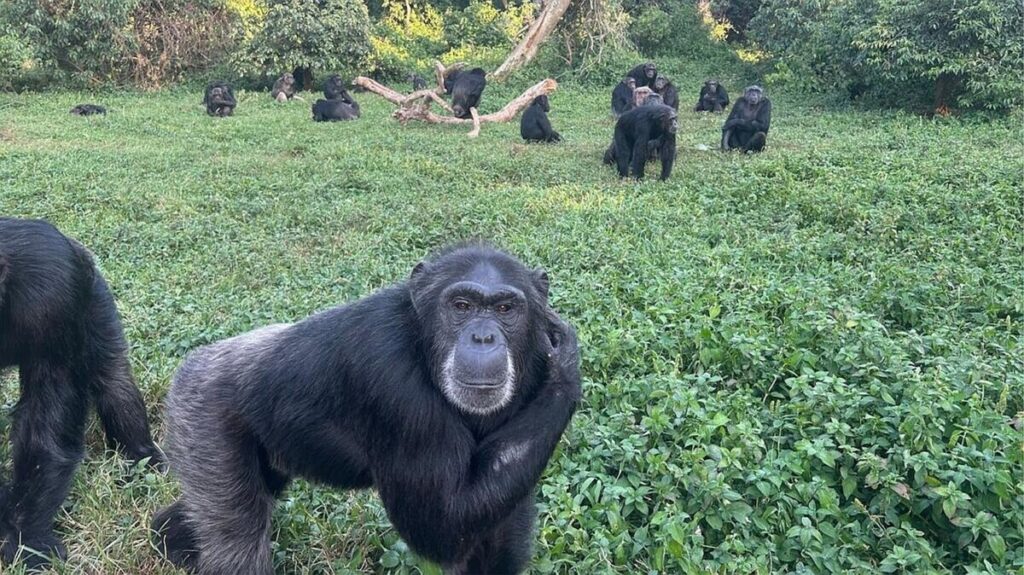
Chimpanzees shock biologists with rational thinking
In a groundbreaking study published in the journal *Science*, researchers have challenged the long-held belief that rational thinking is a uniquely human trait. Conducted at the Ngamba Island Chimpanzee Sanctuary in Uganda, the study reveals that chimpanzees possess remarkable abilities in rational decision-making and metacognition—qualities previously thought to be exclusive to humans. The researchers presented the chimpanzees with two boxes: one containing food and the other empty. Initially, the chimps received a strong clue about which box held the snack. As the experiment progressed, they were given additional clues of varying strengths. The findings were striking: when the initial evidence was compelling, the chimpanzees maintained their choices, but when new evidence was significantly stronger, they adeptly switched their selections. This behavior not only demonstrates their capacity for rational belief revision but also suggests they engage in a sophisticated understanding of their own thought processes.
Co-author Hanna Schleihauf, an assistant professor in developmental psychology at Utrecht University, highlights that the chimps exhibited metacognitive sensitivity, meaning they were aware of the basis for their beliefs and adjusted their choices accordingly. This ability to weigh evidence and revise beliefs is a hallmark of rationality traditionally associated with human cognition, particularly in children around four years old. The study indicates that the cognitive gap between humans and chimpanzees may not be as wide as previously thought, suggesting a continuum of rational reasoning rather than a strict divide. The implications of these findings extend beyond academic curiosity; they provide a comparative baseline for understanding the evolution of human reasoning. By identifying which aspects of rationality are shared with chimpanzees and which are distinctively human, researchers can gain insights into cognitive development in children and the cultural influences on reasoning.
Furthermore, the study carries significant implications for animal conservation and welfare. By demonstrating that chimpanzees can engage in rational thought processes, the research reinforces the need for ethical considerations in the treatment of great apes, advocating for their protection and the establishment of cognitively enriching environments in sanctuaries and zoos. As Schleihauf notes, this research contributes to a growing body of evidence that challenges the notion of human uniqueness, encouraging a deeper understanding of our closest primate relatives and the cognitive abilities they share with us. Ultimately, this study not only enriches our understanding of chimpanzee intelligence but also prompts a reevaluation of our perceptions of rationality across species.
The human capacity for rational thinking makes us unique among the animal kingdom, according to wise, old
Aristotle
. However, an ever-growing body of research suggests that rationality
might not be quite as distinctive a human quality
as we might have thought.
In a
study recently published in the journal
Science
, researchers at the Ngamba Island Chimpanzee Sanctuary in Uganda presented
chimpanzees
with two boxes: one with food and one without a snack. They were initially given a clue as to which one had food. The team then provided the chimps with sequential clues of varying strength about which one contained a snack.
“When the initial evidence was strong, the chimpanzees stuck with their original choice; when the new evidence clearly outweighed the first, they switched their choice,”
Hanna Schleihauf
, an assistant professor in developmental psychology at Utrecht University and co-author of the study, tells
Popular Science
.
Schleihauf and her colleagues also incorporated computer models to confirm that the chimpanzee’s responses matched up with rational strategies of belief revision. In other words, they made sure the primates were practicing genuine reasoning and not, for example, simply favoring the most recently presented evidence. Researchers typically associate this sort of reasoning with children around four-years-old.
“Most strikingly, the chimps also showed metacognitive sensitivity to evidence,” Schleihauf continued.
Metacognition
is awareness and understanding about our
thinking processes
.
“They not only adjusted their choices, but did so in ways that suggest they tracked the evidential basis of their beliefs: when earlier evidence was defeated, they revised their belief accordingly,” she explains. “This indicates that belief revision based on weighing evidence—a key hallmark of rationality long considered uniquely human—is also present in chimpanzees.”
The study also suggests that there isn’t as sharp a difference between human and animal cognition as we once believed. It’s more akin to a gradual continuum of rational reasoning, Schleihauf says.
However, this study provides more than just an interesting discovery about one of our closest primate relatives. According to the team, the results have several practical applications.
For example, “demonstrating rational belief revision in chimpanzees provides a powerful comparative baseline for understanding the evolution of human reasoning,” said Schleihauf. By identifying which aspects of rationality humans share with
chimps
versus which are unique to us, researchers can better recognize which, “develop early in children, which depend on culture, and which rely on uniquely human forms of social learning such as teaching or argumentation.”
She adds that the study is important for animal conservation and welfare because it further justifies the protection of great apes, the increased ethical norms in research and
conservation
, and the creation of more cognitively stimulating habitats in sanctuaries and zoos.
Ultimately, the paper joins a host of recent
research
suggesting that humans simply aren’t as unique as we thought.
The post
Chimpanzees shock biologists with rational thinking
appeared first on
Popular Science
.


