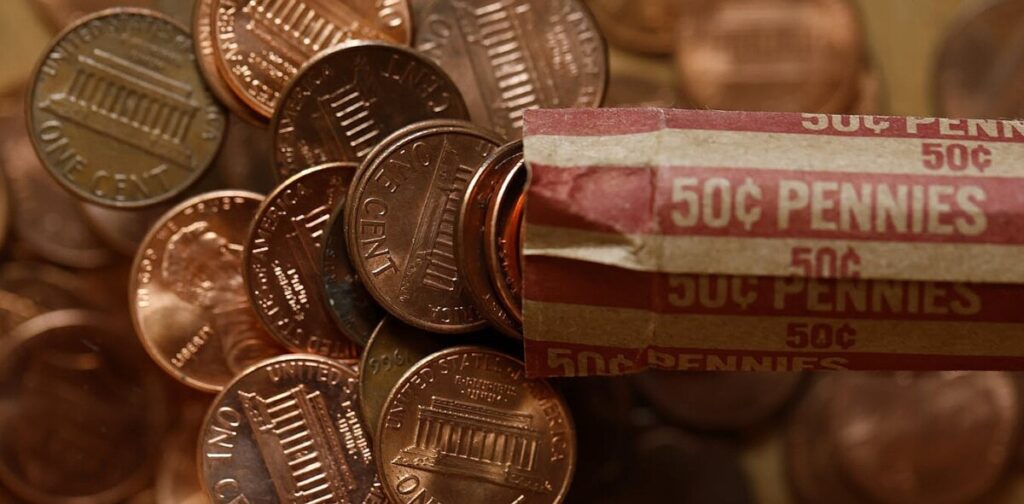
Who wins and who loses as the US retires the penny
The impending demise of the penny marks a significant shift in the U.S. monetary landscape, with the U.S. Mint scheduled to press its last 1-cent coin on November 12, 2025, following a directive from the White House. While pennies will remain legal tender, their gradual withdrawal from circulation will have far-reaching implications for various sectors of society. The penny, which costs approximately 4 cents to produce, may seem trivial, yet its cultural significance is profound, symbolizing kindness in the “take a penny, leave a penny” tradition and evoking nostalgia through penny loafers and fountain tosses. As the U.S. moves toward a cashless future, small, cash-dependent businesses and low-income consumers who rely on coins will face the brunt of this change, while larger corporations and banks stand to benefit.
The economic implications of eliminating the penny are multifaceted. On one hand, the U.S. government will save millions annually by ceasing production of a coin that costs more to mint than its face value. Financial institutions, particularly banks and credit unions, will also gain from reduced handling costs associated with pennies, which involve labor-intensive processes for counting and transporting these low-value coins. Large retailers are likely to adapt more easily to the transition, as their scale allows them to negotiate lower card processing fees and prepare for the change in consumer payment habits. However, small businesses, already struggling with higher transaction fees and operational costs, may find themselves at a disadvantage, facing what economists term a “rounding tax” as cash transactions round to the nearest nickel. This could lead to an estimated annual loss of around $6 million for businesses and consumers alike.
Moreover, the impact on consumers, particularly those who rely on cash, cannot be overlooked. Older adults, lower-income households, and the unbanked will feel the effects of price rounding more acutely, as small increases in costs can significantly affect their budgets. In contrast, digital-first consumers may hardly notice the penny’s absence, as they engage in cashless transactions that maintain precise pricing. This shift underscores a broader trend where efficiency and convenience benefit those who are already economically stable, leaving vulnerable populations to navigate the challenges of a changing financial landscape. While the end of the penny may streamline transactions for some, it serves as a reminder that even minor changes in currency can have disproportionate effects on those least equipped to absorb them.
By now, Americans know the strange math of minting: Each penny costs about
4 cents to make
. Chances are you have some in a jar, or scattered among pockets, purses and car ashtrays.
As small as it is, the penny punches above its weight culturally. If it ever disappeared, so too might the simple kindness of “
take a penny, leave a penny
,” alongside
timeless classics like penny loafers
and the tradition of tossing a penny in a fountain.
But the penny’s days are indeed numbered. The U.S. Mint
pressed the last 1-cent coin on Nov. 12
, 2025, following a directive from the White House. While pennies will remain legal tender, old ones will gradually be taken out of circulation.
The impact of this change will reach beyond coin jars. Its ripples will be felt as small, cash-reliant Main Street merchants face another test of adaptability in a system that increasingly favors scale, technology and plastic. It will also be felt by people who rely on cash – often people
without bank accounts
who have the least room to absorb even tiny shifts in price.
My interest comes from my former lives as the chief financial officer of a large credit union and as a small-business owner. Now, I bridge theory and practice as a professor – or “prac-ademic,” as I like to say –
studying the challenges facing Main Street businesses
.
When the penny goes away, some will win, some will lose – and for some, it’ll be a coin toss.
Heads, they win
The first and most obvious winner is the U.S. government, which will save
tens of millions of dollars each year
by no longer minting a coin that costs more to make than it’s worth. Ending production seems like an easy call for efficiency’s sake.
Banks and credit unions
will likely benefit too. Pennies are disproportionately expensive to handle: Every bag of pennies gets counted, sorted, rolled, verified and shipped back to the Federal Reserve, generating labor and equipment costs that
far exceed the coin’s value
. Removing the smallest denomination strips out an entire layer of cost and friction from bank operations – savings that scale immediately across thousands of branches.
Another beneficiary, this one hiding in plain sight, is who transports the cash: the
armored-carrier industry
. For companies such as Loomis and Brink’s, pennies are heavy, low-value cargo, and a logistical money-loser. Removing penny pickups eliminates one of their most inefficient services, reducing fuel use, labor hours and truck wear.
Large retailers will likely also win. Size and scale make it easier to undertake
preparations both big and small
, such as reprogramming cash registers and stockpiling pennies to hedge against shortages. Larger companies also have the talent and bandwidth to
figure out the true costs and benefits
of accepting cash or noncash payments. If most of their transactions are
already digital
, they could be relatively indifferent to the end of the penny.
Large retailers also negotiate
lower card processing rates
, which are the fees
merchants must pay to the card companies
every time a customer uses a credit or debit card. These rates aren’t uniform: Large chains get discounted pricing
based on sales volume
, while small businesses face higher costs for identical transactions. It follows that any policy change leading to more people paying with plastic will disproportionately benefit larger retailers.
To be sure, some banks, credit unions and large retailers have
expressed concern and surprise
at the pace of the change and the lack of guidance from the federal government. But for most, the penny’s end is a minor operational footnote. Online-only businesses operate in this frictionless world as well – no coins, no counting, no issue.
Tails, they lose
For small, Main Street businesses, the penny’s disappearance highlights the structural disadvantages they already face – and I think it will force a reckoning about what types of payments benefit their bottom lines.
As pennies phase out, local businesses are likely to round cash transactions to the nearest 5 cents, resulting in what economists call a “
rounding tax
.” Rounding to the nearest nickel could cost businesses and consumers about $6 million annually, according to researchers with the Federal Reserve Bank of Richmond.
And it wouldn’t offer much relief if more shoppers turn to plastic and other noncash payments. That’s because most small merchants lack the negotiating power to lower their
card-processing fees
.
Card acceptance comes with a layered stack of costs for merchants: interchange fees, network assessments, processor markups, gateway fees, chargeback penalties, terminal rentals and more. Together, these average
2.5% to 3.5% per sale for many small businesses
. Also, there are expenses related to adopting the latest, greatest payment methods, and then keeping them updated.
Consider a quick-service restaurant where a typical customer spends $14. If that customer pays with a credit card and the business pays an
average processing fee
of 2.2% plus 10 cents per transaction, each sale incurs about 41 cents in fees. Even low-cost debit cards include fixed per-transaction charges that disproportionately affect businesses when the per-sale average is small. When the average sale is $10 or less, it
barely covers the cost
to process it as a card transaction.
That said, handling cash also comes at a cost, and
it’s not always easy
to know what’s best for business
. One analysis found that accepting cash
costs 53 cents per $100 of sales
, compared with $1.12 for accepting debit payments using a signature and 81 cents for PIN-based debit. Of course, businesses also should keep in mind that different customers will have different payment preferences.
And speaking of customers, those who are most likely to feel the pinch from the end of the penny are people who still rely on cash:
older adults
, lower-income households, people without credit cards or bank accounts –
either unbanked or under-banked
– and people who budget in cash because it provides firmer spending discipline.
A few cents added to a grocery total or a convenience store purchase may not matter to someone tapping a rewards credit card, but cash-dependent consumers experience those small increases directly, with no offsetting points, perks or end-of-month cash back. And yes, prices often end in 99 cents, which get
rounded up, not down
. So the burden falls disproportionately on those least equipped to absorb even small, cumulative increases.
For some, it’s a coin toss
Digital-first consumers may barely notice the penny’s disappearance. They tap phones, scan QR codes and use payment apps that will still
settle to the exact amount
.
While businesses haven’t received final guidance on how to handle payments in the post-penny era,
one option
is to price electronic transactions to the cent and round cash transactions to the nearest nickel. If that were widely adopted, digital payments alone would remain precise.
Consumers who use cashless payments may believe their choice doesn’t affect how they shop, but behavioral research says otherwise.
Credit cards reduce the “pain of paying,”
leading people to spend more – often 10% to 20% more than with cash. Credit card rewards programs further incentivize card use. In one last nod to the cost of noncash payments, those rewards are funded by higher merchant fees that ultimately
translate into higher retail prices
.
Killing the penny makes economic sense for the government and some businesses, yet it also highlights a deeper truth: Efficiency tends to reward the already efficient. For many, however, even when the change is small, every cent still counts.
Nancy Forster-Holt does not work for, consult, own shares in or receive funding from any company or organization that would benefit from this article, and has disclosed no relevant affiliations beyond their academic appointment.


