NASA & GLOBE Connect People, Land, and Space
NASA’s GLOBE (Global Learning & Observations to Benefit the Environment) program is making waves in citizen science by connecting individuals—particularly students—with the vast realm of environmental observation and space science. In a recent initiative, GLOBE has expanded its outreach by introducing a new feature that allows volunteers to receive satellite comparison emails for their land cover observations, similar to the existing feature for cloud observations. This enhancement aims to provide participants with a clearer understanding of how their ground-level data correlates with satellite imagery, fostering a deeper connection between local observations and global environmental changes.
One inspiring example of this initiative in action comes from La Grange, Kentucky, where elementary students engage in outdoor activities to observe and record cloud formations. Under the guidance of Children’s Programming Librarian Cheri Grinnell, these young citizen scientists are not only learning about their environment but also receiving real-time feedback from NASA regarding their observations. When students receive emails that align their cloud data with satellite information, it solidifies their role in scientific discovery and encourages them to continue their contributions. As Tina Rogerson from NASA Langley Research Center notes, this feedback serves as a crucial motivator, reinforcing the excitement of participating in real science.
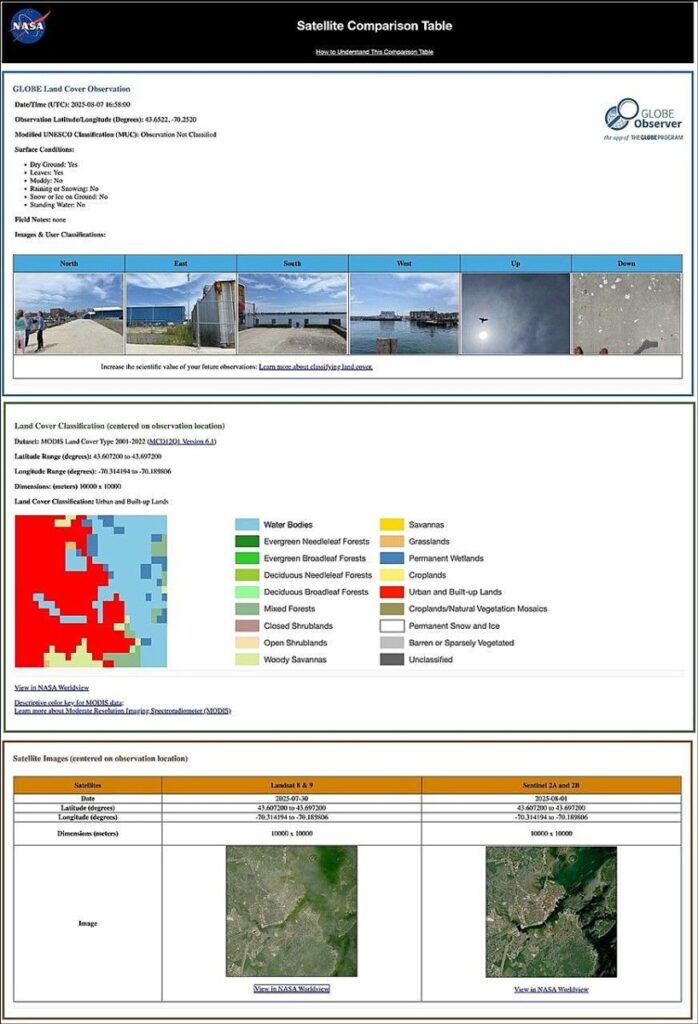
The newly introduced land cover satellite comparison feature will provide GLOBE volunteers with a weekly email that includes a link to a table comparing their submitted observations with satellite data. This table will feature recent satellite images from Landsat and Sentinel-2, allowing participants to visualize how their local observations fit into the broader context of Earth’s changing landscape. With this initiative, GLOBE not only aims to enhance scientific literacy among its volunteers but also to promote ongoing engagement in environmental monitoring, ensuring that citizen scientists understand the impact of their contributions to NASA’s long-term environmental records. Through these innovative programs, NASA is successfully bridging the gap between community involvement and advanced scientific research, demonstrating how citizen science can play a pivotal role in understanding and addressing environmental challenges.
Explore This Section
Science
Science Activation
NASA & GLOBE Connect People,…
Overview
Learning Resources
Science Activation Teams
SME Map
Opportunities
More
Science Activation Stories
Citizen Science
4 min read
NASA & GLOBE Connect People, Land, and Space
The GLOBE Land Cover satellite comparison table is generated weekly for every GLOBE Land Cover observation. GLOBE volunteers receive an email with a link to the table. Information about the table may be found on the GLOBE Observer website.
A group of elementary-aged students gather outside of Oldham County Public Library in La Grange, Kentucky, United States to look at clouds in the sky. “If anyone asks what you are doing, tell them, ‘I am a citizen scientist and I am helping NASA,’” Children’s Programming Librarian, Cheri Grinnell, tells the kids. Grinnell supports an afterschool program called Leopard Spot where she engages K-5 students in collecting environmental data with the
GLOBE (Global Learning & Observations to Benefit the Environment) Program
.
“One little boy really got excited about that, and I heard him tell his mom he was working for NASA as they were leaving,” says Grinnell. That idea is reinforced when the program receives an email from NASA with satellite data that align with the cloud data the students submitted. “I forwarded the NASA satellite response to the after-school coordinator, and she read it to them. That really excited them because it was evidence this is the real deal.”
This experience is one the GLOBE Observer Team (part of the NASA Science Activation program’s NASA Earth Science Education Collaborative, NESEC) hears often: GLOBE volunteers of all ages love getting an email from NASA that compares satellite data with their cloud observations. “Feedback from NASA is huge. It’s the hook,” says Tina Rogerson, the programmer at NASA Langley Research Center who manages the satellite comparison emails. “It ties NASA science into what they saw when they did the observation.”
Now, volunteers will have more opportunities to receive a satellite comparison email from NASA.
GLOBE recently announced
that, in addition to sending emails about satellite data that align with the cloud observations made by learners, they will now also be sending emails that compare the GLOBE Observer Land Cover observations made by learners with satellite data. The new satellite comparison for land cover builds on the system used to create cloud comparisons at NASA Langley Research Center.
When a volunteer receives the email, they will see a link for each observation they have submitted. The link will open a website with a satellite comparison table. Their observation is at the top, followed by a satellite-based assessment of the land cover at that location. The last row of the table shows the most recent Landsat and Sentinel-2 satellite images of the observation site. Rogerson pulls GLOBE land cover data from the public GLOBE database to generate and send the comparison tables on a weekly basis. While users may opt out of receiving these emails, most participants will be excited to review their data from the space perspective.
These new collocated land cover observations are expected to raise greater awareness of how NASA and its interagency partners observe our changing home planet from space in order to inform societal needs. They will help every GLOBE volunteer see how their observations of the land fit in with the wider space-based view and how they are participating in the process of science. Based on the response to cloud satellite emails, seeing that bigger, impactful perspective via the satellite comparison email is motivating. The hope is to encourage volunteers to continue being NASA citizen scientists, collecting Earth system observations for GLOBE’s long-term environmental record.
“I’m excited that land cover is finally becoming part of the operational satellite comparison system,” says Rogerson. This means that GLOBE volunteers will routinely receive satellite data for both land cover and clouds. “We are bringing real science right into your world.”
NESEC, led by the Institute for Global Environmental Strategies (IGES) and supported by NASA under cooperative agreement award number NNX16AE28A, is part of NASA’s Science Activation Portfolio. Learn more about how Science Activation connects NASA science experts, real content, and experiences with community leaders to do science in ways that activate minds and promote deeper understanding of our world and beyond:
https://science.nasa.gov/learn/about-science-activation/
.
Share
Details
Last Updated
Nov 25, 2025
Editor
NASA Science Editorial Team
Related Terms
Science Activation
Citizen Science
Earth Science
Explore More
3 min read
New NASA HEAT and My NASA Data Resources Bring Space Weather Science into Classrooms
Article
1 day ago
2 min read
NASA Citizen Science Toolkit for Librarians
NASA’s Toolkit for Librarians can help you share NASA citizen science opportunities with your patrons…
Article
1 day ago
3 min read
10 Years of Students Helping NASA Grow Space Food with Growing Beyond Earth
Article
4 days ago
Keep Exploring
Discover More Topics From NASA
James Webb Space Telescope
Webb is the premier observatory of the next decade, serving thousands of astronomers worldwide. It studies every phase in the…
Perseverance Rover
This rover and its aerial sidekick were assigned to study the geology of Mars and seek signs of ancient microbial…
Parker Solar Probe
On a mission to “touch the Sun,” NASA’s Parker Solar Probe became the first spacecraft to fly through the corona…
Juno
NASA’s Juno spacecraft entered orbit around Jupiter in 2016, the first explorer to peer below the planet’s dense clouds to…


