Jonah Goldberg: Presidents can no longer be trusted with pardons
In a recent commentary, Jonah Goldberg revisits the foundational principle of the U.S. government: checks and balances. This system was designed to prevent any one branch from wielding excessive power, ensuring that the executive, legislative, and judicial branches can counterbalance each other. However, Goldberg argues that the power of presidential pardons has become a significant exception to this rule, leading to potential abuses that undermine the integrity of the system. He highlights the alarming trend of recent presidents, specifically Donald Trump and Joe Biden, using their pardon powers in ways that appear to favor political allies and personal interests rather than justice, suggesting that it’s time to reconsider this aspect of the Constitution.
Goldberg points to specific instances of pardons that raise ethical questions, such as Trump’s controversial pardons for political allies and individuals involved in the January 6 Capitol insurrection, as well as Biden’s preemptive pardons for family members and associates. He argues that these actions not only reflect a troubling pattern but also expose the limitations of Congress’s ability to hold presidents accountable through impeachment, particularly in our current hyper-partisan climate. The author asserts that the Founding Fathers anticipated potential abuses of the pardon power, believing that impeachment would be the remedy. However, the reality today is that Congress struggles to act decisively against presidential misconduct, leading to a scenario where the pardon power is wielded without sufficient checks.
Goldberg calls for a constitutional amendment to eliminate the president’s unilateral authority to grant pardons, advocating for a system that maintains the spirit of clemency while ensuring that it is not subject to misuse. He believes that a reformed approach to pardons could restore the seriousness and integrity that once characterized this power, noting that historical precedents, such as the two-term limit established after Franklin Roosevelt’s presidency, demonstrate that constitutional amendments can effectively adapt to changing political realities. Ultimately, Goldberg’s argument serves as a reminder of the importance of accountability in government and the need to safeguard democratic principles against potential abuses of power.
Ours is a system of “checks and balances.”
The president can do this or that, but the courts and Congress can put a stop to it (depending on the circumstances and relevant rules). When the courts rule that the executive branch can’t do something, Congress can write a new law saying the president can do it. When Congress passes a law the president doesn’t like, the president can veto it. Congress, if it has enough votes, can override the veto. And so on. The whole idea is to deny any one branch or person too much concentrated power.
I’m sorry if I sound a bit condescending given that everyone is supposed to have learned this stuff in grade school. But it seems a lot of people have forgotten how our system is supposed to work, so I thought a quick recap might be helpful.
Anyway, even under our system, each branch has powers that really can’t be checked. Congress, for instance, has sole authority to levy taxes and spend taxpayer money, declare war, etc. Once a court acquits a defendant, the defendant can’t be prosecuted for that crime again.
The president has some unique powers too. Including the sole, final authority to grant pardons, which cannot be reviewed or repealed by Congress or the courts.
It’s time we changed that — and the only way to do so is by amending the Constitution.
There are two reasons for getting rid of the president’s power to pardon. The first is the grotesque abuses of that power by Presidents Trump and Biden. In his first term, Trump issued a series of
egregious pardons
for, among others,
lackeys
,
war
criminals
and
political
allies
.
Biden then issued blanket and preemptive
pardons
for
his
family
and various political allies. Partisan defenders like to say this was necessary to protect the Bidens from persecution by the incoming Trump administration. These defenses tend to overlook the
Biden
family’s
exceedingly
shady business
dealings
. They also ignore a raft of other pardons and commutations Biden allegedly just outsourced to ideologues on his staff.
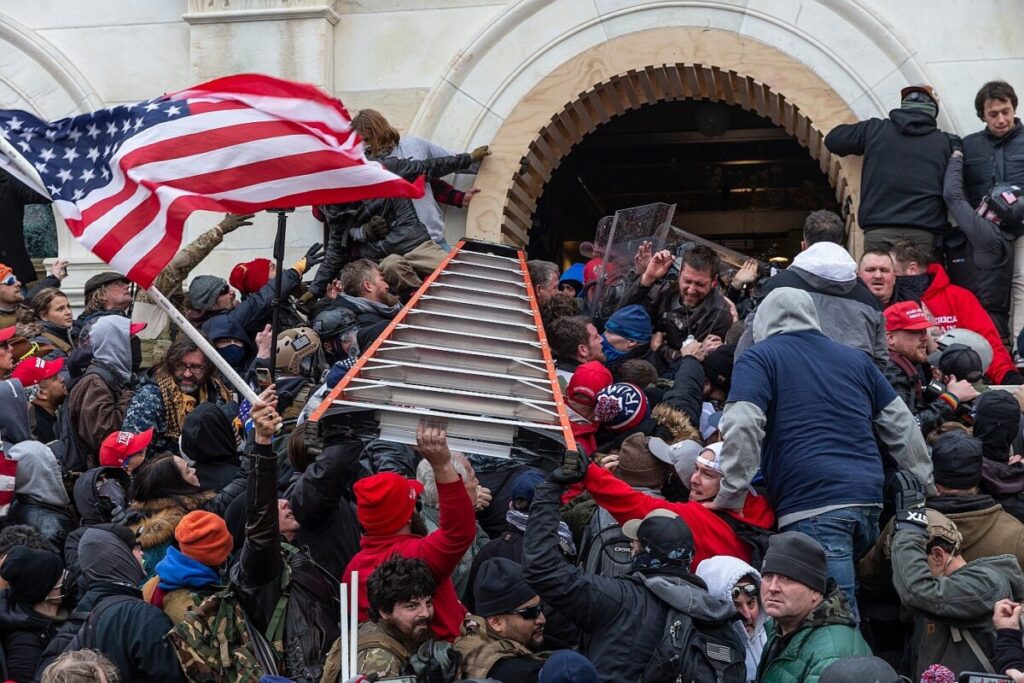
Back in office in 2025, Trump has outdone Biden (and himself). He launched his second term by granting mass pardons to the goons who beat police with flagpoles and stormed the Capitol on his behalf on Jan. 6, 2021. Since then, he’s pardoned a rogues’ gallery of donors, partisan allies and people with business ties to him or his family, including crypto billionaire Changpeng Zhao, the chief executive of Binance, a trading platform that
allowed
terrorists and criminal organizations to finance their operations under the radar.
Zhao pleaded guilty to money laundering, but he also worked
assiduously
to boost the Trump family’s crypto business. It certainly
appears
that he got a pardon in exchange for services rendered.
The second reason for getting rid of the president’s pardon power involves that earlier stuff about checks and balances. The Founding Fathers believed the only remedy for the corrupt abuse or misuse of pardons was impeachment. James Madison, the principal author of the Constitution, was explicit on this point.
At the Virginia ratifying convention, George Mason objected that the pardon power was too great, and that presidents could use pardons to suborn criminal activity on their behalf. Madison
responded
that, “If the president be connected in any suspicious manner with any (such) persons, and there be grounds to believe he will shelter himself, the house of representatives can impeach him.”
The problem: Congress’ impeachment power has proven to be a dead letter in the modern era of hyper-partisanship. Just as presidents cannot be trusted to use the pardon power responsibly, Congress cannot be trusted with the responsibility to hold presidents accountable. Without checks, there is no balance.
There still should be room for pardons and clemency in our system. But leaving it solely in the power of presidents has led to evermore abuse. Indeed, I think it’s almost a certainty that Trump will use the Biden precedent to preemptively pardon much of his administration, his sons and himself before he leaves office. Given the ongoing weaponization of the justice system — and his abuse of it — he’d almost be a fool not to.
The Constitution was written with men like George Washington in mind. When Washington opted to step down after two terms, it established a two-term tradition that endured until Franklin Roosevelt violated it. Afterward, we amended the Constitution to codify what had been a tradition.
For most of our history, presidents took the solemnity of pardons — and the threat of impeachments — seriously. They no longer do. It’s time to change the Constitution accordingly.
Jonah Goldberg is editor-in-chief of The Dispatch and the host of The Remnant podcast. His Twitter handle is
@JonahDispatch
.


