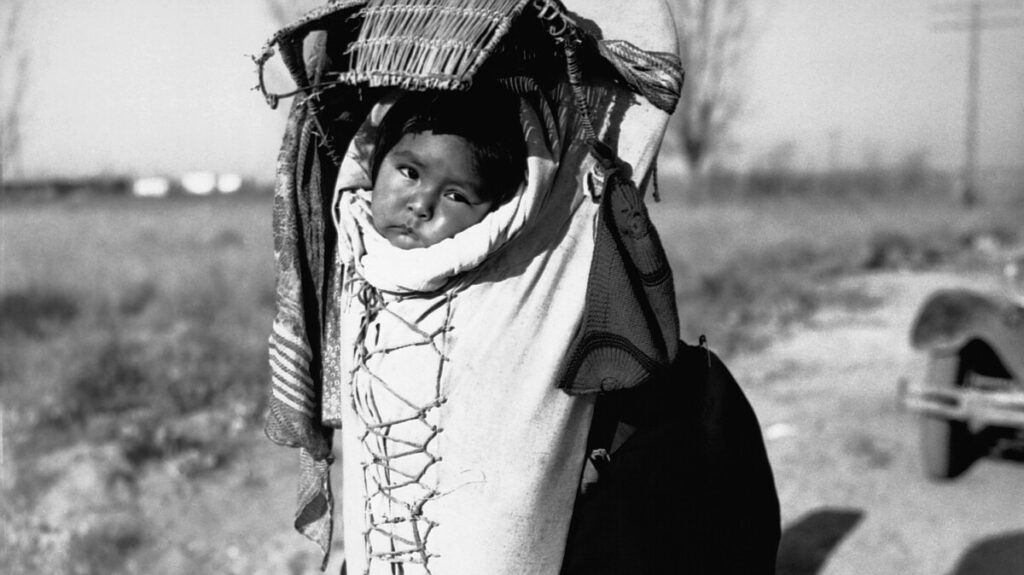
Indigenous women engineered energy-efficient baby carriers
Indigenous women have long been overlooked as pioneers in technology, despite their significant contributions to communal survival and innovation. A recent initiative led by researchers, including Alexandra Greenwald from the National History Museum of Utah, aims to highlight the critical inventions of Indigenous women, particularly focusing on the cradleboard—a tool that has been instrumental in balancing childcare and foraging. In a profile from the University of Utah, Greenwald emphasizes that traditional knowledge and Western scientific methods can converge to validate the ingenious designs of these cradleboards, which have been used across various Indigenous cultures for millennia.
Historically, narratives surrounding Indigenous cultures have often been skewed, particularly in terms of gender dynamics. Many anthropological accounts have disproportionately highlighted male contributions, especially in hunting, while neglecting the vital roles women played in gathering and nurturing. Recent studies indicate that women in existing hunter-gatherer societies contribute up to 75% of their community’s caloric intake, largely through the gathering of plants and crops. To explore the practical advantages of cradleboards, Greenwald conducted a series of experiments comparing the efficiency of foragers using cradleboards, slings, and no carrying aid at all. The results were telling: participants using cradleboards not only gathered more acorns but also demonstrated an ability to move more freely while foraging, underscoring the cradleboard’s role as an essential tool for Indigenous women.
The findings from Greenwald’s research not only celebrate the ingenuity of Indigenous women but also challenge long-standing misconceptions about gender roles in hunter-gatherer societies. The cradleboard, a simple yet effective baby-carrying device, exemplifies a sophisticated understanding of maternal needs and environmental demands. As the study concludes, the contributions of women to community survival and health are indispensable, reshaping our understanding of Indigenous societies and highlighting the need to acknowledge and honor the technological innovations of Indigenous women throughout history. By recognizing these contributions, we can begin to give credit where it is due and appreciate the rich tapestry of knowledge that Indigenous cultures have woven over generations.
Indigenous
women were technological trailblazers. But while lived experiences and communal histories have long supported this, they routinely
fail to receive the credit they deserve
. A group of researchers are using clinical experiments to showcase these inventions and finally give credit where it’s due. According to
National History Museum of Utah
’s curator of ethnography
Alexandra Greenwald
, one of the best examples of Indigenous women’s ingenuity undoubtedly remains the baby cradleboard.
“Any Indigenous woman who’s had their infant in a cradle could tell you exactly what I’m about to tell you, through traditional knowledge,” Greenwald
said in a recent University of Utah profile
. “Traditional ways of knowing and western science ways of knowing are different, but they can arrive at similar, complementary conclusions.”
A history of bias
Outside anthropologists, archaeologists, and historians have presented
skewed versions of Indigenous culture
for generations. These also usually fall along biased gender dynamics. For example, it’s common to hear claims that men provided most of a community’s food through hunting. But primary records, ecology, and common sense says otherwise.
“Everyone is so focused on men, meat, and stone tools because bones and stone tools preserve so well in the archaeological record. But that doesn’t mean that was the only thing that was happening,” Greenwald explained.
In a study published earlier this year
in the
American Journal of Biological Anthropology
, Greenwald and colleagues noted that even today, women in the world’s remaining hunter-gatherer populations still provide as much as 75 percent of their community’s caloric needs. They don’t do this by tackling the biggest game animals they can find, but by focusing on reliable, seasonal plants and crops. And all the while, they’re still birthing and raising children.
What is a cradleboard?
So, how did these women juggle both familial and foraging responsibilities? With tools like the cradleboard.
Examples of the technology
stretch back thousands of years across Indigenous cultures around the world. In Apache communities, a cradleboard is woven from willow, dogwood, and other plant fibers. Meanwhile, Navajo baby carriers are built from a Ponderosa pine frame laced with buckskin straps. The detailed designs kept babies safe and prevented them from crawling away while women worked. When on the move, mothers simply strapped the cradles to their backs or carried them to the next location before setting them down to continue their daily tasks. The benefits go beyond convenience and safety. Cradleboards essentially function as Indigenous foraging lifehacks.
To showcase their utility, Greenwald set up a trio of trial experiments. After consulting with tribal community representatives, her team documented three different foraging scenarios: participants wearing a cradleboard, participants wearing a sling, and another scenario without either accessory. Before donning the cradleboards and slings, researchers also stuffed them with a 10 pound sandbag to approximate the size and proportions of a 1 to 2 month old infant.
After volunteers fasted, Greenwald measured their metabolic base rates, then attached heart rate monitors, accelerometers, GPS devices, and respirometers. From there, they tasked participants to cycle through each test group while gathering acorns from a preselected area to guarantee uniform foraging scenarios.
A Diné (Navajo) baby on a cradleboard with a lamb approaching, Window Rock, Arizona, 1936. Credit: H. Armstrong Roberts, from the U.S. National Archives
Indigenous scientists and mathematicians
Researchers already knew unencumbered gatherers would amass the most acorns while burning the fewest calories. But after excluding the control group, cradleboard wearers gathered far more acorns than those who donned a sling. Interestingly, the cradle group also burned more calories, but Greenwald said this actually makes sense. Once they set the cradlebacks on the ground, foragers could move even more quickly while gathering more acorns. Despite the caloric difference, however, cradles were comparatively the most efficient baby-carrying tool.
“Humans, especially women, have been scientists and mathematicians, experimenting for time immemorial, figuring out their landscape, what is safe, what is not safe,”
said Greenwald
.
According to the study’s authors, you really don’t need clinical trials to see evidence of the cradleboard’s usefulness.
“The utility of cradle carrying is not only reflected in the increased return rate of the method, but it is also emphasized by its rapid expansion across western North America after the prehistoric development of the technology among Basketmaker peoples in the Southwest,” they
wrote in the study
.
Regardless of how Indigenous peoples carried their children while foraging, the team also explained how vital women were to their community’s survival and health.
“This study empirically demonstrates the importance of maternal foraging contributions to hunter-gatherer subsistence economies, and undermines the notion that females of reproductive age rely primarily on male hunting efforts,” they concluded.
The post
Indigenous women engineered energy-efficient baby carriers
appeared first on
Popular Science
.


