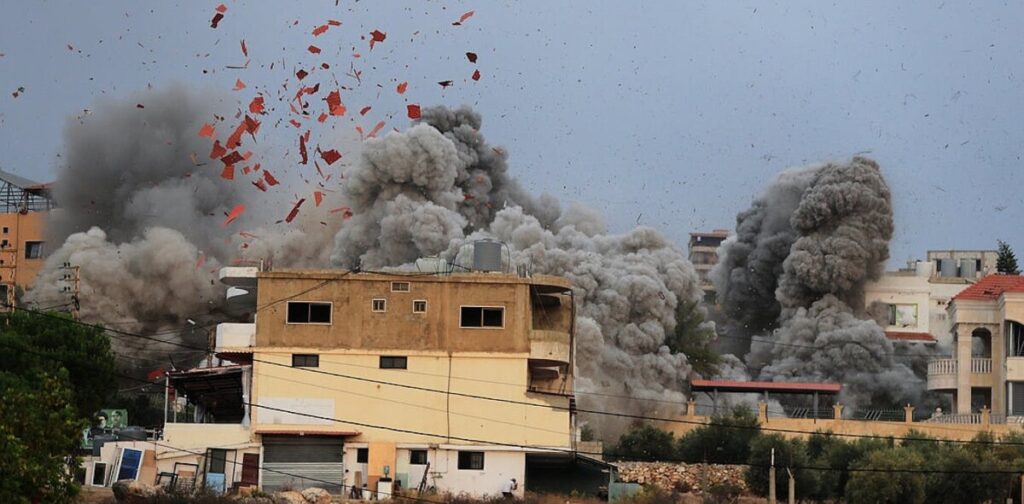
A year on, the Israeli-Lebanese ceasefire looks increasingly fragile − could a return to cyclical violence come next?
The fragile ceasefire agreement between Israel and Lebanon, established on November 27, 2024, is facing severe challenges as tensions escalate once again. Recent reports from the United Nations Interim Force in Lebanon (UNIFIL) reveal that since the truce, Israel has conducted over 10,000 air and ground violations in Lebanese territory. The situation deteriorated further with a series of Israeli airstrikes that resulted in the assassination of a high-ranking Hezbollah military commander and attacks on Palestinian refugee camps. Israel justifies its actions by claiming that they target Hezbollah’s attempts to rearm and regain its military capabilities. As the conflict continues, there are growing concerns that Israel’s military strategy is shifting towards a more aggressive stance aimed at decisively dismantling Hezbollah’s power.
The ceasefire was intended to stabilize the region following the escalation of hostilities triggered by Hamas’ attack on Israel on October 7, 2023. However, a year later, key provisions of the agreement remain unfulfilled. The Lebanese government was supposed to disarm non-state military forces, including Hezbollah, while Israel was to withdraw its troops from occupied areas in southern Lebanon. Instead, Israel maintains control over several border posts and continues to conduct daily military operations. The Lebanese military, which has historically struggled to assert its authority, faces immense challenges in disarming Hezbollah, a powerful entity that has long been a significant player in both Lebanese politics and military dynamics. The complexities of Lebanon’s internal politics, compounded by Hezbollah’s entrenched position, make disarmament a daunting task.
The potential for renewed conflict looms large, as both Israel and Hezbollah engage in a cycle of retaliation that undermines any hope for lasting peace. The U.S. has historically played a role in Lebanese affairs, often pressuring the Lebanese state while overlooking the complexities of disarming Hezbollah. As the situation escalates, the need for a balanced approach to diplomacy becomes critical. Analysts suggest that without a strong and stable Lebanese state capable of controlling its arms and establishing a coherent foreign policy, the cycle of violence is likely to persist. The resolution of border disputes and the establishment of a functioning Lebanese government devoid of Hezbollah’s influence are essential for breaking this cycle. Ultimately, achieving peace in the region will require a concerted effort from all parties involved, including a more equitable application of U.S. diplomatic pressure.
Smoke rises following an Israeli airstrike in the village of Teir Debba in southern Lebanon on Nov. 6, 2025.
AP Photo/Mohammad Zaatar
An already troubled ceasefire agreement between Israel and Lebanon is looking shakier than ever.
Since the truce was announced on Nov. 27, 2024, there have been more than 10,000 Israeli air and ground violations inside Lebanese territory, according to the
latest report from UNIFIL
, the United Nations peacekeeping mission in Lebanon.
And in the run-up to the ceasefire’s first anniversary, a
spate of Israeli strikes
over its northern border saw the assassination of Hezbollah’s top military commander and a deadly attack
on a Palestinian refugee camp
.
Israel argues that all its
military attacks
in Lebanon target Hezbollah’s efforts to rearm and rehabilitate itself. And a flurry of reports from Israel suggest the Israeli military is getting ready to “
finish the job
” against Hezbollah.
From my perspective as a
historian focusing on Israeli-Lebanese relations
, the ceasefire and Israel’s emergence as the regional military hegemon has not translated into stability and constructive change in the Middle East, not even for Israel. In fact, the shaky agreement is a testament that without diplomacy and a long-term stabilizing accord, military power alone will not suffice.
What’s in a ceasefire
The ceasefire ostensibly brought an end to the latest war between Israel and Hezbollah. After entering the conflict that followed Hamas’ attack on Israel on Oct. 7, 2023, Hezbollah saw its leadership and military capabilities debilitated by Israel, setting off a ripple effect that has helped reshape the Middle East.
Just as an empowered Hezbollah managed for decades to
influence Middle East politics
, its sudden loss of strength had a similar effect in reverse – contributing to regime change in Syria and Israel’s war on Iran in June.
A retired member of the Lebanese security forces holds a national flag and flashes a victory sign next to burning tires blocking a road leading to the government palace during a protest in Beirut on Sept. 17, 2025.
AP Photo/Bilal Hussein
The November 2024
ceasefire agreement
stipulated that, along with the cessation of fighting, Lebanon would remove all nonstate military forces and assets, starting in the south, between the Litani River and the border with Israel. The Lebanese army and other state security branches would remain the sole armed forces in the country.
In exchange, Israel was meant to gradually withdraw from the areas it occupied in southern Lebanon within 60 days. The agreement also stipulated that the United States would broker indirect negotiations between Israel and Lebanon to achieve an internationally recognized delineation of their land border.
A year later, none of these objectives has been achieved. Israel continues to occupy
five border posts
inside Lebanon and conducts daily raids into the country. In some of these attacks, which Israel
says are focused on Hezbollah and allied groups
,
UNIFIL forces
have been hit or come under fire.
An opening for the Lebanese state?
The
formation of a new Lebanese government
in February 2025 opened a new political window. It was the
first Lebanese government since 2008
in which Hezbollah did not possess veto power over its actions.
Many in Lebanon saw this as a
once-in-a-generation opportunity
for the state to regain its sovereign capacities, including through the disarmament of Hezbollah. By doing so, it was hoped the country could achieve stability and begin the process of an economic recovery badly needed following its
October 2019
financial meltdown.
Yet disarming Hezbollah has proved to be extremely challenging. Hezbollah was – and arguably still is – the most powerful military force in Lebanon. Its military might had enabled it not only to establish a perceived balance of deterrence with Israel, but to position itself as a critical player in Lebanese politics. Willingly giving up its arms to the Lebanese state would be tantamount to fundamentally transforming its “
resistance
” identity and relinquishing political power to other Lebanese parties and sectarian forces.
U.N. peacekeepers secure an area in southern Lebanon following the beginning of a ceasefire between Israel and Lebanon on Nov. 27, 2024.
AP Photo/Mohammed Zaatari, File
Carrying out the disarmament of Hezbollah in line with the ceasefire is theoretically a job for the Lebanese army. But since its foundation in 1945, the army has mainly operated as a symbol of the country’s sovereignty rather than as practical defender – even in times of acute crises such as the
civil war from 1975 to 1990
.
The army does not have the military capacity, political clout or will to force Hezbollah to give up its arms. If it tried coercively, it would likely lead to armed resistance that might spiral into a new civil war. Some
reporting has even suggested
that elements in the army have been helping Hezbollah in its rehabilitation efforts.
The US puts its thumb on the scale
Consistent with the
long – and dubious – history of U.S. support for the Lebanese state
via security cooperation and the Trump administration’s general view of ceasefire as a tool for restricting Hezbollah, American officials have insisted that the Lebanese army should disarm Hezbollah.
When the Lebanese army’s chief of staff recently criticized Israel for violating Lebanon’s sovereignty, he was criticized by Trump administration officials for not addressing Hezbollah’s violations of the country’s sovereignty and later had his
scheduled Nov. 25 trip
to the U.S. canceled.
Meanwhile, despite Iran’s own weakened position,
Trump officials
say it still managed to funnel US$1 billion to Hezbollah in the past year. This could give Hezbollah a lifeline at a time when the rest of the country is begging,
unsuccessfully, for foreign aid
.
The risk of renewed war
These dynamics put Israel and Hezbollah on a risky path of
continued friction
.
After its 2006 war against Israel, Hezbollah built a perceived
balance of deterrence
that, until Oct. 7, 2023, Israel had accepted as a fait accompli. But the massacre on that day transformed Israeli security doctrine to zero tolerance toward security risks.
Hezbollah fighters carry the coffin of senior Hezbollah official Haytham Tabtabai, who was killed in an Israeli airstrike in a southern suburb of Beirut on Nov. 23, 2025.
AP Photo/Hussein Malla
The possibility of renewed conflict in Lebanon is also tied to Israel’s domestic politics. Prime Minister Benjamin Netanyahu
remains unpopular
. He was roundly accused of prolonging the war in Gaza to deflect from his own legal problems and his government’s deficiencies. And that remains a distinct possibility when it comes to Lebanon, too.
Resolving existing border disputes between the two countries, as stipulated in the ceasefire agreement, would be significant. Since 2000, such disputes have been used by Hezbollah as an excuse to continue its armed struggle against Israel. And in general,
the lack of defined Lebanese borders with both Syria and Israel
has been a constant source of conflict.
But so far, any diplomatic efforts have failed to materialize over ongoing
deep mistrust
and, despite the ceasefire, active conflict.
As of now, there are only dim prospects for that to change, absent unlikely U.S. pressure. On the Israeli side, any border agreement that would entail ceding territory to Lebanon is politically untenable, and the current right-wing government is showing little interest in diplomacy. For Lebanon, the weakness of the central government in the face of Hezbollah’s still-significant power, along with Israel’s ongoing military actions, makes practical negotiations exceedingly difficult.
The same old sordid tune?
Instead, what appears to be unfolding is a return to the vicious cycle that has characterized Israel-Lebanon relations since the late 1960s: Hezbollah and other nonstate actors in Lebanon respond to Israeli military incursions, only to be met with further Israeli retaliation. That, in turn, further weakens the Lebanese state – yet Lebanese state capacity remains the only way to break the vicious cycle.
The key for calm in Lebanon may be again in the hands of the U.S. administration, with the support of an extended regional coalition, perhaps even by including Iran in the deal.
So far, most American diplomacy in the Lebanon-Israel context has been to pressure Beirut. Avoiding renewed war on the Israel-Lebanon front may require U.S. coercive diplomacy, where the pressure is more equally distributed on each party.
At the end of the day, only a strong and stable Lebanon, where the state is the sole holder of arms and in charge of foreign policy, can move us past the current cycle. Israeli military pressure will not get us far in this direction. It must come mainly through an internal Lebanese political process.
Asher Kaufman does not work for, consult, own shares in or receive funding from any company or organization that would benefit from this article, and has disclosed no relevant affiliations beyond their academic appointment.


