The plague of frog costumes demonstrates the subversive power of play in protests
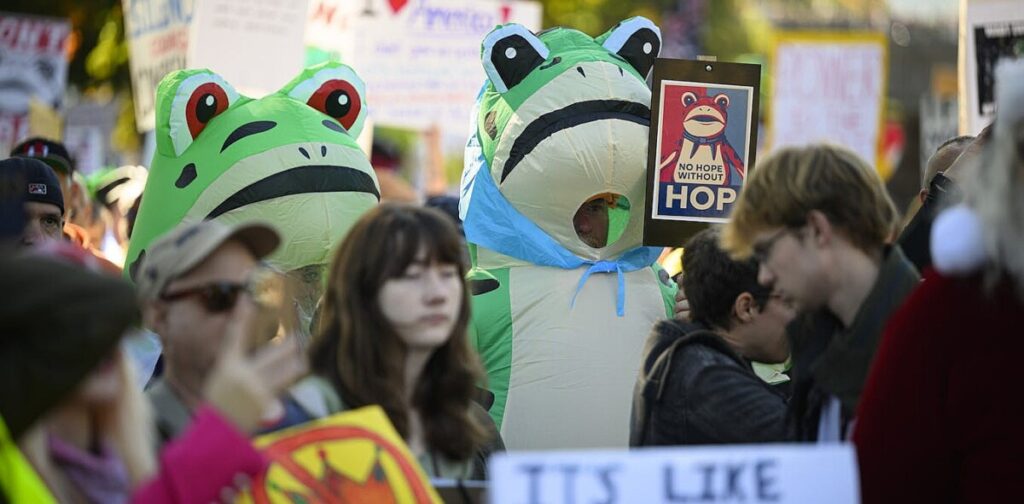
In recent protests against immigration enforcement, the whimsical sight of demonstrators clad in inflatable frog costumes has emerged as a striking symbol of resistance, particularly following a controversial incident involving ICE agents in Portland, Oregon. On October 18, 2025, an ICE agent deployed pepper spray into the air vent of a peaceful protester’s inflatable frog costume, igniting outrage and prompting a viral video that showcased the absurdity of the situation. This incident not only solidified the frog costume as a symbol of protest but also marked a shift in the landscape of demonstrations against the Trump administration’s immigration policies, moving the focal point of activism to Charlotte, North Carolina. The use of such costumes serves as a humorous and subversive tactic, softening the protest’s image at a time when officials labeled demonstrators as violent or affiliated with extremist groups.
The playful nature of inflatable costumes, as explained by sociologist Anya M. Galli Robertson, allows activists to adopt a less threatening demeanor, making it harder for authorities to justify aggressive responses. Activist Seth Todd, who donned an inflatable frog costume, emphasized that such attire does not scream extremism or violence, thus inviting a wider range of participants, including those new to activism. This approach is reminiscent of historical protest tactics that employ humor and absurdity to challenge the legitimacy of powerful opponents. The emergence of groups like the Portland Frog Brigade and Operation Inflation, which distribute inflatable costumes to protesters, further illustrates the growing trend of using playful imagery in political dissent. In a landscape where serious issues are often met with harsh realities, the inclusion of costumes like frogs, bears, and unicorns allows for a creative and accessible form of protest that invites broader participation and challenges the status quo.
The trend of using inflatable costumes in protests isn’t entirely new; it echoes past movements that have utilized humor and absurdity to draw attention to serious issues. From the “Trump baby” blimp in London to the towering puppets of the Bread and Puppet Theater during the Vietnam War, creative expressions of dissent have long played a role in social movements. The recent rise of inflatable costumes at protests highlights a return to these carnivalesque tactics, where the juxtaposition of playful imagery against the backdrop of state violence serves as a powerful form of political expression. By fostering a sense of community among participants and creating a visually engaging spectacle, these costumes not only challenge the narrative surrounding protests but also reinforce the importance of humor and creativity in the ongoing struggle for social justice.
Demonstrators in frog costumes during the “No Kings” protest on Oct. 18, 2025, in Portland, Ore.
Mathieu Lewis-Rolland/Getty Images
When the center of protests against immigration enforcement switched recently to Charlotte, North Carolina, so did the frogs.
Back in October 2025, an agent with Immigration and Customs Enforcement, the agency popularly known as ICE, deployed pepper spray into the air vent of a peaceful protester’s inflatable frog costume.
Video of the incident
in Portland, Oregon, quickly went viral. Frogs and other inflatable costumes
became a fixture of protests
against Trump administration actions everywhere.
As a
sociologist
who studies social movements and political discourse, I knew when I saw the video that we’d soon see frogs everywhere at protests.
And indeed, the costumes have visually distinguished recent events from earlier anti-Trump demonstrations, softening their public image at a time when Republican officials were calling protesters “violent” and “
Antifa people
.”
It’s hard to be violent in a frog suit.
Humor is subversive. When used strategically, it can help undermine the legitimacy of even the most powerful opponents.
A ‘Trump baby’ inflatable was used in a protest on June 4, 2019, in London against the state visit of President Donald Trump.
Mike Kemp/In Pictures via Getty Images
Playful and potentially protective
Portland activist
Seth Todd
began protesting in an inflatable frog costume as a way of “looking ridiculous” when federal law enforcement ramped up repressive tactics against his fellow protesters at ICE facilities in October 2025.
“Nothing about this screams extremist and violent,” he told The Oregonian newspaper.
Such costumes are interactive, playful, physically unwieldy and potentially protective. They can help activists appear less threatening to police, evade
facial recognition systems
and even deflect the blows of police batons or rubber bullets.
Wearing inflatable costumes at demonstrations checks all the boxes for tactics that can be widely imitated: cultural relevance, symbolic power, accessibility and easy participation. My
interviews with activists
who used
glitter bombing
in past protests revealed that light-hearted tactics can expand participation by attracting newcomers who are wary of more confrontational forms of protest. This is especially true when the tactics are
easy to adopt
– notably, wearing inflatable costumes in the weeks leading up to Halloween.
“Protest costumes” are now a category on Amazon.
Unlike the seasoned activists who were early adopters, protesters who wore inflatable animal and character costumes – sometimes because frog costumes had sold out – at No Kings protests on Oct. 18 represented a range of experiences and affiliations, including
many first-timers
.
“We are middle of the road,” explained
one protesting frog
in Chicago, “we’re just regular folks who have had enough.”
Jordy Lybeck, Operation Inflation co-founder, organizes inflatable costumes for protesters near a U.S. Immigration and Customs Enforcement facility on Oct. 21, 2025, in Portland, Ore.
AP/Jenny Kane
Bears, unicorns, dinos and raccoons
Activists
continue to don frog costumes in solidarity. One group calling itself the
Portland Frog Brigade
says its goal is “artfully exercising our First Amendment right to free speech.”
Others created
Operation Inflation
to collect and distribute inflatable costumes to Portland protesters.
Just days after the pepper spray incident, a
video circulated
showing people outside the Portland ICE facility wearing inflatable bear, unicorn, dinosaur and raccoon costumes, dancing to raucous music in front of a line of law enforcement officers clad in riot gear.
Despite the almost literal novelty value of frog costumes, there’s nothing new about any of this.
Inflatables have long
played an important role
in outlandish protest tactics. A large inflatable “
Trump chicken
” was installed outside the White House back in 2017, while a “
Trump baby
” blimp hovered over Parliament in London during a 2018 state visit by Trump.
During the 1960s, the
Bread and Puppet Theater
used towering puppets and satirical street performances to protest the Vietnam War and social inequality.
Carnivalesque tactics
and
clown costumes
have been popular responses to police repression at anti-globalization protests.
The
Raging Grannies
were a mainstay at antiwar and antinuclear demonstrations in the early 2000s, easily recognizable with their colorful costumes and witty songs.
And LGBTQ+ rights advocates have
thrown pies
and
glitter-bombed
right-wing politicians, while also staging
costumed flash mobs
and
dance parties
outside the offices and homes of prominent public figures.
Absurdist performances and playful public displays are powerful tools of political dissent, especially when they stand in contrast to state violence, authoritarianism and human rights abuses.
Anya M. Galli Robertson does not work for, consult, own shares in or receive funding from any company or organization that would benefit from this article, and has disclosed no relevant affiliations beyond their academic appointment.


