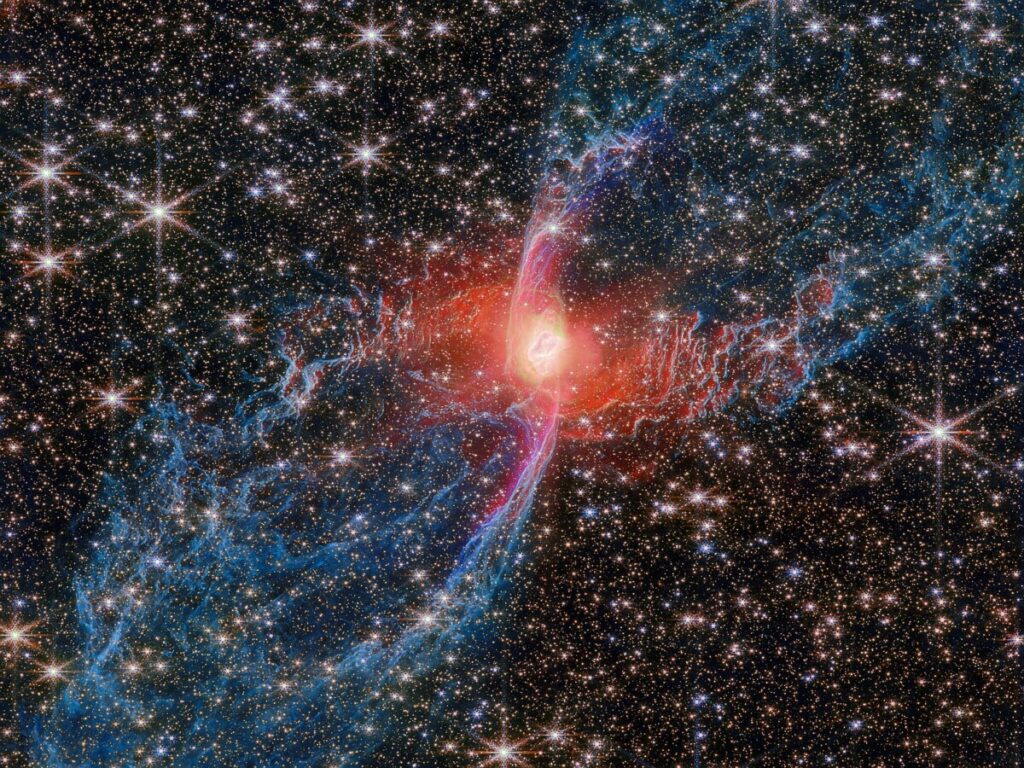
Red Spider Nebula
On October 26, 2025, the James Webb Space Telescope (JWST) unveiled breathtaking new details of the Red Spider Nebula, a stunning planetary nebula located approximately 3,000 light-years from Earth. Utilizing its advanced Near-InfraRed Camera (NIRCam), JWST captured a high-resolution image that showcases the nebula’s intricate structure and expansive outflows, revealing for the first time the full extent of its characteristic ‘legs’—the outstretched lobes that give the nebula its arachnid-like appearance. These lobes, depicted in striking blue hues, are illuminated by light emitted from H2 molecules, which consist of two hydrogen atoms bonded together. This groundbreaking observation allows astronomers to study the dynamics and evolution of this celestial formation in unprecedented detail.
The Red Spider Nebula is a fascinating example of stellar evolution, as it represents the final stages of a star’s life cycle. As the central star expels gas and dust, it creates these magnificent bubble-like structures that extend approximately 3 light-years across, inflating over thousands of years due to the outflowing gas. The new imagery not only enhances our understanding of the nebula’s physical characteristics but also provides insights into the processes that govern the formation of planetary nebulae. By observing these structures, scientists can glean information about the chemical composition and dynamics of the gases involved, which plays a crucial role in the lifecycle of stars and the enrichment of the interstellar medium. The JWST’s advanced imaging capabilities position it as a pivotal tool in unraveling the mysteries of the universe, offering a glimpse into the complex processes that shape celestial phenomena like the Red Spider Nebula.
ESA/Webb, NASA & CSA, J. H. Kastner (Rochester Institute of Technology)
Using its
Near-InfraRed Camera
(NIRCam), NASA’s James Webb Space Telescope captured never-before-seen details of the Red Spider Nebula, a planetary nebula, in this image
released on Oct. 26, 2025
. NIRCam is Webb’s primary near-infrared imager, providing high-resolution imaging and spectroscopy for a wide variety of investigations.
Webb’s new view of the Red Spider Nebula reveals for the first time the full extent of the nebula’s outstretched lobes, which form the ‘legs’ of the spider. These lobes, shown in blue, are traced by light emitted from H2 molecules, which contain two hydrogen atoms bonded together. Stretching over the entirety of NIRCam’s field of view, these lobes are shown to be closed, bubble-like structures that each extend about 3 light-years. Outflowing gas from the center of the nebula has inflated these massive bubbles over thousands of years.
Image credit: ESA/Webb, NASA & CSA, J. H. Kastner (Rochester Institute of Technology)


