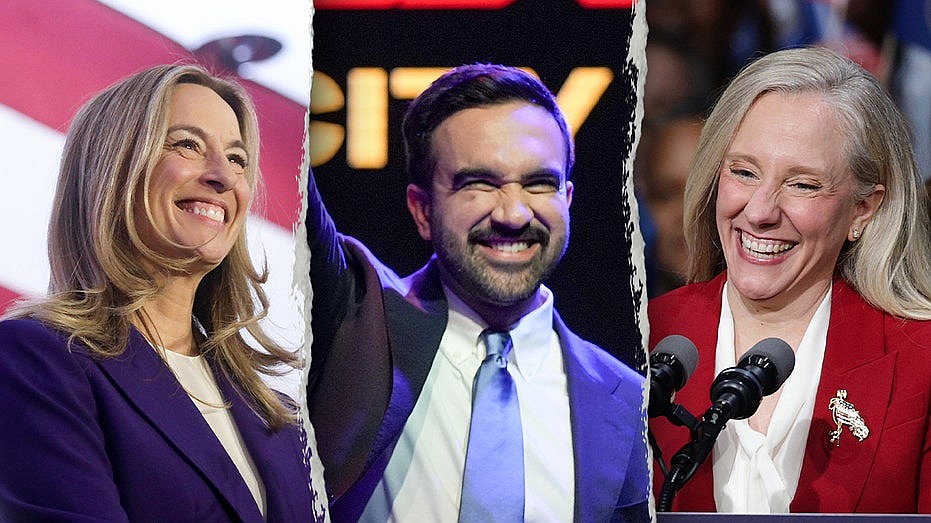
Former Democratic presidential candidate talks about the future of his party after off-year election success
In the recent off-year elections, the Democratic Party celebrated notable victories in various governors’ races and key state and local positions, showcasing a diverse array of candidates across the nation. While this success may suggest a positive trajectory for the party, the future remains uncertain, especially as centrist candidates emerged victorious in states like Virginia and New Jersey, contrasting with the leftist wins seen in more progressive areas such as New York City. Jason Palmer, a former Democratic presidential primary candidate and co-founder of TOGETHER!, highlighted the ongoing debate about the party’s direction, suggesting that the next year will clarify its trajectory. He predicts that the Democrats will adopt a “bigger tent” approach, tailoring their messaging and candidates to resonate with regional political climates ahead of the 2026 elections.
Palmer’s insights emphasize the need for the Democratic Party to balance its messaging, particularly regarding billionaires and businesses. He argues that the party’s current stance may alienate potential supporters, as many successful business leaders in America are self-made rather than inheritors of wealth. Advocating for a pro-entrepreneurship stance, Palmer believes that the party should embrace “conscious capitalism,” a concept gaining traction among younger voters who seek purpose in their work. He notes that this shift in values may be replacing traditional religious affiliations for many young Americans. To further this agenda, Palmer proposes a two-step taxation policy that would reward mission-driven corporations with lower tax rates, thereby incentivizing businesses to prioritize social impact alongside profit.
As the 2026 midterm elections approach, Palmer urges Democrats to focus on nurturing younger candidates in competitive districts, promoting a new generation of leaders who embody the principles of conscious capitalism. He plans to endorse a list of young candidates in their 20s and 30s who have entrepreneurial backgrounds and a commitment to social responsibility. This strategic shift could be crucial for the party as it navigates a politically fragmented landscape, aiming to unify diverse perspectives while addressing the evolving values of the electorate. Palmer’s vision encapsulates a potential path forward for the Democrats, blending progressive ideals with a pragmatic approach to governance that resonates with a wider array of voters.
https://www.youtube.com/watch?v=XH-GAmSez0M
The Democrats enjoyed a series of wins across the country in the
off-year election
, taking governors’ races and key positions in several state and local elections.
Despite the successes, the party’s future still appears unclear, as more centrist candidates won in Virginia and New Jersey, while more leftist candidates scored victories in places like New York City.
Jason Palmer, a former
Democratic presidential primary candidate
and co-founder of TOGETHER!, argued the future of the party is “very much up for debate” — but not for long. He said he believes things will be clear within the next year and predicts the 2025 victories could lead to Democrats using split messaging, meaning candidates and platforms would be chosen based on their potential voters.
“I think what’s going to end up happening is that the Democrats are going to become a bigger tent and take in different candidates in different regions based on the politics of those regions,” Palmer told Fox News Digital. “So, you’ll see people that are more like Beshear in Kentucky across the Midwest, you’ll some people more like Mamdani all throughout Vermont, New Hampshire, Massachusetts, etc., but
the Democratic Party
will have different messages for different parts of the country in the 2026 election.”
‘FULL-BLOWN BATTLE’ BREWING IN DEM PARTY AS MAMDANI-STYLE CANDIDATES RISE IN KEY RACES
The former presidential candidate, who ran in the 2024 election cycle, said that his party is making a mistake in its messaging on billionaires and business.
“Well, personally, I think they’re going too far anti-billionaire in their approach. America is a country where people can make of themselves what they want, and most of the people that are billionaires in America did not inherit their wealth,” Palmer said.
“Business building is a core part of what makes America great, and I don’t think the Democratic Party should be bashing business builders. I think we should be pro-entrepreneurship and pro-mission-driven entrepreneurship, especially,” he added.
While Palmer discussed the possibility of split messaging, he believes there is one issue that both
Democrats and Republicans
can get behind: conscious capitalism. He sees public benefit corporations (PBC) as the way of the future as young people search for meaning.
“I think conscious capitalism is where our economy is ultimately going,” he said. “More and more young people want to work at purpose-driven companies, and they’re okay with them being for-profit companies.”
MEET THE NEW ‘SQUAD’: THE NEXT GENERATION OF TRUMP-ERA PROGRESSIVE CONGRESSIONAL CANDIDATES
When asked about what is driving young people’s need to find meaning through their work, Palmer said that he believes purpose-driven work has come to replace religion for many. While he himself is a Quaker, Palmer said he sees young people pulling away from organized religion and towards something else.
“I think a lot of people are trying to get their purpose through work, and there are a lot of companies that provide that purpose and that family feeling, basically,” Palmer said.
In order to implement conscious capitalism as actual policy, Palmer suggested a
two-step taxation process
in Washington, D.C. This would allow corporations that have mission-driven principles and release impact metrics to pay a lower rate than companies that go completely for-profit.
With less than a year to go before the 2026 midterms, Palmer’s message to Democrats is to “look for younger candidates to run in purple districts all across the country.” He also shared that he plans to release a list of young candidates who he is endorsing. He said the people on his list are in their 20s and 30s and have entrepreneurial backgrounds and believe in “conscious capitalism.”