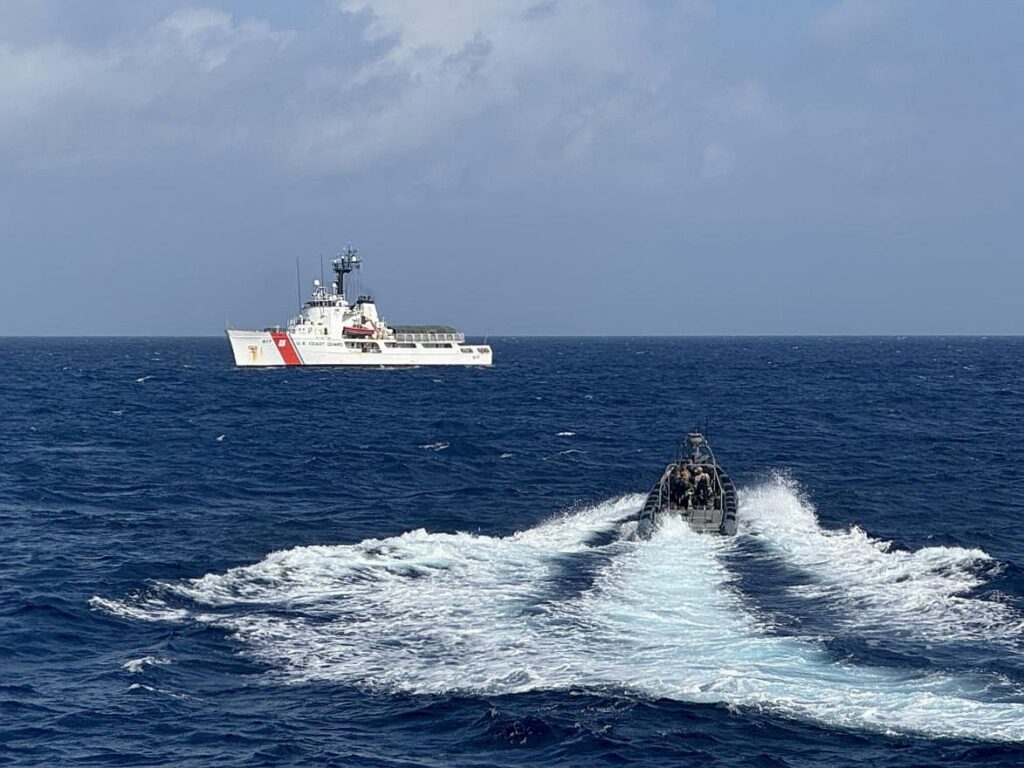
Coast Guard drug chases can run for miles, and they don’t always end how they expect
In a thrilling account of the Coast Guard’s counter-drug operations, Lt. Cmdr. Michael Brooks of USCG TACLET South details the intense and unpredictable nature of drug interdictions at sea. Based in Opa-locka, Florida, the Tactical Law Enforcement Teams (TACLETs) are elite units tasked with intercepting vessels suspected of smuggling drugs into the United States. They often face treacherous conditions, as highlighted by Lt. Matthew Lesyk’s recounting of a high-speed chase through blinding rain and eight-foot waves after a go-fast boat loaded with narcotics. Despite having a clear protocol for boarding suspected drug boats, the reality of these operations can be chaotic, requiring teams to adapt quickly to changing circumstances, such as the behavior of smugglers and the unpredictable nature of the sea.
The challenges faced by TACLETs extend beyond just the weather and sea conditions. The teams must remain vigilant, as smugglers can react violently when approached, and sometimes the contents of the vessels are not what they seem. For instance, maritime enforcement specialist Morgan Fussell shared a bizarre experience where a suspected drug shipment turned out to be bales of sausage instead of narcotics. Such surprises highlight the necessity for flexibility and quick decision-making during these high-stakes missions. The Coast Guard’s focus remains on the safety of both their personnel and the suspected traffickers, with protocols in place to switch to rescue operations if a smuggler jumps overboard in a desperate attempt to escape.
As drug traffickers continuously evolve their tactics, the Coast Guard is also adapting, employing advanced strategies and tools to combat the growing sophistication of smuggling operations. Cmdr. Chris Guy, commanding officer of TACLET South, emphasizes the increasing need for well-trained personnel to meet the challenges of modern drug interdiction. With more drugs being seized at sea than ever before, the Coast Guard is committed to enhancing their capabilities and ensuring that their teams are equipped to handle the complexities of maritime law enforcement. The ongoing battle against drug smuggling remains a critical mission for the Coast Guard, underscoring their dedication to protecting U.S. waters and communities.
TK
Courtesy of Lt. Cmdr. Michael Brooks, USCG TACLET South
Coast Guard personnel have set procedures to follow when they’re boarding suspected drug boats.
Not every interdiction plays out the way they think it will, prompting changes in the moment.
Weather, sea conditions, how smugglers react to being boarded, and the type of vessel all can impact the interdiction.
USCG TACLET SOUTH OPA-LOCKA, Florida — When a go-fast boat loaded with drugs was on the run, elite
Coast Guard
troops weren’t far behind. They’d been chasing this vessel for nearly 50 nautical miles through blinding rain and eight-foot waves, Lt. Matthew Lesyk, officer in charge of Law Enforcement Detachment 404, recalled for Business Insider.
A
Coast Guard helicopter
had spotted the vessel and fired off warning shots, but the Tactical Law Enforcement Team (TACLET) giving chase could barely see anything.
“That reflects how serious and dangerous this job can be,” said Morgan Fussell, an ME3, or maritime law enforcement specialist. It isn’t always smooth seas.
And while there’s a step-by-step process for
drug interdictions
, things don’t always go to plan.
Not every drug interdiction goes smoothly. Drug runners do unexpected things, and sometimes suspected drugs turn out to be something else entirely. Coast Guard crews have to be ready to change their course of action in the moment.
tk
Courtesy of Lt. Cmdr. Michael Brooks, USCG TACLET South
Both Lesyk and Fussell said they’ve mostly boarded “go-fast” vessels with some fishing boats and semi-submersibles. Beyond the latter being slippery and riding low in the water, it’s also possible someone aboard could pull a scuttling valve, quickly sinking it.
At Coast Guard TACLET South, headquartered just outside Miami, these specialists go out on
months-long drug interdiction deployments
. In preparation for the high-stakes counter-drug missions, which require boarding potentially dangerous vessels on the high seas, they go through intense training.
“I’ve trained to the worst scenarios possible so that when we’re out there, if something does go left or right, we’re ready to react and execute that mission,” Lesyk told BI during a recent visit to TACLET South.
The Coast Guard has two TACLETs, one in California and one in Florida. Like the
Coast Guard’s Helicopter Interdiction Squadron
in Jacksonville, Florida, TACLETs are selective and take years to join. Once teams are deployed, their job is to conduct counter-drug operations and enforce maritime law.
“There’s definitely a certain mindset that you need to have in order to execute these missions properly,” Coast Guard maritime law enforcement specialist Morgan Fussell said. There’s a certain flexibility needed should the standard boarding process suddenly go awry.
TK
Courtesy of Lt. Cmdr. Michael Brooks, USCG TACLET South
For TACLETs, the foremost concern during boarding is the safety of their team. If a
Coast Guard member
falls in the water trying to make the initial boarding, a dangerous process in the open ocean, or is threatened by someone aboard the drug vessel, the mission set changes instantly. Important, too, is keeping the suspected traffickers safe. If a smuggler jumps overboard trying to escape, switching to search and rescue mode is key.
Leysk recalled an incident in which an abandoned runaway boat nearly ran over a crewman who had jumped overboard. A marksman in a helicopter shot out the engine at the last minute to keep the man out of harm’s way. TACLETs take similar precautions.
The most difficult part of the boarding process can vary. Sometimes it’s how smugglers react, especially if they’re armed. Sometimes it is just getting aboard an unusual vessel like a narco-sub. The sea conditions and weather can play a role, too.
With the semi-submersible narco-subs,
TACLETs have a tool they bring to pump the water out should the smugglers attempt to sink the vessel. And other boats and safety officers also tag along on the boarding process to keep an eye out and ensure team members are aware of any potential problems.
Once the boarding team has gained control of the target boat, they begin the process of gathering information from the crew, determining the vessel’s origin, and searching for drugs, which can be in barrels or hidden in false bulkheads and fuel tanks.
tk
Courtesy of Lt. Cmdr. Michael Brooks, USCG TACLET South
Fussell told BI that one of the craziest interdictions she’s been on involved opening bales she assumed had drugs in them but turned out to be carrying tons of sausage, not cocaine or marijuana. “The weird part about that was it was packaged like drug packaging,” she said, wrapped up and thrown in bales.
When it comes to expecting the unexpected, sometimes it isn’t drugs. Sometimes it’s sausages.
The boat was headed southbound, which is less suspicious than vessels headed north toward the US from South America. But it still checked enough boxes for reasonable suspicion as the Coast Guard gathered intelligence on it before beginning the standard interdiction process.
TACLET members may engage in a varying number of interdictions during deployments. They may be on a
Coast Guard vessel
, like a cutter, with a primary focus on stopping drug runners, or they could be aboard US Navy or international allied vessels, which means interdictions aren’t always the priority.
TK
Courtesy of Lt. Cmdr. Michael Brooks, USCG TACLET South
Regardless, they continue to adjust to different tactics traffickers turn to get drugs into the US.
“They’re seeking new ways to smuggle contraband at any given time,” Cmdr. Chris Guy, commanding officer of TACLET South, told BI during the recent visit, and “the level of sophistication at times has gone up.”
With more drugs now being
seized at sea
by the Coast Guard than ever, he said, getting the right people to do this mission is becoming more important. “We need more people,” Guy said, “and we want to make sure when our folks go out and conduct the mission, that they’re going to be very best they could be.”
Read the original article on
Business Insider


