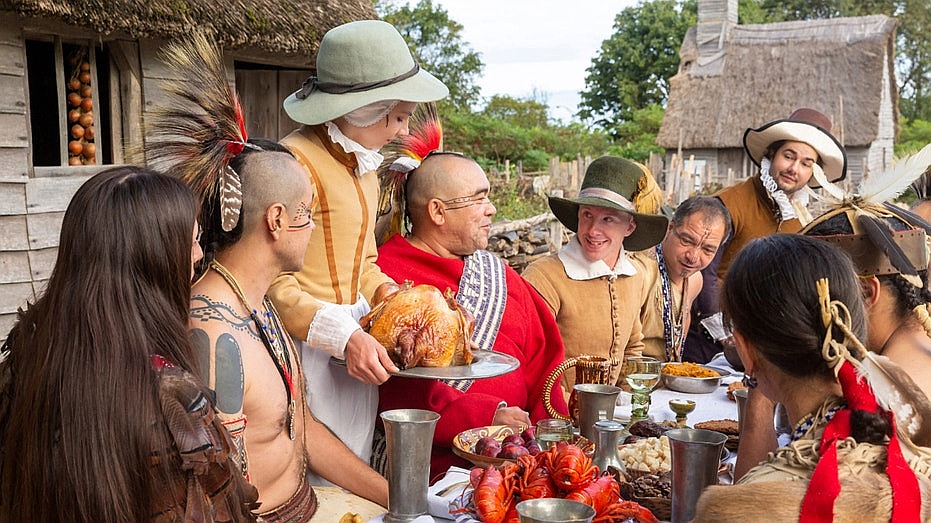
Universities, school districts nationwide call for ‘decolonizing’ Thanksgiving: ‘Day of mourning’
As Thanksgiving approaches, a growing movement among educators and institutions across the United States is prompting a reevaluation of the holiday’s traditional narratives, particularly its colonial roots. Events aimed at “decolonizing Thanksgiving” are being held at various universities, where the focus is shifting towards inclusivity and the acknowledgment of Indigenous perspectives. For instance, the California History-Social Science Project at the University of California, Davis, hosted a Zoom event titled “Decolonizing Thanksgiving in the Classroom.” This initiative encourages educators to rethink their teaching practices and engage students in discussions that center on the perspectives of Indigenous peoples, referred to as Turtle Island by some. The goal is to foster new conversations about the holiday’s meaning and implications, moving beyond the conventional story of Thanksgiving.
In a similar vein, Washington University in St. Louis is promoting events that honor diverse cultural understandings of Thanksgiving, aiming to contribute to systemic change through inclusive practices. Meanwhile, at the Massachusetts Institute of Technology (MIT), students are invited to participate in the “4th annual Thanksgiving Myth-busting” event, which includes discussions about colonialism and its impact on Indigenous communities. This year’s activities even involve attending the National Indigenous Day of Mourning rally in Plymouth, Massachusetts, a symbolic site of the Mayflower’s landing. These initiatives reflect a broader trend in educational institutions to address historical injustices and promote awareness of the ongoing struggles faced by Native American tribes.
Conversely, some critics argue that this approach risks overshadowing the holiday’s spirit of unity and gratitude. Paul Runko, senior director at Defending Education, emphasizes that Thanksgiving should be a time for families to come together and celebrate shared values rather than a platform for division. He points out that the holiday has a long-standing tradition of reflection and gratitude, dating back to President George Washington’s original proclamation. As schools and educators navigate these complex discussions, the challenge remains to honor the diverse narratives surrounding Thanksgiving while fostering a sense of community and togetherness.
As families across the U.S. gather on Thanksgiving to celebrate one of the nation’s most cherished national holidays, some educators and schools are lamenting the day, pushing back on its “colonial” roots, and incorporating diversity, equality and inclusion
DEI
into the holiday.
At the University of California, Davis, the California History-Social Science Project, which describes itself as “Resources & professional learning for K-12 history-social science,”
hosted
a Zoom event called “Decolonizing Thanksgiving in the Classroom.”
“We will discuss reframing classroom practices and rituals about Thanksgiving,” the event description explained. “Centering perspectives from Turtle Island (a name for North America used by some indigenous people) will help us decolonize Thanksgiving and spark new conversations about how to authentically make meaning of this holiday with our students.”
Earlier this month, Washington University in St. Louis, an institution that has
long been criticized
over its DEI policies, put out a press release promoting an event that “highlights and honors the way different cultures recognize and understand Thanksgiving, both as part of their history and as a tradition brought into the present day.”
CLICK HERE FOR MORE CAMPUS RADICALS COAST TO COAST
The event was described as a way to “actively contribute to inclusive and equitable practices that influence individual and systemic change.”
On Tuesday, Massachusetts Institute of Technology students are invited to the “4th annual Thanksgiving Myth-busting” event that is aimed at “continuing our exploration of the narratives justifying land grabs via colonialism” and includes a viewing of the TV show “Buffy the Vampire Slayer.”
Part of that effort, according to the
invitation
, includes students traveling in rental cars to the National Indigenous Day of Mourning (NDOM) rally in Plymouth, Massachusetts, at the location of the Mayflower’s landing.
In a statement, an MIT spokesperson told Fox News Digital the school is closed on Thursday and Friday in honor of Thanksgiving.
“In the same way that individuals are free at MIT to express their views, they are free to observe holidays as they wish, pray as they choose, share their ideas about holidays, and, yes, watch Buffy the Vampire Slayer if that’s what they freely choose to do,” the spokesperson said, adding that “the views expressed by an individual are their own and do not reflect those of MIT or the wider community on campus.”
At the University of Massachusetts, the school referred to Thursday as a “Day of Mourning” in an
announcement
on its Diversity, Equity, Inclusion and Accessibility website.
“The National Day of Mourning is an annual demonstration, held on the fourth Thursday in November, that aims to educate the public about Native Americans in the United States, notably the Wampanoag and other tribes of the Eastern United States; dispel myths surrounding the Thanksgiving story in the United States; and raise awareness toward historical and ongoing struggles facing Native American tribes,” the announcement says.
UNIVERSITY OF MINNESOTA SITE WARNS OF A ‘WHITENESS PANDEMIC,’ URGES WHITE PARENTS TO ‘RE-EDUCATE’
Earlier this month, the University of Maryland School of Public Policy
hosted a talk
called “Harvesting the Truth: Colonial Disruptions of Indigenous Food Systems & the Myths of Thanksgiving.”
Students attending Albuquerque Public Schools in New Mexico were sent a November Indigenous Education
update
explaining that “many native people do not celebrate” Thanksgiving because it is a “reminder of the genocide of millions of Native people, the appropriation of Native lands, and the erasure of Indigenous cultures.”
The school district also referred to
Thanksgiving
as a time of “mourning” for some.
The Berkeley Unified School District in California
also used the term
“mourning” in its “Rethinking Thanksgiving Teaching Guide” while asking the community to consider the “painful legacy” and “nuanced perspectives” of the day.
Paul Runko, senior director of Strategic Initiatives at Defending Education, told Fox News Digital, “Thanksgiving is meant to bring people together, not to divide students or cast blame over heritage. It is an opportunity for students, parents, and teachers to celebrate America, build unity in their communities, and share a meal with family and friends.”
“236 years ago, President George Washington urged Americans to set aside a day to give thanks for the blessings and abundance of our nation. Presidents throughout our history have continued that tradition, reminding us each Thanksgiving to pause and reflect with gratitude.”