PLANETS Units Have Landed – Free NASA-Funded Out-of-School Time Resources
The PLANETS project, spearheaded by Northern Arizona University and supported by NASA, has officially launched three free out-of-school time (OST) educational units aimed at engaging students in grades 3-5 and 6-8 with the wonders of planetary science and engineering. These units—Space Hazards, Water in Extreme Environments, and Remote Sensing—are designed to be both educational and engaging, allowing learners to explore real-world challenges in planetary science. Each unit comes equipped with comprehensive educator guides, instructional videos, and additional resources, ensuring that educators are well-prepared to facilitate the learning experience.
One of the standout features of the PLANETS curriculum is its commitment to inclusivity. The materials have been developed with input from subject matter experts in planetary science and educational professionals, ensuring that they are not only scientifically accurate but also accessible to a diverse range of learners, including multilingual and Indigenous students, as well as those with varying physical abilities. For instance, in the Space Hazards unit, students engage in a card game that teaches them about potential hazards faced by astronauts and robotic probes, while also taking on the challenge of designing a protective space glove. Similarly, the Water in Extreme Environments unit allows students to explore the distribution of water in our solar system and design a water filtration system, highlighting the importance of sustainability in both space and extreme Earth environments.
The Remote Sensing unit immerses students in the role of NASA engineers as they work with real remote sensing data to determine optimal landing sites for Mars rovers. This hands-on approach not only fosters critical thinking and problem-solving skills but also cultivates a sense of curiosity and excitement about science and engineering. As noted by Kara Branch, CEO of Black Girls Do Engineer, the PLANETS units are thoughtfully designed to spark curiosity and build STEM identities among students, making them an invaluable resource for educators looking to inspire the next generation of scientists and engineers. All materials are available for free at planets-stem.org, empowering educators and students alike to explore the universe together.
Explore This Section
Science
Science Activation
PLANETS Units Have Landed –…
Overview
Learning Resources
Science Activation Teams
SME Map
Opportunities
More
Science Activation Stories
Citizen Science
4 min read
PLANETS Units Have Landed – Free NASA-Funded Out-of-School Time Resources
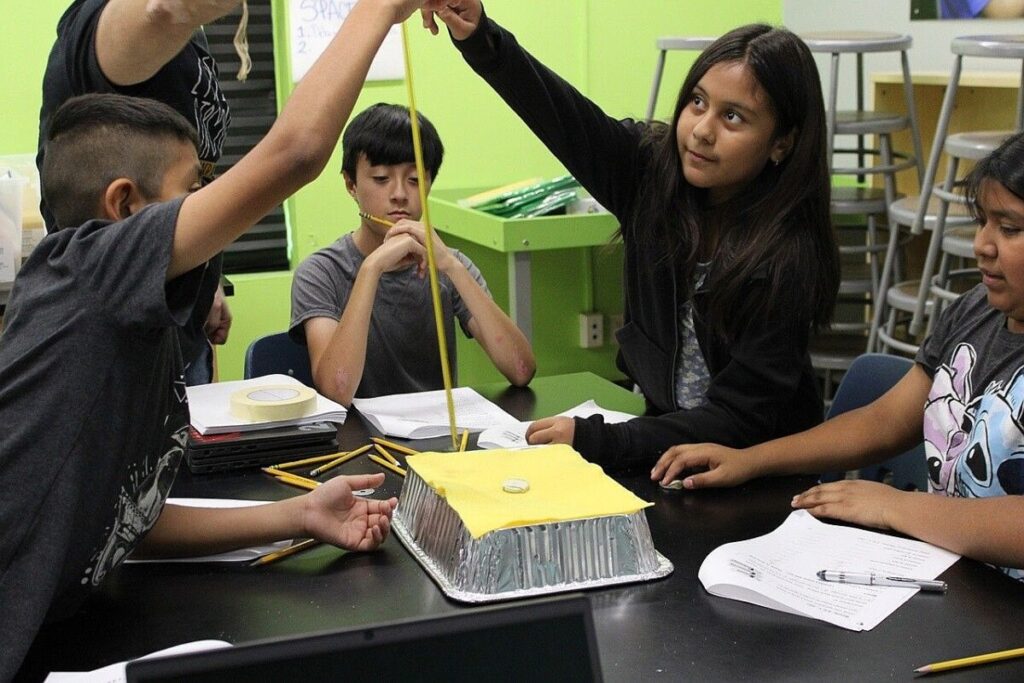
Constructing a three dimensional topographic map from the Remote Sensing Science Pathway.
The NASA Science Activation program’s PLANETS (Planetary Learning that Advances the Nexus of Engineering, Technology, and Science) project, led by Northern Arizona University (NAU), is pleased to announce the official launch of three free out-of-school (OST) time units that give all learners in grades 3-5 and 6-8 the chance to do real planetary science and engineering. These units are supported by comprehensive educator guides, videos, and resources.
These three units – Space Hazards, Water in Extreme Environments, and Remote Sensing – have complementary engineering and science pathways that can be taught on their own or together. Subject matter experts in planetary science from the USGS Astrogeology Science Center were involved in every part of developing the activities, working with STEM (Science, Technology, Engineering, & Mathematics) education experts from Northern Arizona University Center for STEM Teaching & Learning, the Boston Museum of Science, and WestEd to ensure the activities are educational, engaging, and accurate.
PLANETS intentionally designed the units to benefit all learners. The curriculum reflects research-based pedagogical strategies, including those for multilingual learners, Indigenous learners, and learners with differing physical abilities. The units have been tested extensively in out-of-school time programs across the country and revised based on their feedback to ensure the needs of all learners are met. PLANETS provides a practical guide for out-of-school time educators with useful advice to effectively teach all students. All units also include educator background on the subject matter, as well as videos, and many useful tips and links to relevant NASA projects and resources.
“PLANETS is one of the most thoughtfully designed STEM resources I’ve used in an out-of-school setting. The hands-on activities are engaging, accessible, and grounded in real-world challenges that spark curiosity in every learner. What sets it apart is the intentional support for diverse learners and the clear, practical guidance for facilitators—making it truly turnkey for OST educators at any experience level. If you’re looking to build STEM identity, teamwork, and creative problem-solving in your program, PLANETS is a must.” ~ Kara Branch, CEO & Founder, Black Girls Do Engineer
In the Space Hazards unit, intended for learners in grades 3-5, students play a card game to learn about how to protect against the different hazards that people face on Earth and that astronauts and robotic probes face in space. The engineering pathway for this unit presents students with a challenge: design a space glove that will keep astronauts safe while still allowing them to do their work.
The Water in Extreme Environments unit is designed for grades 6-8. In the science pathway, students use planet “water cards” to learn where there is the most water in our solar system (hint: it’s not Earth!). The engineering pathway introduces learners to the scarcity of fresh water, both in extreme environments on Earth and for astronauts in space. Students design a filtration system to purify water for reuse.
The engineering pathway for the Remote sensing unit, also designed for grades 6-8, puts students into the shoes of NASA spacecraft engineers, designing remote sensing devices to learn about the surface of planets, like Mars. The science pathway then uses real NASA remote sensing data from Mars landing site candidates to choose the best place to land a rover on Mars.
All PLANETS materials are available at no cost on the website:
planets-stem.org
. Check them out and empower every learner to see themselves as scientists and engineers.
PLANETS is supported by NASA under cooperative agreement award number NNX16AC53 and is part of NASA’s Science Activation Portfolio. Learn more about how Science Activation connects NASA science experts, real content, and experiences with community leaders to do science in ways that activate minds and promote deeper understanding of our world and beyond:
https://science.nasa.gov/learn/about-science-activation/
.
Share
Details
Last Updated
Nov 26, 2025
Editor
NASA Science Editorial Team
Related Terms
Science Activation
Grades 5 – 8 for Educators
Grades K – 4 for Educators
Planetary Science
Explore More
4 min read
NASA & GLOBE Connect People, Land, and Space
Article
1 day ago
3 min read
New NASA HEAT and My NASA Data Resources Bring Space Weather Science into Classrooms
Article
2 days ago
3 min read
10 Years of Students Helping NASA Grow Space Food with Growing Beyond Earth
Article
5 days ago
Keep Exploring
Discover More Topics From NASA
James Webb Space Telescope
Webb is the premier observatory of the next decade, serving thousands of astronomers worldwide. It studies every phase in the…
Perseverance Rover
This rover and its aerial sidekick were assigned to study the geology of Mars and seek signs of ancient microbial…
Parker Solar Probe
On a mission to “touch the Sun,” NASA’s Parker Solar Probe became the first spacecraft to fly through the corona…
Juno
NASA’s Juno spacecraft entered orbit around Jupiter in 2016, the first explorer to peer below the planet’s dense clouds to…


