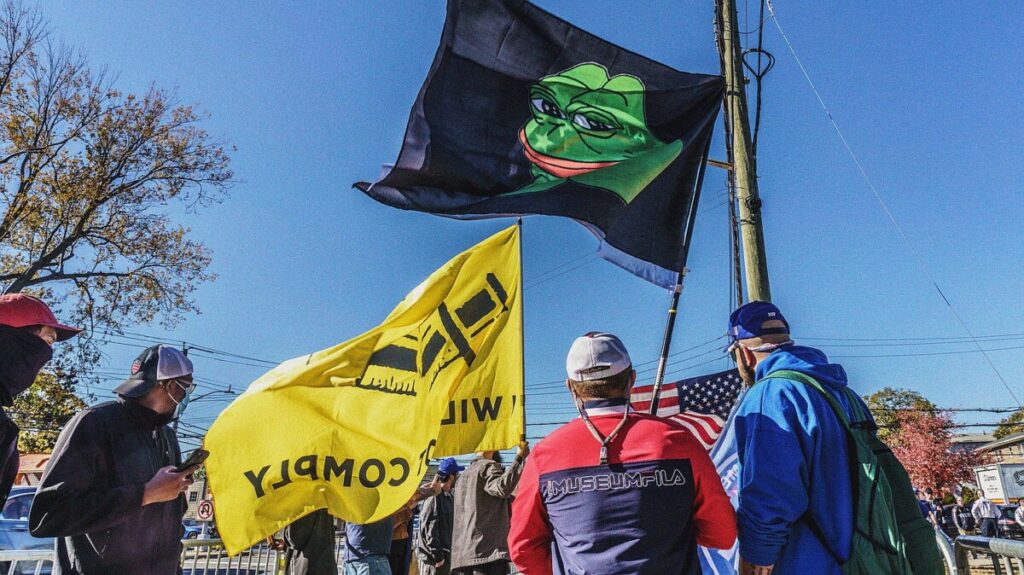
People Are Underestimating America’s Groyper Problem
In recent discussions surrounding anti-Semitism in American political discourse, a striking revelation emerged from Elon Musk’s platform, X (formerly Twitter). The platform’s recent feature exposed the geographical origins of various accounts, leading to a significant discovery: many vocal MAGA influencers decrying government spending on foreign wars were actually operating from countries like Pakistan and Russia. Additionally, accounts sharing images of attractive Israeli soldiers were traced back to India, while poignant narratives about Gazan suffering were found to originate from Europe. This led some commentators to suggest that the anti-Semitism proliferating on the app might be an orchestrated foreign influence rather than a genuine reflection of American attitudes. Eyal Yakoby, a student activist, characterized this phenomenon as a “foreign psyop,” arguing that such accounts were masquerading as American voices to discredit the MAGA movement.
However, this perspective, while comforting, overlooks the reality of domestic anti-Semitism. Research by David Shor highlighted a troubling trend: a significant portion of young Americans now hold unfavorable views toward Jews, a sentiment that has become alarmingly prevalent in recent years. The rise of anti-Semitic rhetoric is not solely a product of foreign interference but is deeply rooted in American society. Notable figures in media and politics have contributed to this environment, with popular podcasts and public figures espousing overtly anti-Semitic conspiracy theories. The tragic events at the Tree of Life synagogue in Pittsburgh and the Jersey City kosher supermarket shooting illustrate that these sentiments have real-world consequences, driven by domestic actors rather than foreign entities.
The underlying causes of this surge in anti-Semitism are complex and multifaceted. As Holocaust memory fades with the passage of generations, and as the conflict in Gaza intensifies, some individuals have resorted to justifying violence against Jews based on their political beliefs. The algorithms of social media platforms often prioritize sensational and inflammatory content, facilitating the spread of hate speech and conspiracy theories. While foreign accounts may amplify these sentiments, they do not create them; rather, they exploit existing divisions within American society. The conclusion is clear: while astroturfed campaigns can distort public discourse, the roots of American anti-Semitism lie within the nation itself. It is imperative for society to recognize and address these issues authentically, rather than attributing them solely to external influences.
https://www.youtube.com/watch?v=tV3OiBjSSVQ
I
s anti-Semitism in American political
discourse actually just a carefully cultivated deception? Over the weekend, Elon Musk’s X revealed the location of every account on the site, and the results were eye-opening. Viral MAGA influencers ranting about “my tax dollars” funding foreign wars were exposed as Pakistani or Russian. Thirst traps of attractive Israeli soldiers turned out to be run by Indians. Heartbreaking stories of Gazan suffering were found to be posted from Europe. And many overtly racist accounts championing Nick Fuentes, the young white supremacist and Hitler aficionado, were revealed to be foreign-run. This discovery led some to suggest that anti-Semitism on the app was in fact an inauthentic intrusion into the American debate with little organic appeal.
[
Read: Elon Musk’s worthless, poisoned hall of mirrors
]
“Groypers are in shambles right now,”
crowed
Eyal Yakoby, a student activist who once testified before Congress about anti-Semitism on college campuses, referring to the supporters of Fuentes. “It’s all a foreign psyop,” he
added
. “Liberals point to these accounts and say, ‘See, here’s the evidence that Trump’s base, the MAGA movement, is racist and anti-Semitic to its core,’” the libertarian journalist Robby Soave
wrote
. “Well, guess what? A substantial number of them are based in the Middle East—Pakistan in particular. They’re not MAGA or America First. They’re cosplaying as America First in order to discredit MAGA.”
The notion that American anti-Semitism is an outside influence operation rather than a homegrown menace is a comforting story. Unfortunately, it’s not true. Fuentes followers punch above their weight in American discourse because they are young and disproportionately online; some foreigners no doubt found this far-right niche useful for generating engagement and revenue. But the rise of American anti-Semitism is not a foreign phenomenon, and it is not an online illusion.
Last year, David Shor, a data scientist who did polling for Kamala Harris’s presidential campaign, surveyed nearly 130,000 voters and
found
that a quarter of young people had an “unfavorable opinion” of Jews—not Israel, Jews—far more than their elders. Today, some of the top podcasts in the country regularly feature overtly anti-Semitic conspiracy content, whether it’s Tucker Carlson
rehabilitating Hitler
, Candace Owens claiming that Israel had a hand in the assassinations of President John F. Kennedy and Charlie Kirk, or Joe Rogan hosting a conspiracy theorist who fulminated about how a “giant group of Jewish billionaires is running a sex-trafficking operation targeting American politicians and business people.”
And it’s not just words. When far-right activists, including a college student named Nick Fuentes, marched in Charlottesville, Virginia, in 2017 and chanted “Jews will not replace us,” that wasn’t a foreign psyop. When a white supremacist
animated
by that same fear—that conniving Jews were replacing the white race through mass migration—massacred worshippers at Pittsburgh’s Tree of Life synagogue in 2018, he wasn’t taking cues from abroad. Neither were the Black nationalists who
shot up
a Jersey City kosher supermarket in 2019, nor the anti-Israel assassins this past year who
attempted to incinerate
Pennsylvania Governor Josh Shapiro and murdered three people, including a young Jewish woman allegedly
shot in the back
in Washington, D.C., and an 82-year-old
burned to death
in Boulder, Colorado.
The reasons for this anti-Jewish eruption are manifold.
Holocaust memory
has attenuated with the passing of older generations. Outrage over Israel’s war in Gaza has led some self-styled Palestinian partisans to perpetrate or justify attacks on Jews thousands of miles away. Social-media platforms lowered the barriers to spreading anti-Semitic invective, allowing bigots to find and amplify one another more easily. Algorithms often
privilege
novel inflammatory content—including conspiracy theories—over careful, factual reporting. Sites such as X no longer pretend to moderate this material, not that they ever
did much to impede it
in the first place.
The upshot is this: Whether anti-Semitic content comes from America or abroad, the supply is simply rising to meet demand. Viral Groyper content only goes viral in the first place because it appeals to Americans who share the sentiment. Outside spending and propaganda cannot manufacture what isn’t already there.
[
Read: The anti-Semitic revolution on the American right
]
Consider an analogy: In 2022, the Democratic Party
spent millions
to boost pro–Donald Trump primary candidates who denied the outcome of the 2020 presidential election. The strategy succeeded—many of these extreme candidates won their primary, only to be
defeated
by Democrats in the general election. Some Republicans
groused
about Democrats interfering in their party’s processes to promote weaker contenders, but the complaints were copes—a way to avoid blaming their own voters. After all, the Democrats didn’t lie to Republican voters about the election deniers. They simply hyped up extreme candidates—and the GOP-primary electorate liked what it heard. Foreign Groyper accounts, like those election-denying candidates, are merely marketing lies that many people are already predisposed to accept.
To be clear, astroturfed campaigns can and do distort discourse and stoke conflict. For the online marketplace of ideas to function, users need to know what’s authentic and what’s inauthentic, what’s foreign and what’s domestic. X’s location update was a small but salutary step in that direction. But no one should fool themselves into thinking that American pathologies—including anti-Semitism—are primarily paid propaganda. Foreign actors may exploit our divisions, but they don’t create them. They can fan the flames, but they didn’t start the fire. We did that ourselves—and we will have to put it out.


