New NASA images confirm comet 3I/ATLAS is not aliens
NASA has unveiled the most detailed images yet of the interstellar comet 3I/ATLAS, a celestial traveler that is currently making its way through our solar system. This remarkable comet, discovered by the Asteroid Terrestrial-impact Last Alert System (ATLAS) on July 1, is only the third known interstellar object observed in our solar system. During a press conference on November 19, NASA officials confirmed that 3I/ATLAS poses no threat to Earth and dismissed conspiracy theories suggesting it might be an alien spacecraft. Dr. Tom Statler, the lead scientist for solar system small bodies, expressed the awe that this discovery inspires, stating, “It expanded people’s brains to think about how magical the universe could be.”
The images released by NASA were captured by various spacecraft, including the James Webb Space Telescope, Hubble Space Telescope, and the MAVEN spacecraft, providing a comprehensive view of the comet as it speeds through space at an astonishing 130,000 miles per hour. Notably, one image reveals the comet as a bright, fuzzy orb, while another showcases its halo of gas and dust, known as a coma, which is produced as sunlight heats the comet’s icy nucleus, turning water ice into vapor. This process not only contributes to the comet’s visual spectacle but also results in the release of hydrogen and oxygen atoms into space. As 3I/ATLAS approaches the sun, its coma brightens, leading to earlier reports of color changes that were later clarified by astronomers to reflect the comet’s true nature.
3I/ATLAS is not just a fleeting visitor; it offers a glimpse into the cosmic past, with scientists theorizing that it may have originated from a distant solar system. As the comet continues its journey, NASA is set to utilize the James Webb Space Telescope as a primary tool for further study. With its closest approach to the sun occurring on October 30, 2025, and a proximity of 19 million miles to Mars, 3I/ATLAS presents a unique opportunity to deepen our understanding of interstellar objects. As Nicky Fox, associate administrator for the Science Mission Directorate, noted, the comet serves as a “window into the deep past,” reminding us of the wonders and mysteries that the universe holds.
Today,
NASA
released the most detailed images yet of
3I/ATLAS
. The comet is currently traveling through the cosmos and only the third known interstellar object observed in our solar system. During a press conference on November 19, NASA confirmed the icy rock poses no danger to Earth, and
contrary to certain conspiracy theories
, is not an alien spacecraft.
“It expanded people’s brains to think about how magical the universe could be,” said
Dr. Tom Statler
, lead scientist for solar system small bodies, during the livestream announcement.
Several NASA spacecraft including the
James Webb Space Telescope
(JWST), Hubble Space Telescope, and LUCY all imaged the interstellar visitor as it travels through our solar system. A sample of the images are listed below.
(Click to expand images to full screen.)
This image shows the 3I/ATLAS interstellar comet as a bright, fuzzy orb in the center. Traveling through our solar system at 130,000 miles (209,000 kilometers) per hour, 3I/ATLAS was made visible by using a series of colorized stacked images from Sept. 11-25, using the Heliocentric Imager-1 (H1) instrument, a visible-light imager on the STEREO-A (Solar Terrestrial Relations Observatory) spacecraft. The colorization was applied to differentiate the image from other observing spacecraft images.
Image: NASA/Lowell Observatory/Qicheng Zhang.
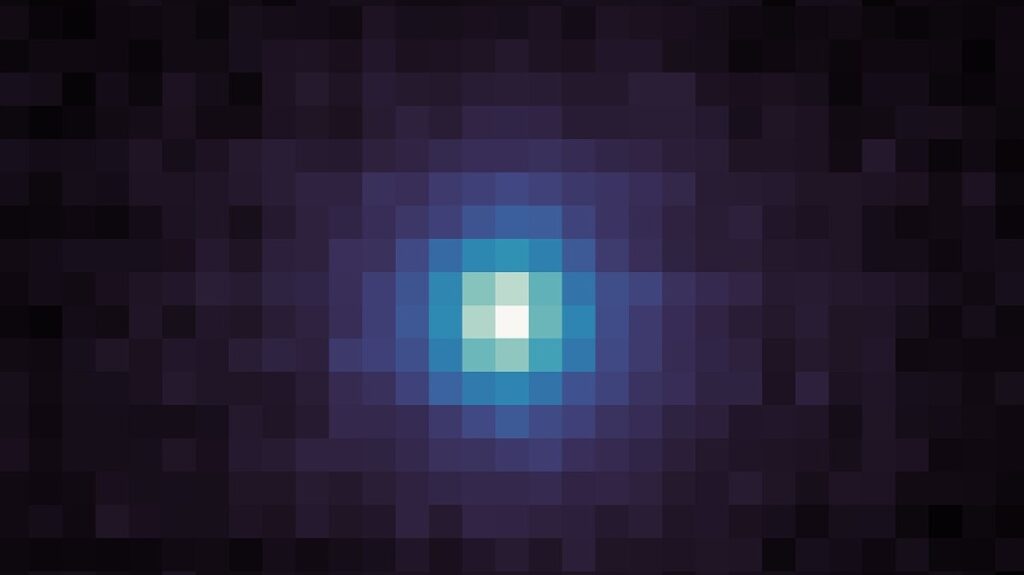
This image shows the halo of gas and dust, or coma, surrounding comet 3I/ATLAS, the third interstellar object ever detected by astronomers as it passes through our solar system. The image was taken on Oct. 9, 2025, by an instrument onboard NASA’s MAVEN spacecraft, which has been studying Mars from its orbit since 2014. The instrument, the Imaging Ultraviolet Spectrograph, takes pictures in the ultraviolet part of the spectrum to reveal the chemical composition of objects. The center of the image has the brightest pixel, indicating where the comet is. The next brightest shades in the image indicate areas where the instrument detected atoms of hydrogen coming from the comet. This hydrogen is released when sunlight heats the comet, causing its water ice to turn directly into vapor. Once released into space, the water molecules break apart into oxygen and hydrogen atoms.
Image: NASA/Goddard/LASP/CU Boulder
Comet 3I/ATLAS appears as a bright object near the center of this image, made from combining observations from NASA’s PUNCH mission taken from Sept. 20 to Oct. 3, 2025, when the comet was about 231 million to 235 million miles from Earth. Its tail appears as a short elongation to the right. Stars appear as streaks in the background.
Image: NASA/Southwest Research Institute
.
The High Resolution Imaging Science Experiment (HiRISE) camera aboard NASA’s Mars Reconnaissance Orbiter captured this image of interstellar comet 3I/ATLAS on Oct. 2, 2025. At the time it was imaged, the comet was about 0.2 astronomical units (19 million miles, or 30 million kilometers) from the spacecraft. NASA/JPL-Caltech/University of Arizona
[ Related:
Scientists finally solve the mystery of why comets glow green
. ]
The speedy Comet 3I/ATLAS was discovered by the Asteroid Terrestrial-impact Last Alert System (ATLAS) observatory on
July 1
. Currently, it is only the third object ever identified as entering our solar system from elsewhere in the galaxy. The space rock doesn’t pose any known threat to Earth and will
not get any closer than 170 million miles away
. However, it only flew within 19 million miles of Mars in October.
When 3I/ATLAS was first discovered, it was traveling at about 137,000 miles per hour. As it was pulled by the sun’s gravity, the comet’s speed increased to about 153,000 miles per hour when it made its closest approach to the sun on October 30. While it skirted by the sun, three spacecraft had the chance to document the ancient, icy cosmic rock. These include the Mars Atmosphere and Volatile EvolutioN (MAVEN) spacecraft, which provided a composite gas spectrum image depicting what NASA officials called “science wiggles” emanating from the comet.
The Hubble Space Telescope captured this image of the interstellar comet 3I/ATLAS on July 21, 2025, when the comet was 277 million miles from Earth. Hubble shows that the comet has a teardrop-shaped cocoon of dust coming off its solid, icy nucleus. This image was not included in the new batch.
Image: NASA, ESA, David Jewitt (UCLA); Image Processing: Joseph DePasquale (STScI).
As far as physical features, NASA says 3I/ATLAS has speed, color, and direction that are, “consistent with what we’d expect from a comet.” It has an icy nucleus and a coma—a bright cloud of gas and dust that surrounds the comet. That coma is emitted at increasing rates as the comet approaches the sun.
Earlier this month,
conspiracy theories and misinformation about the comet changing color
spread online. Multiple outlets asserted 3I/ATLAS had suddenly, and perhaps inexplicably, changed in appearance. Earlier observations indicated that 3I/ATLAS appeared red in color, but additional analysis led astronomers to note in a
preprint study
it’s actually “distinctly bluer than the sun.” Study co-author Qicheng Zhang at Arizona’s Lowell Observatory asserted that there is
no evidence of the gas coma changing color
. 3I/ATLAS only “changed color” when the coma brightened as it zoomed closer to the sun.
The interstellar comet 3I/ATLAS, circled in the center, as seen by the L’LORRI panchromatic, or black-and-white, imager on NASA’s Lucy spacecraft. This image was made by stacking a series of images taken on Sept. 16, 2025, as the comet was zooming toward Mars. Lucy was 240 million miles away from 3I/ATLAS at the time making its way to explore eight asteroids that share an orbit with Jupiter. The L’LORRI imager captured the comet’s coma, the fuzzy halo of gas and dust surrounding 3I/ATLAS above, and its tail, a smudge of gas flowing to the right of the comet. This image spans about 11 arcminutes of sky, or roughly one-third the width of the full Moon. Solar system north is up.
Image: NASA/Goddard/SwRI/JHU-APL
NASA is still waiting on more data from ongoing satellite and space probe downlinks, but can already surmise some incredible details about the comet. Based on circumstantial evidence such as observed speed, experts theorize 3I/ATLAS possibly originated from a distant solar system much older than our own. While this will be the comet’s only pass through our solar system, Science Mission Directorate associate administrator Nicky Fox explained that the James Webb Space Telescope will become the primary tool to study 3I/ATLAS as it heads back into the depths of interstellar space.
“It expanded people’s brains to think about how magical the universe could be,” added Statler. “It gives me goosebumps to think about, honestly… It’s a window into the deep past.”
The post
New NASA images confirm comet 3I/ATLAS is not aliens
appeared first on
Popular Science
.


