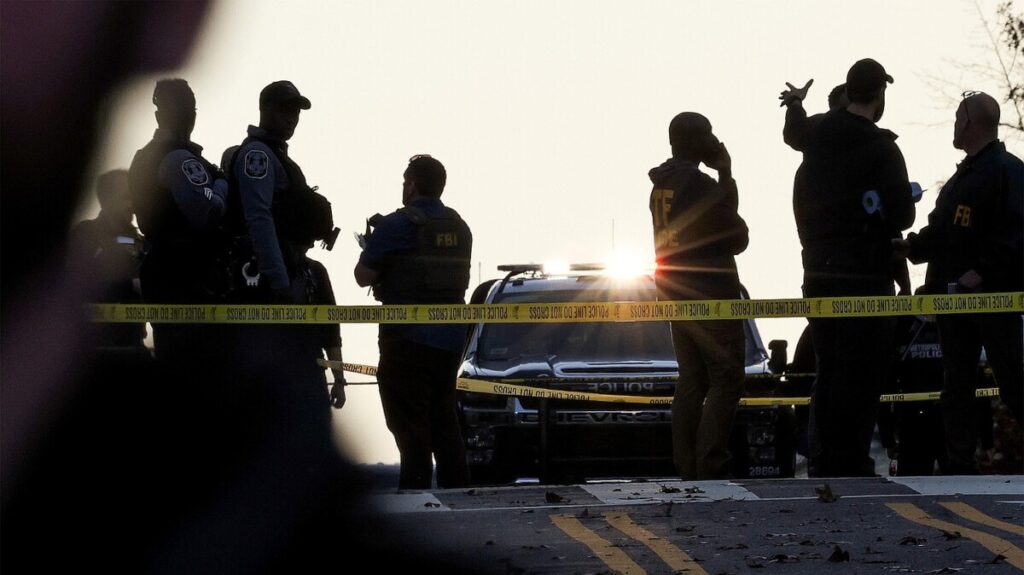
A Tragic Shooting in D.C.
In a shocking incident near the White House this afternoon, two West Virginia National Guardsmen were shot in the head, leaving both in critical condition. The assailant, identified as Rahmanullah Lakanwal, a recent Afghan immigrant who entered the United States following the Taliban’s return to power in 2021, has been taken into custody. Early reports from CBS News indicate that Lakanwal was wheeled into an ambulance in a state of undress, raising questions about his mental state and the circumstances surrounding the attack. As authorities investigate the motive behind this senseless act, speculation runs rampant, though it is essential to approach such discussions with caution. The question of “why shoot a stranger in the head?” highlights the complexity of human behavior and the dangers of projecting personal narratives onto violent acts.
The political ramifications of this shooting are already being felt, with notable responses from media figures and government officials. Jane Mayer of The New Yorker criticized the deployment of National Guardsmen to the streets of Washington, labeling it a “political show” and questioning the potential costs associated with such actions. The White House’s response to Mayer’s commentary was swift and aggressive, branding her a “sick, disgusting ghoul.” This exchange underscores the charged political atmosphere surrounding the deployment of military personnel in domestic settings, particularly in light of recent court rulings deeming such actions illegal. While Mayer did not condone the attack, her remarks suggest that the presence of Guardsmen may have inadvertently escalated tensions, leading to tragic outcomes.
As the investigation unfolds, the lack of clear motive raises further concerns. No statements from Lakanwal at the time of the attack have been reported, and authorities have yet to provide insight into his reasoning. The absence of any political or ideological declarations during the shooting suggests that Lakanwal’s actions may stem from a disordered mindset rather than coherent political beliefs. This incident serves as a grim reminder of the unpredictability of violence and the complex interplay between mental health, immigration, and political discourse. Until more information emerges, the tragic shooting remains a stark illustration of the dangers faced by those in uniform and the unpredictable nature of violent acts in today’s society.
This afternoon, blocks from the White House, a man sneaked up on two West Virginia National Guardsmen and shot them in the head with a handgun. Both soldiers are reportedly in critical condition. A motive has not been determined, but a recent Afghan immigrant named Rahmanullah Lakanwal is in custody, according to
CBS News
. Early photos of the suspect show a burly, bearded man being wheeled almost naked into an ambulance. Lakanwal entered the United States after the return of the Taliban in 2021, CBS reported.
The desire to speculate about motive is only human, but speculators beware:
Why shoot a stranger in the head?
is a trick question, and often reveals more about the thoughts of the one who answers it than of the one about whom it is asked. There is, of course,
no
reason to shoot a stranger. But some people, when they hear a gunshot, instinctively project their own view of the situation onto the mind of the apparent assailant.
After today’s shooting,
The New Yorker
’s Jane Mayer
called
the Trump administration’s deployment of National Guardsmen to the streets of Washington a “political show” and asked “at what cost” this deployment was taking place. The White House social-media team
called
Mayer a “sick, disgusting ghoul” (oh, for the days when “Jane, you ignorant slut” was a
joke
rather than a plausible script for actual government press releases), as if she had implied that killing soldiers was a reasonable response to the illegality or stupidity of deploying them. Mayer’s original post did not, of course, defend the attack, but it made the trivial claim that if the deployment hadn’t happened, the Guardsmen would not be dead now. The decision to deploy troops to the District of Columbia (to combat crime and disorder, Donald Trump said, though courts have recently declared such a deployment illegal) may be right or wrong, but its rectitude does not depend on whether a random guy tries to kill two of the soldiers with a handgun.
Of course, facts might emerge that establish a clear motive, one that would relieve reporters of the peril of speculation. But even the absence of facts may suggest hints about the nature of the motive for this apparently senseless crime. When the absence of these details becomes prolonged, certain inferences become more plausible. No published reports yet suggest that the alleged assailant said anything when he attacked—no leftist slogans, no jihadist chants, no mentions of a favorite or least favorite U.S. war. He must not be explaining himself all that comprehensibly in captivity either. If he were, authorities could have said something by now about his reasoning or perhaps have just said, as they sometimes do, that “the suspect is talking.” That line and its variations remain absent from reports.
What little we know about the man is that he thought the best way to advance his interests was to walk up to a couple of soldiers, about as close as he could get to the White House, and try to kill them. This modus operandi is, all by itself, an indication of an unwell mind, if only because there is nothing one could wish to accomplish in the world that would not be better accomplished by doing something else. Someone who chooses such disordered means should be expected to be acting in service of equally disordered ends. The most surprising outcome to this bloody afternoon would be if it turned out that the assailant had been reading
The New Yorker
and agreed with Jane Mayer about the Trump administration’s undermining of the rule of law.
More likely, this alleged assailant is yet another case of a man motivated more by spleen than by brain. Coherent politics are, as always, an elite preoccupation, and more surprising when present than when absent.


