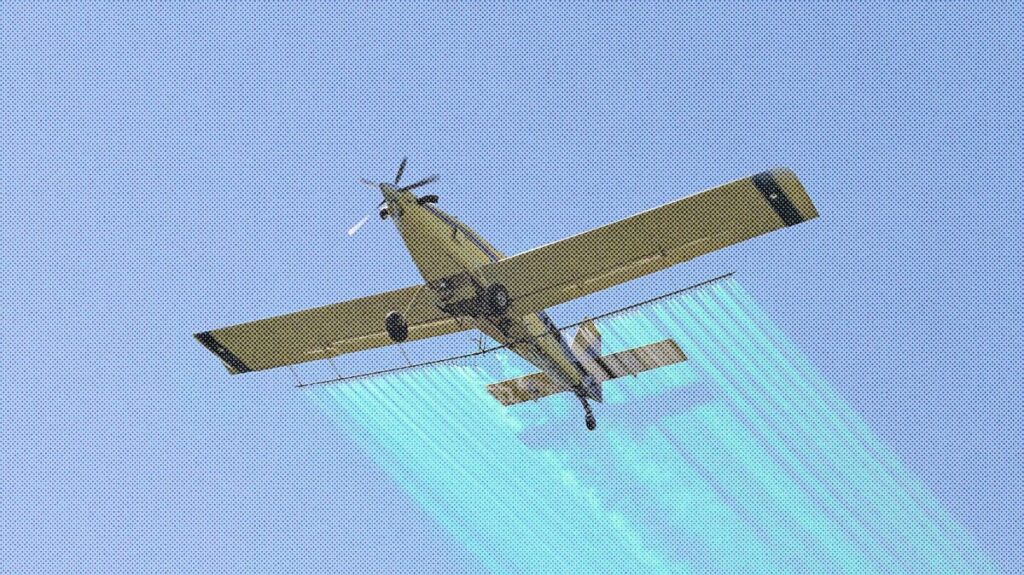
Who’s Ready to Think About Blocking Out the Sun?
The debate surrounding geoengineering—deliberately manipulating the Earth’s climate to counteract global warming—has intensified, shifting from skepticism to a more nuanced discussion among scientists and policymakers. A recent study published in *Frontiers in Science* brought together over 40 experts who expressed concerns about the feasibility and potential dangers of geoengineering, particularly techniques like spraying reflective aerosols into the atmosphere. They warned that such methods could lead to significant unintended consequences, including altered weather patterns and stratospheric heating. Historically, geoengineering has been viewed with suspicion, often associated with dystopian narratives in science fiction, such as Bong Joon Ho’s *Snowpiercer* and Kim Stanley Robinson’s *The Ministry for the Future*, which portray the catastrophic fallout from misguided climate interventions. Yet, as climate change predictions worsen and hopes for rapid emissions reductions fade, a growing number of scientists are advocating for more research into these controversial technologies.
This shift in perspective is underscored by the reality of climate change’s progression, leading figures like Philip Duffy, former science adviser in the Biden administration, to highlight the urgency of exploring geoengineering as part of a broader climate strategy. With traditional mitigation efforts struggling to keep pace with rising emissions, there is an emerging consensus that some form of geoengineering may need to be considered as a potential tool for adaptation. Notably, high-profile figures such as Bill Gates and Elon Musk have expressed support for advancing geoengineering research, emphasizing the importance of understanding these technologies rather than deploying them hastily. However, the political landscape remains complex and polarized. While some states have begun to enact legislation against geoengineering research, citing ethical and safety concerns, others, particularly in developing nations, are actively pursuing research into solar-radiation management.
The current climate discourse reflects a critical juncture in how society approaches the dual challenges of climate change and technological intervention. As the urgency for effective solutions mounts, the historical resistance to geoengineering is being re-evaluated, paralleling past debates over climate adaptation strategies. Just as funding for adaptation infrastructure has gained acceptance over time, there is a possibility that geoengineering could follow a similar trajectory, moving from a fringe idea to a legitimate aspect of climate policy. Nevertheless, the potential risks and ethical implications of geoengineering remain significant, necessitating careful examination and public discourse. The call for more research is not an endorsement of immediate action but rather an acknowledgment of the need to explore all possible avenues to address the climate crisis effectively. As the world grapples with these challenges, the conversation around geoengineering is likely to evolve, demanding a balance between innovation and caution.
https://www.youtube.com/watch?v=l0If2UyK5ao
For years, the idea of geoengineering—artificially lowering global temperatures through technological means—has been met with skepticism. Only a handful of dedicated and much-criticized scientists have argued for researching it at all, and when others weighed in, it was generally to trash the idea. This September, in a
study
published in the journal
Frontiers in Science
, more than 40 experts in climate change, polar geosciences, and ocean patterns warned that geoengineering was extremely unlikely to work and likely to have dangerous consequences. Spraying reflective aerosols into the atmosphere to deflect the sun’s heat, could, for instance, “cause stratospheric heating, which may alter atmospheric circulation patterns, leading to wintertime warming over northern Eurasia,” they wrote.
Science fiction has more vividly imagined how humanity might try to reverse climate change and make a mess of it. This is the stuff of Bong Joon Ho’s
Snowpiercer
, in which a failed geoengineering experiment has rendered the planet uninhabitably cold, and Kim Stanley Robinson’s
The Ministry for the Future
, in which the Indian government decides to unilaterally geoengineer the climate after a heat wave roasts millions of its citizens to death. In Robinson’s telling, though, the problem is not geoengineering itself but the risk humans might hastily deploy such technology to manipulate our atmosphere, before we have studied it enough to fully understand what it might do.
As the actual predictions for Earth’s future have become more dire, scientists are starting to agree. More than 120 of them signed on to a response to the
Frontiers
paper that argued that more research into geoengineering was, in fact, “urgently needed.”
“Within the scientific community, I don’t think there’s any question that there’s growing support for the research, just driven by the reality that climate change is progressing,” Philip Duffy, the former top science adviser in the Biden administration, told me. “There’s a very strong realization now that some amount of overshoot is inevitable, and that mitigation alone can’t fix this.” Hopes of cutting emissions quickly enough to limit the dangers of climate change are fading: This year’s United Nations climate summit concluded over the weekend with a final statement that avoided any mention of fossil fuels, in what was widely hailed as a victory for oil and gas producers. If the world cannot drastically, quickly overhaul global energy and agricultural systems before the planet reaches irreversible tipping points, then what?
In theory, geoengineering could mean brightening marine clouds, or encouraging heat to bounce back into space by mirroring light off polar ice. The term has also been used to describe technology that removes carbon from the atmosphere, which is now widely accepted as a necessary tool to limit global warming. The most vexing technology is what’s broadly referred to as solar-radiation management—those reflective aerosols that could prevent the sun’s heat from reaching the Earth.
After years of being treated as
fringe notions
, all of these ideas are gaining traction. The billionaire Peter Thiel has backed geoengineering work. Elon Musk has expressed his support for start-ups pursuing the technology. One Silicon Valley-backed company, Make Sunsets, went as far as carrying out a rogue experiment in Baja California in 2022. Left-wing environmental circles have long criticized even researching these technologies; now some activists (
who see
climate change as its own form of unintentional geoengineering) argue that geoengineering technologies are a way of reversing capitalism’s climate sins. U.S.-government labs have been
actively investigating
what it would mean to pour sulfur dioxide into the Arctic atmosphere. Stardust Solutions, an Israeli-U.S. start-up that wants to commercialize reflective-aerosol technology, recently
raised $60 million
; the company’s aim, CEO Yanai Yedvab told me, is to give governments the information they need to weigh whether to deploy this technology. Bill Gates
has publicly been arguing
that the climate movement should worry less about emissions goals and more about improving life in a hotter future; at a private lunch I attended last month, he said that dramatic tools such as geoengineering technologies would be good to have “in the arsenal” of climate adaptations.
Like most geoengineering supporters, Gates meant only that we should understand these tools better. More research, after all, would not guarantee deployment. Virtually no advocates are publicly arguing for deploying geoengineering at present; they are arguing only for publicly funded (and therefore publicly accountable) programs.
But at the same moment that scientific and business leaders are softening to the idea of geoengineering, the political opposition in the U.S. is growing. “The politics are wildly bipolar,” Craig Segall, a senior adviser to the Federation of American Scientists and a former top lawyer at the California Air Resources Board, told me. In recent years, he himself has embraced the need to research geoengineering, but he has also watched opponents on both ends of the political spectrum dig in. On the left, the most extreme thinkers argue that the world should be talking only about mitigating emissions—that the solution to climate change is dramatically scaling back energy production. On the right, a contingent of MAGA leaders have become vocal adversaries to geoengineering research and are using it to feed conspiracy theories about government manipulation of the atmosphere.
On Dr. Phil’s show in April, for instance, a young woman asked Robert F. Kennedy Jr., the secretary of health and human services, about the familiar conspiracy theory that the condensation trails of airplanes contain mind-altering chemicals designed to sicken or control the American people. The so-called chemtrails theory emerged in the 1990s on internet forums and late-night radio, where amateur sleuths presented the idea and used scientists’ rebuttals as evidence of how deep the conspiracy went. Rather than challenge the idea, Kennedy suggested that it was, in fact, a campaign carried out by the U.S. military’s Defense Advanced Research Projects Agency.
“That is not happening in my agency. We don’t do that. It’s done, we think, by DARPA,” he said, before explaining that the chemicals that the woman had mentioned—bromium, aluminum, strontium—might be coming from jet fuel. He promised to “do everything in my power to stop it,” adding that “we’re bringing on somebody who’s gonna think only about that, find out who’s doing that and hold them accountable.” (Kennedy did not respond to my request for comment.)
In July, after deadly floods in Texas killed more than 130 people, Fox News
aired an interview
in which the chief executive of Rainmaker, a start-up aiming to seed clouds, was asked whether its experiments had spurred the floods. (This notion has been widely debunked.) Few geoengineering experts consider cloud-seeding to be geoengineering; it’s now commonly used in drought-parched places such as Dubai and the Tibetan Plateau as part of China’s efforts to ensure the continued flow of glacial water. But Representative Marjorie Taylor Greene soon piled on. Two months after the floods, the Georgia Republican
held a hearing
, called “Playing God With the Weather,” that conflated weather modification with geoengineering.
These public officials are responding to a broader movement. In 2020, Children’s Health Defense, the anti-vaccine group founded by Kennedy,
called
geoengineering research “a template for both hubris, hypocrisy and risk.” President Donald Trump’s ex-wife Marla Maples has become a prominent activist against both vaccines and geoengineering. Nicole Shanahan, the Silicon Valley lawyer who was Kennedy’s running mate in the 2024 presidential election, has said geoengineering should be “a crime.”
On the left, Craig Segall told me, the opposition to geoengineering has been mostly moral signaling. But on the right, millions of dollars are going toward blocking geoengineering before it ever starts in earnest. More than two dozen states have introduced legislation, mainly sponsored by Republicans, to block any geoengineering efforts. Bills have passed into law in at least two states,
Tennessee
and
Florida
.
Elsewhere in the world, the situation looks different. In a talk at the Paris Peace Forum last month, Ghanaian Foreign Minister Samuel Ablakwa hailed the research into solar-radiation management currently under way in Malaysia, Mexico, South Africa, and his own country. Developing countries, he said, must be “active architects of our own future.” China’s geoengineering efforts are still nascent, but John Moore, a scientist at the University of Lapland, in Finland, who has advised China’s research into geoengineering, told me that if Beijing does “decide to prioritize it, it will get done.” In other words, our world is looking more and more like the one Kim Stanley Robinson imagined, in which some country decides to try altering the atmosphere.
There’s an analogue for the moment we’re in now. Back in the early 2000s, many climate activists vocally opposed funding adaptation infrastructure—sea walls, raised streets, and other measures meant to mitigate the impacts of a changing climate. They argued that these undertakings would prove ineffective and, worse, would remove the will to decrease emissions. More than two decades later, emissions are still rising, and the cost of adapting to climate change has mounted by the billions each year. Now virtually no serious people involved in climate policy still oppose adaptation funding.
It’s easy to imagine a similar scenario playing out with geoengineering, which essentially amounts to a particularly potent and large-scale tool for adaptation. The arguments that scientists still make against geoengineering follow much the same logic as those against sea walls: In the
Frontiers
paper, the authors wrote that geoengineering technologies offered “false hope,” and risked sapping the will to address greenhouse gas pollution. They’re right that would-be geoengineers cannot guarantee that their ideas will work or that the intended benefits will outweigh the negative side effects. The barriers to exploring the possibilities of these technologies are rising, arguably more on the right than the left. But short of just going for it, the only way to find out how helpful or dangerous geoengineering might be is to let people ask.


