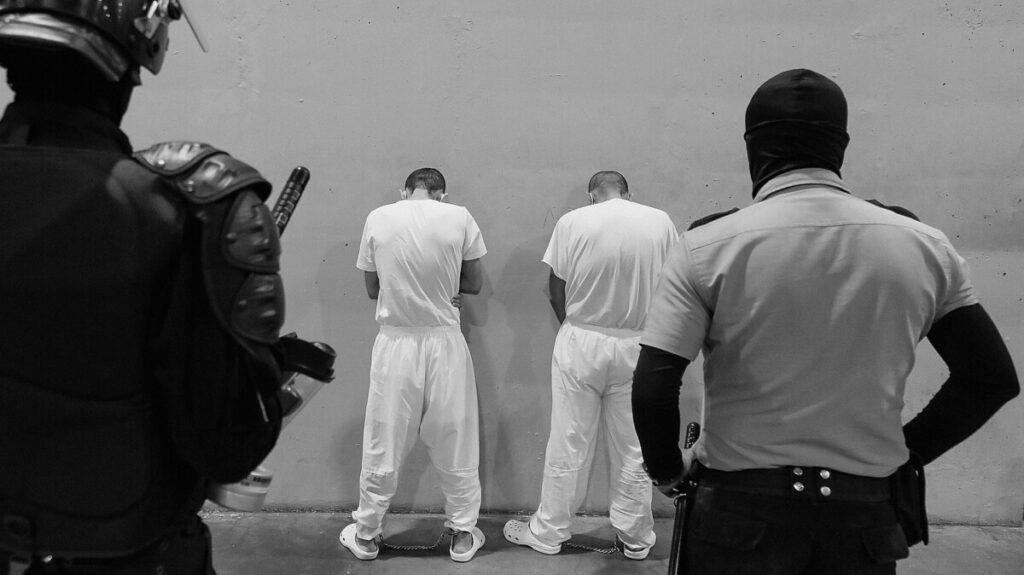
What the Deported Venezuelans Went Through in El Salvador
In a troubling revelation, a report by Human Rights Watch and Cristosal has unveiled the horrific treatment endured by 252 Venezuelan deportees sent to El Salvador by the United States earlier this year. The deportees were transferred to the Centro de Confinamiento del Terrorismo (CECOT), a facility notorious for its inhumane conditions, where they faced severe physical abuse, psychological torture, and sexual violence. Despite warnings about the human rights violations prevalent in El Salvador’s prison system, the U.S. government went ahead with the deportation, even providing El Salvador with nearly $4.76 million to facilitate the imprisonment of these individuals. The report, titled “‘You Have Arrived in Hell’: Torture and Other Abuses Against Venezuelans in El Salvador’s Mega Prison,” draws on firsthand accounts from 40 former detainees, corroborated by forensic evidence and testimonies from relatives and legal representatives.
The findings paint a grim picture of life inside CECOT, where detainees reported being subjected to brutal beatings upon arrival, with many claiming they were treated as criminals despite being noncriminal migrants fleeing political persecution and poverty in Venezuela. Testimonies reveal that guards inflicted daily violence, including physical assaults and sexual abuse. One detainee described the prison conditions as “filthy,” with mold, urine-stained floors, and contaminated water, while others recounted being beaten for seeking medical attention. This systematic abuse raises serious questions about the complicity of the U.S. government in these human rights violations, particularly under the Trump administration, which has been criticized for its harsh immigration policies and disregard for international human rights standards.
As calls for accountability grow, the report highlights the need for a congressional inquiry into the U.S. government’s role in these abuses. Questions remain regarding who authorized the transfer of these detainees and whether the Trump administration violated the Leahy Law, which prohibits U.S. assistance to foreign security forces implicated in gross human rights violations. While the issue is politically sensitive, it transcends party lines; both Republican and Democratic leaders have a responsibility to investigate these allegations. The treatment of these Venezuelan deportees should serve as a wake-up call to American voters and policymakers alike, emphasizing that human rights should remain a paramount concern in U.S. foreign policy and immigration practices.
https://www.youtube.com/watch?v=V9PNnaAhRmA
Sign up for our
newsletter about national security
here
.
Earlier this year, the United States deported 252 Venezuelans to El Salvador and paid its government to imprison them, despite
clear evidence
of human-rights abuses in the country’s prison system and
forceful
warnings
that the men would suffer
cruel and unusual treatment
. Now two human-rights organizations, Human Rights Watch and the Central America–based Cristosal, have found that
all
of those men were physically abused.
Citing prisoner testimony, their report claims that the men were held in filthy cells, psychologically tortured, and given fetid water to drink, and that guards sexually violated at least three of them. Titled “‘
You Have Arrived in Hell’
: Torture and Other Abuses Against Venezuelans in El Salvador’s Mega Prison,” the report draws on interviews with 40 of the Venezuelans who were held at the Centro de Confinamiento del Terrorismo, or CECOT, and echoes the
findings
of
New York Times
interviews with former prisoners. The researchers who produced the report vetted the detainees’ accounts with corroborating information from fellow prisoners, as well as with lawyers, relatives, and forensic experts who examined photographs of their injuries (including a crooked nose, a missing front tooth, and two enduring marks left by rubber-coated bullets). If even a fraction of the allegations are true, the U.S. is complicit in sadistic acts that our own laws forbid.
The Trump administration has characterized the CECOT prisoners as
gang members
, but the report finds that many of them were noncriminal migrants and people who’d fled Venezuela because of political persecution or poverty. In the men’s telling, the abuses inflicted on them began before they even saw their cells. “Meters before the entrance, riot police and guards forced the new arrivals to run a gauntlet of prison guards, who beat them with batons, fists, and kicks as they entered,” the report states. One detainee, sharing a representative account, said, “My ribs hurt, they beat me in the abdomen, on the elbows, on the ankles, in the back.” For roughly four months, all of the former prisoners who were interviewed suffered “serious physical and psychological abuse on a virtually daily basis,” the report states, until they were released in a prisoner exchange with Venezuela. (El Salvador’s government and the White House did not respond to a request for comment from Human Rights Watch. A White House spokesperson, Abigail Jackson, told the
Times
in response to its reporting: “President Trump is committed to keeping his promises to the American people by removing dangerous criminal and terrorist illegal aliens who pose a threat to the American public.”)
The details ought to haunt every Trump-administration official who consigned these men to a place unfit for humans. A man identified as Julián G. described the facility: “There was mold, the floor was black and sticky, the toilets were filthy, it smelled of urine, and the water we had in the tanks—used both for bathing and for drinking—was yellow and had worms.” A man identified as Mario J., one of three detainees who claims to have been sexually violated, said that four guards stuck batons between his legs and rubbed them against his genitals, then “forced him to perform oral sex on one of the guards, groped him, and called him ‘faggot.’”
Other detainees recounted being beaten for seeking medical care. One man, identified as Carlos J., reportedly complained for days of severe pain in his ears. Taken to the infirmary, he was told by staff that he had “an infection and pus in both ears” but was given no antibiotics, he said. When he kept asking for medication, “four guards took him out of the cell, brought him to the hallway and beat him for several minutes in the back, stomach, and legs,” according to J.’s testimony. He told interviewers that “they beat me until I vomited blood” and then locked him in a punishment cell for days.
Meanwhile, both
the Trump administration
and
Salvadoran authorities
refused to release information on the detainees, needlessly subjecting their loved ones to fears that they were dead. The United States government did not merely transfer the prisoners to this fate. Its secretive arrangement with El Salvador included a payment of
$4.76 million
from the State Department, the report says. In that respect, what the regime of
Nayib Bukele
—who has referred to himself as “the coolest dictator in the world”—predictably did to the prisoners was underwritten by U.S. taxpayers.
At the very least, a congressional inquiry is warranted to corroborate or disprove claims that taxpayer dollars underwrote beatings, psychological torture, and sexual assault. But the GOP-led Congress has so far been unwilling to conduct adequate oversight of Donald Trump on morally urgent matters. In the 2026 midterms, in primaries, and in general-election contests, candidates should prove to voters that they are willing to probe the following questions:
How many people
sent to El Salvador
by the U.S. government were tortured, sexually assaulted, or physically abused?
Who within the White House and the Department of Homeland Security green-lighted the transfer of detainees to El Salvador? What did they know about human-rights abuses in El Salvador’s prison system, and when did they know it?
Did the Trump administration violate
the Leahy Law
, statutory provisions “prohibiting the U.S. Government from using funds for assistance to units of foreign security forces where there is credible information implicating that unit in the commission of gross violations of human rights”?
What are the details of the financial arrangement between the Trump administration and the Bukele regime?
This needn’t be a partisan matter. The Republicans who control Congress could investigate all of these questions now. But most GOP members of Congress fear crossing Trump. Politically, they are probably right to fear the president more than the electorate on this, because alleged human-rights abuses of foreign nationals don’t factor into most voters’ decisions. But if enough voters insist that this is unacceptable, perhaps leaders will get the message that this depravity is un-American.


