Trump pushes peace in Europe, pressure in the Americas — inside the two-front gamble
In a striking juxtaposition of U.S. foreign policy, Washington is simultaneously pursuing peace in Europe while ramping up military actions in the Western Hemisphere, particularly regarding Venezuela. As the U.S. seeks to negotiate an end to the ongoing conflict in Ukraine, it is intensifying its stance against Nicolás Maduro’s regime in Venezuela by designating the military-linked Cartel de los Soles as a terrorist organization. This move coincides with a significant increase in U.S. military presence in the Caribbean, with the USS Gerald R. Ford, the world’s largest aircraft carrier, heading toward the region. Reports suggest that President Trump has authorized covert CIA operations within Venezuela, potentially laying the groundwork for direct military strikes against cartel targets, which could aim to destabilize Maduro’s government.
This military buildup is not without context. The U.S. aims to diminish Russian influence in Latin America, where Venezuela has long served as a strategic ally for Moscow. Recent intelligence has indicated that Russian military advisers, including Colonel General Oleg Makarevich, have been reassigned to oversee training for Venezuelan forces, although experts suggest that Russia is unlikely to engage militarily with the U.S. due to its preoccupation with the ongoing war in Ukraine. Analysts note that while the U.S. has a vested interest in removing Maduro—viewed as a linchpin for Russian, Chinese, and Iranian influence in the region—there are concerns that the U.S. strategy may not be as coordinated as it appears. Some experts argue that the current escalation in Venezuela and peace overtures in Europe may be more coincidental than part of a unified strategy, highlighting the complexities of U.S. foreign policy in a rapidly changing geopolitical landscape.
As the U.S. prepares for potential military action, the stakes are high. Observers predict that strikes could occur between Thanksgiving and Christmas, driven by Trump’s impatience with Maduro’s attempts to stall negotiations. The situation is further complicated by Russia’s limited capacity to respond militarily in the Western Hemisphere, which is constrained by its commitments in Ukraine. While the U.S. seeks to stabilize one front in Europe, it must also brace for possible confrontation closer to home, embodying the paradox of its dual approach in late 2025: pursuing de-escalation abroad while preparing for potential conflict in its own backyard.
https://www.youtube.com/watch?v=S2aB1qGBcBQ
In one corner of the world, the U.S. is trying to end a war. In another, it may be preparing to start one.
While Washington pushes proposals aimed at easing Russia’s terms for a cease-fire with Ukraine in Europe, it’s taking a far tougher stance in
the Western Hemisphere
— moving to label Venezuela’s military-linked Cartel de los Soles a terrorist organization and quietly expanding its military footprint in the Caribbean.
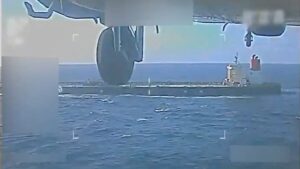
Sporadic strikes on alleged cartel boats off Venezuela’s coast have grown into the largest U.S. military presence in Southern Command’s area in a generation, with the world’s biggest aircraft carrier, the USS Gerald R. Ford, steaming toward the Caribbean Sea. President
Donald Trump
has reportedly approved CIA covert measures inside Venezuela — operations that often precede military force — and U.S. planners have already drawn up target lists for cartel sites, according to
The New York Times
.
Many believe the U.S. could soon launch direct strikes on Venezuelan territory aimed at pushing Nicolás Maduro out of power.
TRUMP’S STRIKE ON CARTEL VESSEL OFF VENEZUELA SENDS WARNING TO MADURO: ‘NO SANCTUARY’
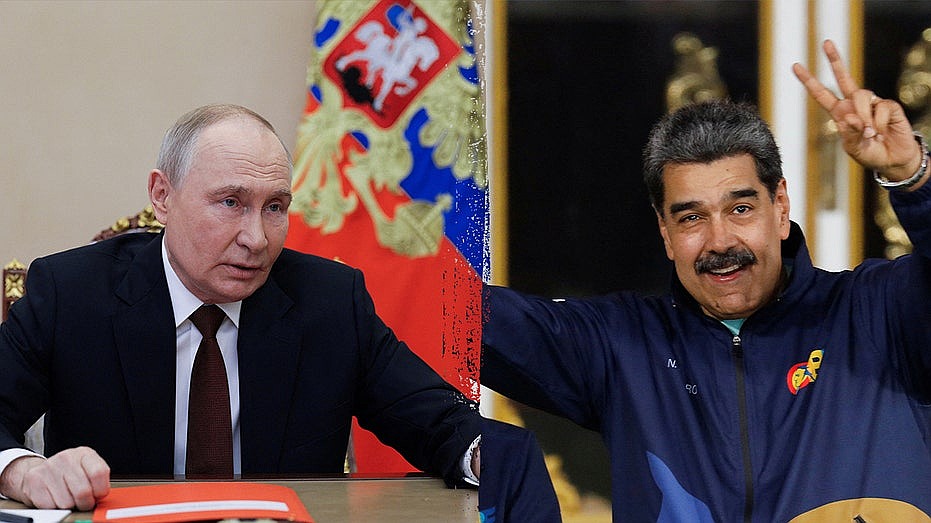
At the same time, a top Russian commander, Colonel General Oleg Makarevich, has been reassigned from the Ukrainian front to head Russia’s Equator Task Force
in Venezuela
, overseeing roughly 120 troops training Venezuelan forces, Ukrainian intelligence chief Lt. Gen. Kyrylo Budanov
told The War Zone
. Fox News Digital has not independently verified Budanov’s claim.
Seth Krummrich, a retired U.S. Army colonel and vice president at Global Guardian, said Russian military advisers are indeed operating inside Venezuela but doubted Moscow would back Maduro militarily. “They’re there, full stop,” Krummrich said. “But Russia needs to stop the massive blood-letting of its young men in Ukraine. They’re not going to go toe-to-toe with us militarily.” He added that the relationship is long-standing: “There is a long history of Russian military advisers in Cuba and in Venezuela that goes on for decades.”
Many in Washington see a strategic payoff in forcing out Maduro: it would strip Russia of its last firm foothold in the Western Hemisphere — a loss comparable, in some analysts’ view, to Moscow’s waning influence in Syria. “Venezuela, for the longest time, has been a launch pad for Chinese, Russian, and Iranian influence in the Western Hemisphere,” Krummrich said. “These chess pieces are all tied together when you arch your great-power competition.”
Other experts caution against assuming the U.S. escalation in Venezuela and its peace overtures in Europe are part of a single coordinated plan. Ryan Berg, director of the Americas Program at the Center for Strategic and International Studies (CSIS), spoke with Fox News Digital and said any overlap may be more coincidence than strategy.
“We’ve been zigging and zagging in Venezuela,” Berg said. “Trump has gone back and forth between build-ups and calls for dialogue, while the Russia timeline has only recently become parallel to these events. Anything that looks coordinated is likely coincidence.”
Berg recalled that during Trump’s first administration, some advisers floated an “Ukraine-for-Venezuela” concept — asking Russia to relinquish its stake in Caracas in exchange for U.S. concessions in Eastern Europe — but the idea was quickly abandoned. “Russian power in Venezuela is important,” Berg said, “but it’s not so overwhelming that it’s the reason Maduro survives.”
HOW TRUMP’S STRIKES AGAINST ALLEGED NARCO-TERRORISTS ARE RESHAPING THE CARTEL BATTLEFIELD: ‘ONE-WAY TICKET’
Russia’s footprint in Latin America has grown only modestly since the early 2000s, dwarfed by China’s economic expansion. Moscow’s closest partners remain Cuba, Venezuela, and Nicaragua. Beyond them, its influence is exercised mainly through media and selective economic pressure.
“If you look at Russia’s trade profile with the region, it’s small,” Berg said. “But Moscow is very good at using those few trade points for leverage.”
He cited examples: when Ecuador considered sending old Russian-made equipment to Ukraine in exchange for U.S. military aid, Russia threatened to block Ecuadorian banana exports — nearly $1 billion annually — by imposing new phytosanitary checks. The deal collapsed within a week.
Similarly, Moscow has kept Brazil and Argentina largely muted on the Ukraine invasion by leveraging its control over nitrate fertilizer exports, crucial to both agricultural giants. “They use whatever levers they have — bananas, fertilizer, spare parts — to coerce quietly,” Berg said.
Russia also continues to service aging equipment across the region. “They sell a lot of kit here,” Berg added. “Many countries still operate Russian-origin systems that need maintenance and parts. That creates dependency.”
If U.S. forces strike Venezuelan targets, most observers expect Russia to limit its response to intelligence sharing and disinformation, not combat support. “The Russians are pretty tied down in Ukraine,” Berg said. “We saw during the 12-day war, when Iran appealed for help, Moscow stayed silent. They simply don’t have the capacity.”
Berg described a recent episode in which a sanctioned Ilyushin cargo plane landed in Caracas. Russian lawmakers briefly claimed it carried air-defense systems and technicians to assist Maduro, but Foreign Minister Sergei Lavrov later denied it. “He essentially said, ‘We have no mutual-defense treaty,’” Berg noted. “That was widely read as: we’re not coming to Venezuela.”
John Hardie, deputy director of the Russia Program at the Foundation for Defense of Democracies, also spoke with Fox News Digital and said there is little evidence of a coordinated link between the U.S. buildup in the Caribbean and Washington’s peace overtures in Europe. “I don’t see any immediate connection,” Hardie said. “Russia’s ability to influence events in Venezuela is pretty limited.”
He said Moscow’s power-projection capacity in the Western Hemisphere remains constrained. “They can take limited action — fly some bombers into the region, sail submarines to Cuba — but major operations in Latin America are beyond their capacity,” Hardie said.
Hardie also noted reports of the Russian Ilyushin transport aircraft visiting Venezuela and suggestions it could have carried air-defense systems, but said any such transfer would have little strategic effect. “Even if Russia slipped in some air defenses, it wouldn’t make much difference,” he said. “The Venezuelan military would still be heavily overmatched by the United States.”
Both Krummrich and Berg agree that momentum is building toward U.S. kinetic action. Berg said indications point to possible strikes between Thanksgiving and Christmas, as U.S. naval and intelligence assets align and Trump signals impatience with Maduro’s attempts to stall.
“Maduro’s instinct is to buy time — that’s what’s kept him afloat through multiple administrations,” Berg said. “But Trump wants results, not a two-year transition or vague promises about U.S. oil access. The question is what Maduro can offer that will actually satisfy him.”
Whether this two-track moment represents coincidence or coordination, the stakes are high. A peace framework in Europe could stabilize one front while a new flashpoint ignites closer to home — underscoring the paradox of Washington’s posture in late 2025: seeking de-escalation abroad while bracing for confrontation in its own hemisphere.