Red Spider Nebula
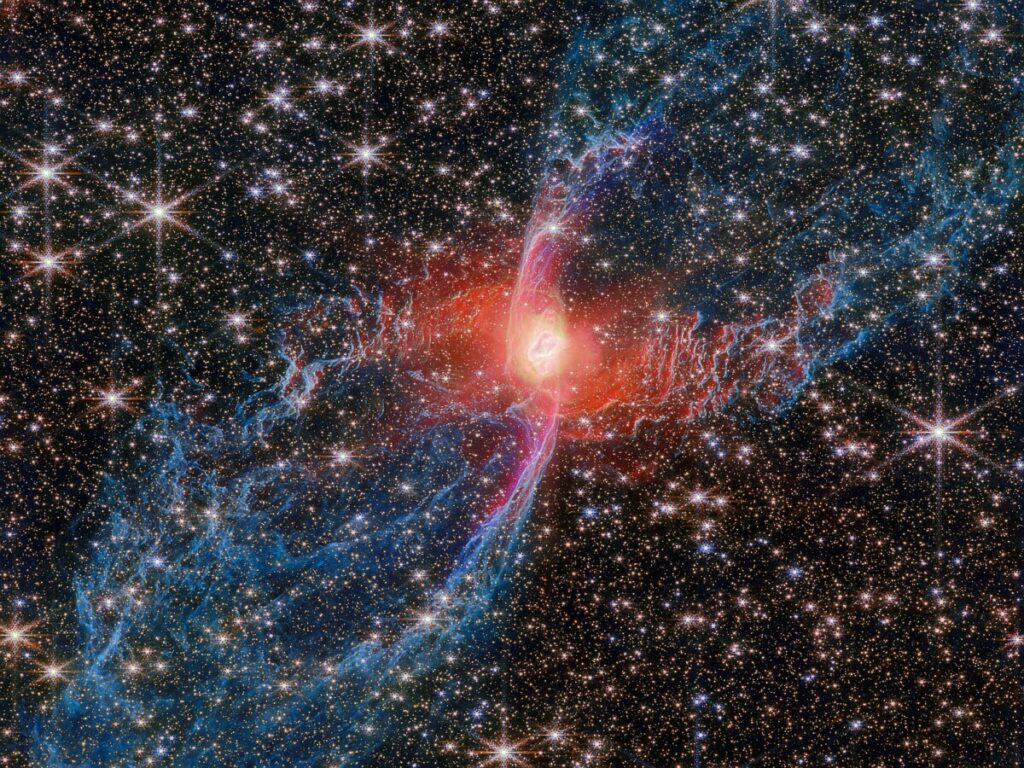
NASA’s James Webb Space Telescope (JWST) has unveiled stunning new details of the Red Spider Nebula, a planetary nebula located approximately 3,000 light-years away in the constellation of Scorpius. Utilizing its advanced Near-InfraRed Camera (NIRCam), Webb captured an unprecedented image that showcases the nebula’s intricate structure, revealing the full extent of its characteristic outstretched lobes, which resemble the legs of a spider. Released on October 26, 2025, this image marks a significant milestone in our understanding of nebulae and the processes that shape them. NIRCam, known for its high-resolution imaging capabilities, allows astronomers to observe celestial phenomena in extraordinary detail, providing valuable insights into the life cycles of stars and the dynamics of interstellar gas and dust.
The newly released image highlights the nebula’s lobes, which are depicted in striking blue hues. These lobes are traced by light emitted from H2 molecules, which consist of two hydrogen atoms bonded together. Each lobe extends approximately 3 light-years from the nebula’s center, showcasing their impressive scale. The lobes are not just visually captivating; they are the result of gas outflows from the nebula’s core, which have inflated these bubble-like structures over thousands of years. This dynamic process illustrates the complex interactions that occur in the life cycle of stars, particularly in the later stages of their evolution when they shed their outer layers to form planetary nebulae. The Red Spider Nebula serves as a fascinating example of how stellar death can lead to the creation of stunning cosmic structures that continue to intrigue astronomers and space enthusiasts alike.
The JWST’s observations of the Red Spider Nebula contribute to a broader understanding of planetary nebulae, which play a crucial role in the recycling of materials in the universe. As these nebulae disperse their enriched gas into the interstellar medium, they provide the building blocks for new stars and planets. This research not only enhances our knowledge of stellar evolution but also underscores the importance of advanced telescopes like the JWST in exploring the cosmos. As scientists continue to analyze this remarkable data, they hope to uncover more secrets about the formation, structure, and evolution of such nebulae, ultimately shedding light on the intricate tapestry of the universe.
ESA/Webb, NASA & CSA, J. H. Kastner (Rochester Institute of Technology)
Using its
Near-InfraRed Camera
(NIRCam), NASA’s James Webb Space Telescope captured never-before-seen details of the Red Spider Nebula, a planetary nebula, in this image
released on Oct. 26, 2025
. NIRCam is Webb’s primary near-infrared imager, providing high-resolution imaging and spectroscopy for a wide variety of investigations.
Webb’s new view of the Red Spider Nebula reveals for the first time the full extent of the nebula’s outstretched lobes, which form the ‘legs’ of the spider. These lobes, shown in blue, are traced by light emitted from H2 molecules, which contain two hydrogen atoms bonded together. Stretching over the entirety of NIRCam’s field of view, these lobes are shown to be closed, bubble-like structures that each extend about 3 light-years. Outflowing gas from the center of the nebula has inflated these massive bubbles over thousands of years.
Image credit: ESA/Webb, NASA & CSA, J. H. Kastner (Rochester Institute of Technology)


