John Fetterman is an unusual politician – but his rise from borough mayor to US senator reflects a recent trend
On November 10, 2025, U.S. Senator John Fetterman of Pennsylvania made headlines by voting to end a federal government shutdown, showcasing his distinctive approach to politics that diverges from traditional norms. Fetterman, who has cultivated a political persona as an “anti-politician,” is known for his casual attire, willingness to cross party lines, and candid discussions about his struggles with mental health. His recent memoir, “Unfettered,” reflects this authenticity, focusing more on his personal battles with depression than on his political achievements. This unconventional narrative aligns with Fetterman’s rise from the mayor of Braddock, a small borough with a population of under 2,000, to the U.S. Senate, a journey that highlights a broader trend of mayors from small and midsized cities gaining national prominence.
Fetterman’s ascent is emblematic of a significant shift in American politics over the past few years, where local leaders are increasingly stepping onto the national stage. This trend, which has roots in the political and economic transformations of the 1990s, illustrates how mayors, particularly from Rust Belt communities, are leveraging their local experiences to address national issues. Fetterman’s tenure as mayor of Braddock saw him tackle the challenges of poverty and unemployment head-on, implementing initiatives such as community centers and urban farms. His story resonates with many, echoing the experiences of other prominent figures like Cory Booker and Pete Buttigieg, who also transitioned from local governance to higher political office. These leaders have successfully articulated their personal narratives against the backdrop of deindustrialization and its impacts on their communities, thus bringing a unique perspective to national discussions.
The emergence of mayors as viable candidates for significant political roles reflects a changing political landscape, particularly as suburbanization and polarization reshape American society. Midsized cities, often caught between urban liberalism and rural conservatism, provide fertile ground for leaders like Fetterman, who can address pressing social issues while maintaining a nonpartisan appeal. As the political climate evolves, it is anticipated that the trend of local leaders rising to national prominence will continue, especially in the upcoming 2028 Democratic primaries. Fetterman’s journey not only represents his personal narrative but also signifies a broader movement within American politics, where grassroots leadership is increasingly seen as a pathway to higher office.
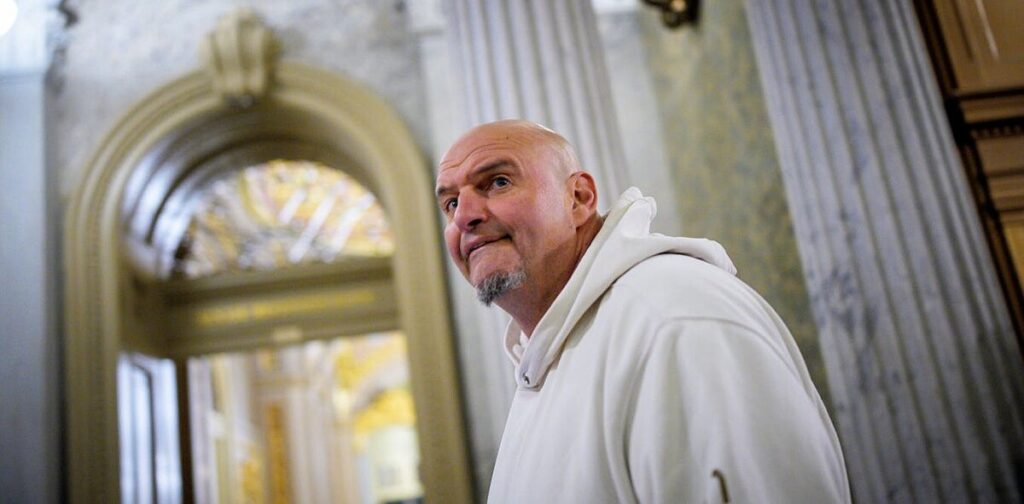
U.S. Sen. John Fetterman arrives on Capitol Hill on Nov. 10, 2025, to vote to open the government.
Andrew Harnik via Getty Images
Pennsylvania Sen. John Fetterman – among the eight Democrats who
voted to end the federal government shutdown
– has always been a unique character and a sly self-promoter.
His political brand is that of an anti-politician. It’s reflected in his
ultracasual wardrobe
, his willingness – and even eagerness – to vote and express opinions
across party lines
, and his stated
inability to socialize or glad-hand
.
John Fetterman’s memoir was released in November 2025.
Penguin Random House
Even his new book,
“Unfettered,”
is
not your typical political memoir
, and thus is entirely on-brand for Fetterman. Most political memoirs are written to advance the politician’s career. Fetterman’s, however, discusses his dissatisfaction with Congress and spends far more time on his battles with depression than his role as a senator.
As
a politics professor who studies Philadelphia and Pennsylvania
, I find that one of the most unique things about Fetterman is his political rise from mayor of Braddock, Pennsylvania – a small borough outside Pittsburgh with fewer than 2,000 residents – to the U.S. Senate.
And yet, while this sort of political leap is highly unusual, it also reflects a recent trend in American politics. Over the past five years, more mayors of small and midsized cities have developed national political profiles in a way they hadn’t before.
It’s a phenomenon that has roots in suburbanization and 1990s-era political trends, and it’s one we will likely see again in 2028, at least among Democrats.
A view of a steel plant in Braddock, Pa.
Jeff Swensen via Getty Images
From small town to Senate chambers
Boroughs are the smallest form of municipality in Pennsylvania, and there are
more than 950 of them
in the state. The office of borough mayor is so insignificant that in Braddock, it came with a small stipend instead of a salary.
Yet after holding that obscure position for a decade, Fetterman mounted a credible campaign to be the Democratic candidate for a U.S. Senate seat in 2016. He fell short but captured
nearly 20% of the primary vote
against three other candidates.
In 2018, Fetterman was
elected Pennsylvania lieutenant governor
, and then in 2022, he ran again for the Senate. He beat Conor Lamb
by a landslide
in the Democratic primary and then
squeaked out a victory
against Republican candidate Dr. Mehmet Oz.
It may seem incredible that someone could jump from being a borough mayor to lieutenant governor and then U.S. senator. But other politicians over the past decade have used their positions as mayors of small-to-midsized cities to run for national office, including the U.S. presidency.
Cory Booker, for instance, was elected mayor of Newark, New Jersey, in 2006; U.S. senator in 2013; and briefly ran for the Democratic presidential nomination in 2020.
Booker was joined in the early race to be the Democratic presidential nominee by Pete Buttigieg, who was elected mayor of South Bend, Indiana, in 2011; and Wayne Messam, who was elected mayor of Miramar, Florida, in 2015.
The 2020 presidential primaries also included some big-city mayors like then-New York Mayor Bill DeBlasio and his immediate predecessor, Mike Bloomberg. Eric Garcetti, mayor of Los Angeles at the time, was apparently also
considering a presidential run in 2020
.
‘Mayor Pete’ Buttigieg speaks to a supporter at a Polish holiday celebration in South Bend, Ind., in 2019.
Kamil Krzaczynski/AFP via Getty Images
By contrast, before 2020, a grand total of
13 people who had ever served as a mayor later ran for president
. Only Grover Cleveland and Calvin Coolidge were successful.
Of course, Fetterman has never run for president, but then, few mayors ever run for U.S. Senate either. As Booker noted in his 2017 memoir,
“United,”
he was, in 2013, the 1,949th person to ever be sworn in as a U.S. senator, but “only the 21st person since 1789 to ascend directly from mayor to Senator.”
Free trade and fractured bonds
How did this trend start? I trace it back to the eight years of the Clinton presidency, from 1993 to 2001, and more specifically, the
North American Free Trade Agreement
that went into effect in 1994 and the Clinton administration’s focus on community and civil society.
NAFTA was a treaty signed by the U.S., Mexico and Canada agreeing to lift tariffs and other barriers to trade. It had bipartisan support, but it was also politically divisive, especially with labor unions, historically a key pillar of the Democratic Party, which did not want to see manufacturers move their operations to Mexico to take advantage of lower labor costs.
NAFTA is often blamed for, among other things, the
“hollowing out” of U.S. communities in the Rust Belt
that stretches from the Northeast to the Upper Midwest states that surround the Great Lakes. In this vast area, there are thousands of small and midsized towns and cities, many of which depended on single industries like paper milling or auto parts manufacturing. Once those businesses relocated, residents found themselves unemployed, underemployed and stranded in increasingly poorer towns.
At the same time, President Bill Clinton convened a series of
seminars on American democracy and community
at Camp David and the White House. He invited some of the country’s most prominent “communitarian” intellectuals to glean policy and speech ideas from them. He also established the AmeriCorps program, which expanded and provided support for various civic-oriented volunteer opportunities.
Of the mayors who developed national political profiles in the 2010s, arguably the most successful were Booker, Buttigieg and Fetterman. All three came from Rust Belt communities that had suffered severely from the deindustrialization that many residents and analysts of various stripes blamed on NAFTA, and all three spoke effectively about their personal experience with it in their communities.
Each mayor was also able to tell stories about personal interactions and interventions in their cities that spoke to the sense of a lost community that came to define the turn of the 21st century. The hardest evidence for this lost community came from the book
“Bowling Alone”
by American political scientist Robert Putnam, who participated in the White House seminars on community and American democracy.
It’s also notable that, prior to running for mayor of Braddock, Fetterman
worked at an AmeriCorps program
in a poor Pittsburgh neighborhood.
John Fetterman talks to customers at a diner in the depressed steel town of Clairton, Pa., in 2018.
Michael S. Williamson/The Washington Post via Getty Images
Suburbanization and polarization
Immediately after World War II, federal mortgage guarantees and massive investment in highways fueled suburban housing construction, for which the returning GIs and the baby boom created huge demand.
Along with suburbanization has come political polarization. Urban areas are increasingly composed of people with liberal ideologies, while rural areas are increasingly more conservative. Suburban areas fall somewhere in between – often serving as
key battlegrounds in statewide elections
.
Midsized cities like South Bend or Miramar are often suburban in nature and design. They typically don’t carry the Democratic ideological baggage of large cities, but they are often also dealing with so-called urban problems such as poverty and crime. This is especially true of Braddock, a suburb with uniquely high levels of
poverty and unemployment
.
A mayor like Fetterman can therefore show how he’s able to address fundamental and widespread problems while at the same time being relatively nonpartisan about it. Among his better-known
accomplishments as Braddock mayor
were building a new community center, rehabbing properties, establishing an urban farm and running a youth program.
No doubt, Fetterman is a unique politician. But he is also the product of a specific moment in American political development and culture when mayors became viable actors on the national stage. My guess is that this trend will continue in what will most likely be a crowded Democratic presidential primary race in 2028.
Read more of our stories about
Philadelphia and Pennsylvania
, or sign up for our Philadelphia
newsletter on Substack
.
Richardson Dilworth does not work for, consult, own shares in or receive funding from any company or organization that would benefit from this article, and has disclosed no relevant affiliations beyond their academic appointment.


