From invasive species tracking to water security – what’s lost with federal funding cuts at US Climate Adaptation Science Centers
**The Impact of Federal Funding Cuts on Climate Adaptation Science Centers**
The ongoing battle against climate change is facing a significant setback as federal funding cuts threaten the vital work of the U.S. Geological Survey’s Climate Adaptation Science Centers (CASC). Established to help ecosystems and communities adapt to the challenges posed by rising global temperatures, these nine regional centers have been pivotal in managing natural resources, tracking invasive species, and developing sustainable agricultural practices. However, in spring 2025, the proposed federal budget zeroed out funding for these centers, leaving many projects at risk and federal workers facing layoffs. This funding freeze has particularly affected three centers—the South Central, Pacific Islands, and Northeast regions—where crucial research and partnerships are now on hold.
The consequences of these funding cuts are far-reaching and can be illustrated through several impactful projects. For instance, in south-central Texas, the Edwards Aquifer Authority relies on projections developed by the South Central Climate Adaptation Science Center to manage water supplies for over 2.5 million residents. With climate change leading to unpredictable rainfall patterns and prolonged droughts, the guidance provided by researchers is critical for maintaining water security and protecting endangered species that depend on the aquifer’s springs. Similarly, on the Hawaiian island of O’ahu, the Pacific Islands Climate Adaptation Science Center has been working with local communities to restore fallow lands through agroforestry, which not only enhances soil health but also mitigates fire risks associated with invasive grasses. The cessation of funding for such initiatives halts progress on sustainable practices that are essential for community resilience against climate change.
Moreover, the Northeast Climate Adaptation Science Center has been instrumental in mapping the risks posed by invasive species like Beale’s barberry, which is still sold for ornamental use despite its invasive nature. The center’s research has helped inform state regulations to combat the spread of such species, which costs the U.S. economy an estimated $10 billion annually. With funding now stalled, the center’s ability to provide critical data and proactive measures against invasive species is severely compromised, leaving communities vulnerable to the escalating impacts of climate change. As Congress considers future budgets, the importance of these centers has been made clear by resource managers and the public, emphasizing the need for continued investment in climate adaptation research to safeguard both natural ecosystems and human communities.
https://www.youtube.com/watch?v=CIU67P6fe58
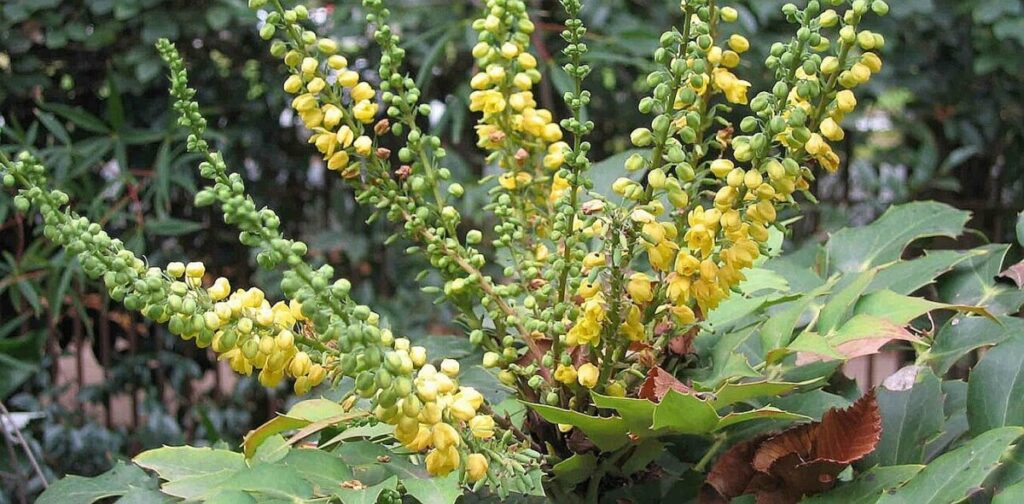
Mahonia bealei, also known as Beale’s barberry or leatherleaf mahonia, is invasive but still sold for landscaping.
HQ Flower Guide via Wikimedia Commons
,
CC BY-SA
When the Trump administration began
freezing federal funding
for climate and ecosystem research, one of the programs hit hard was ours: the U.S. Geological Survey’s Climate Adaptation Science Centers.
These nine regional centers help fish, wildlife, water, land – and, importantly, people – adapt to rising global temperatures and other climate shifts.
The centers have been helping to track invasive species, protect water supplies and make agriculture more sustainable in the face of increasing drought conditions. They’re
improving wildfire forecasting
,
protecting shorelines
and
saving Alaska salmon
, among many other projects.
All of this work happens through partnerships: Scientists, many of them affiliated with universities,
team up with
public and private resource managers – the people who manage water supplies, wildlands, recreation areas, shorelines and other natural resources – to develop the
research and solutions those managers need
.
The Northeast Climate Adaptation Science Center has been tracking invasive species to help natural resource managers prepare. Federally funded scientists develop risk maps and work with local communities to head off invasive species damage.
Regional Invasive Species and Climate Change Network
,
CC BY
But in spring 2025, after 15 years of operation of the centers, the president’s
proposed federal budget zeroed out funding
for them. Federal workers at the centers were threatened with layoffs.
Three of the nine regional centers – covering the South Central, Pacific Islands and Northeast regions – were
left unfunded
when the Office of Management and Budget withheld and then blocked funds Congress had already appropriated.
In spite of these challenges, we have hope that the work will eventually continue. Congress’ proposed budgets in both the U.S.
House
and
Senate
recommend fully funding the Climate Adaptation Science Centers, and there’s a reason:
Natural resources managers and the public
have consistently told their elected officials that the work is important.
Here are three examples of projects in regions where funding has been blocked that show why resource managers are speaking up.
Sustainable water supplies in arid lands
In south-central Texas, the
Edwards Aquifer Authority
is responsible for providing sustained water resources for 2.5 million people in cities such as San Antonio and Uvalde. It also maintains the groundwater-fed springs that
support threatened and endangered species
.
In recent decades, however, both heavy rainfall and prolonged, intense droughts have increased uncertainty about how much water will be available from the aquifer.
At the
South Central Climate Adaptation Science Center
, researchers from the University of Oklahoma teamed up with the aquifer authority to develop
high-resolution climate projections
for assessing future changes to groundwater recharge and ecologically sensitive springs.
The climate projections are helping the authority determine whether its existing drought-mitigation practices are
effective for sustaining freshwater springs and groundwater levels
.
The San Marcos springs on the Texas State University campus, shown in this panorama photo, are fed by the Edwards aquifer.
Adrienne Wootten
Losing funding for the Climate Adaptation Science Center means this technical guidance for water management and many other projects in the region are no longer available.
Stalled science doesn’t just hurt Texas. Many arid and semi-arid regions of the U.S. rely on aquifers to provide water supplies for homes, businesses and agriculture, and they need this type of research to maintain water security.
Solutions for agriculture and fire protection
On the Hawaiian island of O’ahu, up to
40% of agricultural land is unmanaged and unplanted
pasture that is often invaded by non-native grasses. These grasses increase fire risk as the islands face
more intense and longer-lasting droughts
.
The
Pacific Islands Climate Adaptation Science Center
has been working on a solution to help restore fallow lands through agroforestry, in which farmers grow crops among trees, mirroring Indigenous practices.
In agroforestry, crops such as coffee are grown among trees, preserving the trees’ carbon storage while helping to keep invasive plants at bay.
Leah Bremer/University of Hawaii at Mānoa Institute for Sustainability and Resilience
Climate Adaptation Science Center
researchers at the University of Hawai’i Mānoa
partnered with
Kākoʻo ʻŌiwi
, a nonprofit organization that is restoring Indigenous food systems, to identify lands that will remain suitable for agroforestry even under worsening drought caused by climate change. The research has shown how management practices can
increase soil health
and
increase the soil’s carbon storage
.
Since 2019, researchers have taught hundreds of volunteers from the community and student groups about restoration practices that include food production, forest conservation and climate resilience.
Lost funding for Climate Adaptation Science Centers put the brakes on science that supports local communities.
Managing invasive species in a warming world
Invasive species
cost the U.S. economy an estimated US$10 billion a year
in damage to crops, forests and ecosystems. At the same time, climate change is
increasing the range of many invasive species
and making them harder to control.
Scientists involved in the Northeast Climate Adaptation Science Center map invasive species risks. This map shows the current and potential range map of Beale’s barberry, or leatherleaf mahonia, an invasive evergreen shrub that is still being sold for ornamental uses. The plant, which deer don’t eat, has taken over habitat and outcompeted native species in parts of the U.S.
Regional Invasive Species and Climate Change Network
,
CC BY
In 2016, researchers from the
Northeast Climate Adaptation Science Center
at the University of Massachusetts Amherst learned that resource managers were concerned about how climate change would affect invasive species ranges. To understand and address the needs of resource managers, Climate Adaptation Science Center researchers created the
Regional Invasive Species and Climate Change Network
, which has become a primary source for mapping invasive species’ movement and sharing invasive species research across the region.
Climate Adaptation Science Center researchers conducted a series of projects to identify invasive plants expanding into
northern
and
southern New England
and
mid-Atlantic states
. The results have helped the state of Massachusetts update its
invasive plant risk assessment
and expanded regulators’ lists of invasive species to prohibit from sales in New York and
Maine
.
States recently asked the center’s researchers to develop a database of current and emerging invasive plants across the Northeast to help them build consistent and proactive defenses against emerging invasive species. Stalled funding has also stalled this project.
These are the kind of
real-world solutions
that federal funding cuts are stopping. When that work disappears, it leaves America and Americans more vulnerable to climate change.
Bethany Bradley receives funding from the US Geological Survey as the University Director of the Northeast Climate Adaptation Science Center.
Adrienne Wootten previously received funding from the US Geological Survey for research projects through the South Central Climate Adaptation Science Center and is currently engaged in research with the Edwards Aquifer Authority.
Ryan Longman receives funding from the US Geological Survey as the University Director of the Pacific Islands Climate Adaptation Science Center


