The Overview Effect: Astronaut Perspectives from 25 Years in Low Earth Orbit
The experience of viewing Earth from space has a profound impact on astronauts, often referred to as the “overview effect.” This term, coined by space philosopher Frank White in 1987, encapsulates the transformative shift in perspective that many astronauts report after witnessing our planet from the unique vantage point of the International Space Station (ISS). The ISS, which has hosted a continuous human presence for 25 years, features a cupola module with seven windows that provide stunning views of Earth. NASA astronauts, including Christina Koch and Victor Glover, describe this experience as a powerful reminder of our shared humanity. From their lofty perch, they see Earth as a fragile oasis in the vastness of space, devoid of political borders or religious divisions, highlighting the unity of all people living within the thin blue atmosphere.
Astronauts often return to Earth with a renewed sense of responsibility and a desire to foster environmental stewardship. For instance, Mike Foreman, a retired NASA astronaut, noted that seeing the Earth’s delicate atmosphere from space instilled in him a commitment to conservation. Similarly, Nicole Stott shared her realization that her perception of home evolved; Florida transformed from a mere state to a part of a greater whole — Earth itself. This shift in perspective can inspire astronauts to advocate for global unity and environmental protection, as reflected in the sentiments expressed by former astronauts like Bob Behnken and Jack Fischer. They emphasize the importance of viewing Earth as a shared home, especially in light of global challenges such as the pandemic.
The emotional impact of this overview effect is so profound that many astronauts report being moved to tears during their first glimpse of Earth from the cupola. Retired astronaut T.J. Creamer recalled that every crew member he brought to the observation module was overwhelmed by the breathtaking beauty of our planet. As future crews prepare for their missions aboard the ISS, they can expect to undergo similar transformative experiences. NASA continues to share these perspectives through initiatives like the “Down to Earth” series on NASA+, aiming to inspire a greater appreciation for our planet and the interconnectedness of all life on it. The overview effect serves not only as a personal revelation for astronauts but also as a call to action for all of humanity to recognize and cherish our shared existence on this beautiful blue planet.
https://www.youtube.com/watch?v=5EmWMG7H11E
To see Earth from space is to be forever changed by the view. Since Alan Shepard became the first American to lay eyes on our home planet from above, countless NASA astronauts have described feeling awed by the astonishing sight and a profound shift in perspective that followed.
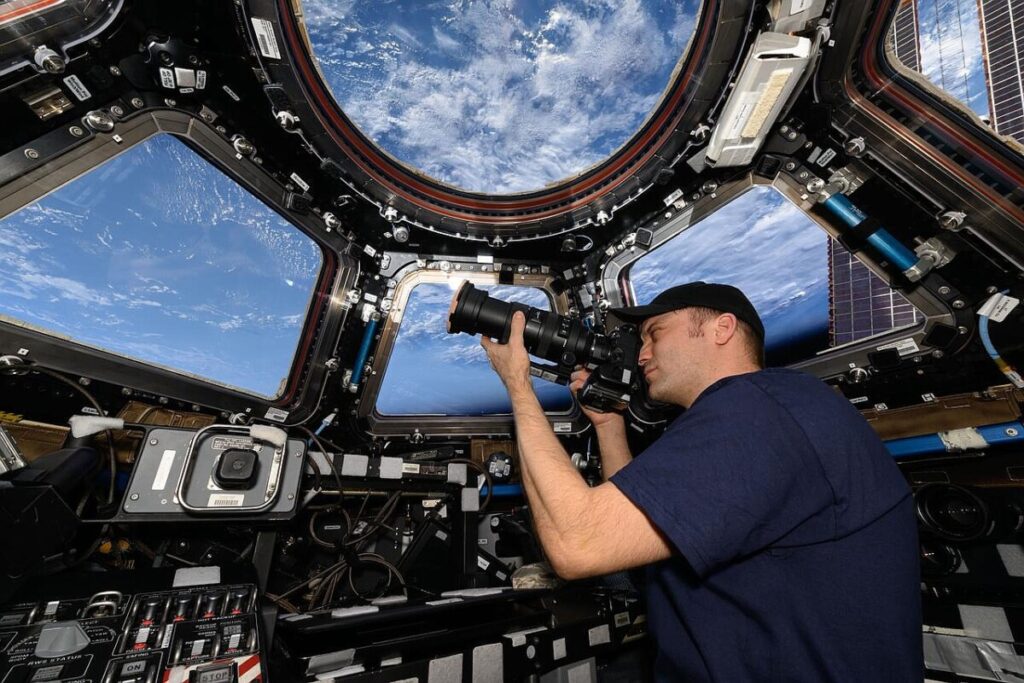
NASA astronaut Matthew Dominick points his camera through a cupola window as the International Space Station orbits 262 miles above the Atlantic Ocean off the coast of Africa.
NASA
This unique experience is known as the overview effect – a term coined in 1987 by space philosopher and author
Frank White
in a book of the same name. The phenomenon creates powerful changes in the way astronauts think about Earth and life and can be particularly strong for those who lived and worked aboard the International Space Station during its 25 years of continuous human presence. The orbiting laboratory’s cupola module, equipped with seven windows looking down on Earth, provides the perfect place for observation and reflection.
NASA astronaut Jessica Watkins is pictured looking out from the International Space Station’s “window to the world” – the cupola. Astronauts use the seven-windowed observation module to monitor the arrival of spacecrafts at the orbiting laboratory and view the Earth below.
NASA
As Artemis II Mission Specialist Christina Koch explained:
“The overview effect is when you’re looking through the cupola and you see the Earth as it exists with the whole universe in the background. You see the thin blue line of the atmosphere, and then when you’re on the dark side of the Earth, you actually see this very thin green line that shows you where the atmosphere is. What you realize is every single person that you know is sustained and inside of that green line and everything else outside of it is completely inhospitable. You don’t see borders, you don’t see religious lines, you don’t see political boundaries. All you see is Earth and you see that we are way more alike than we are different.”
Koch’s Artemis II crewmate, NASA astronaut Victor Glover, said the overview effect’s potency is closely tied to the “sea level effect” – humanity’s shared experience on Earth. “You come back to sea level, and then you have a choice,” he explained. “Are you going to try to live your life a little differently? Are you going to really choose to be a member of this community of Earth?”
NASA astronaut Don Pettit, Expedition 30 flight engineer, is pictured in a window of the cupola of the International Space Station, backdropped by Earth’s horizon and the blackness of space.
NASA
Many astronauts emphasize the importance of unity after experiencing the overview effect. “You see that it’s a single planet with a shared atmosphere. It’s our shared place in this universe,” said former NASA astronaut Bob Behnken. “I think that perspective, as we go through things like the pandemic or we see the challenges across our nation or across the world, we recognize that we all face them together.”
Seeing the Earth from space can also change their concept of home. Former NASA astronaut Nicole Stott recalls wanting to see her home state of Florida during her first mission to the International Space Station. “Finally, we were flying over Florida. I wanted to go to the window and see it, and then realized somewhere down the line that I wasn’t looking at Florida that same way anymore,” she said. “I still wanted to see Florida, but Florida had just become this special part of home, which is Earth. We’re all earthlings.”
The sun shines above Earth’s horizon as the space station orbits 264 miles above the Canadian province of Quebec.
NASA
For some astronauts, their perspective shift inspired them to make changes on the ground. “I think if you’re not a conservationist before you go to space, you’re at least partly a conservationist when you come back. Because when you see how thin that atmosphere is, that protective layer that we have here, you think, wow, we really have to take care of this because it does look so fragile from space,” said retired NASA astronaut Mike Foreman.
Others hope to share the overview effect with more people. “That perspective helps you grow. It has really inspired me to try to get more people this experience and to get a permanent foothold in the stars for our species,” said former NASA astronaut Jack Fischer. “I want to do everything I possibly can to help the human species, humanity as a whole, go further and grow and evolve like I know they’re capable of.”
An Earth observation taken through cupola windows by the Expedition 39 crew. Portions of the International Space Station are in view.
NASA
Future crews to the orbiting laboratory can look forward to a similar experience. “In that instant, when you’re overwhelmed with that vista, when your eyes see nothing but the beauty of the Earth – every single crew member that I brought in [the cupola] for that exposure, cried,” said retired NASA astronaut T.J. Creamer. “It is heart stopping. It is soul pounding. It is breathtaking.”
For more astronaut perspectives from the International Space Station, watch “
Down to Earth
” on NASA+.
Explore More
3 min read
CHAPEA Crew Begins Stay Inside NASA’s Mars Habitat for Second Mission
Article
4 minutes ago
5 min read
NASA’s 2025 Astronaut Candidates: Shaping Artemis Exploration
Article
22 hours ago
8 min read
What is BioSentinel?
Article
4 days ago


