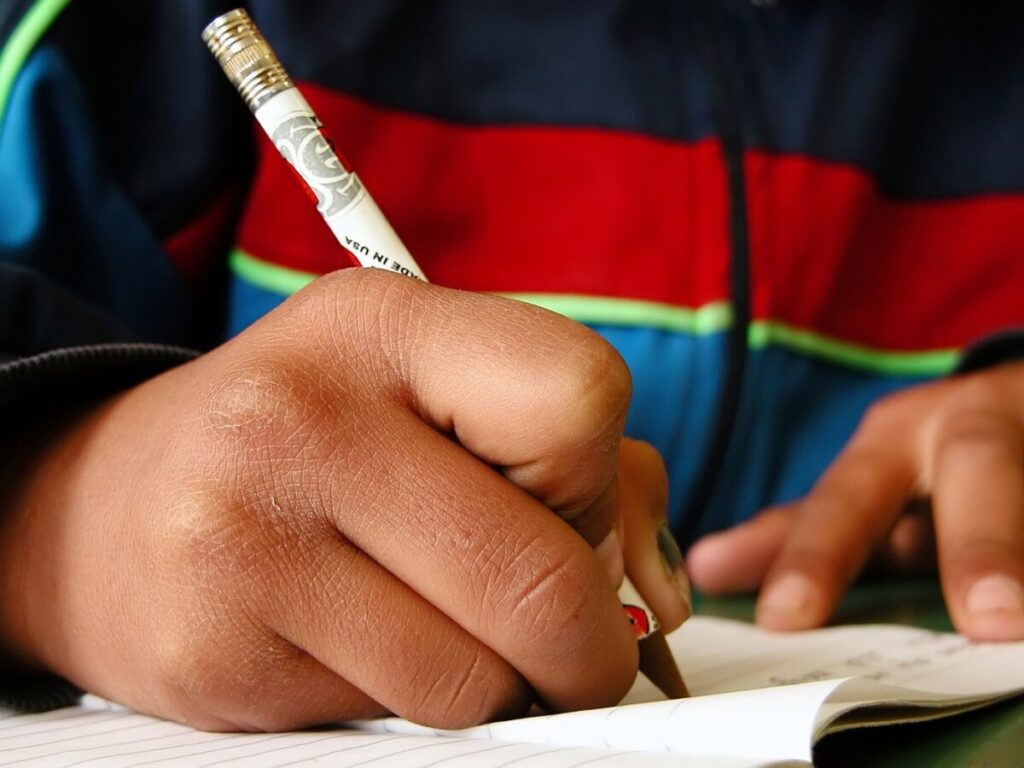
McCloskey: Too many kids can’t read – blame lack of spelling tests
In a thought-provoking article, Abby McCloskey shares her experiences attending parent-teacher conferences for her second-grade son, revealing a concerning trend in modern education: the diminishing emphasis on spelling instruction. Reflecting on her own educational background in the 1980s, McCloskey notes that explicit spelling teaching was a staple of her schooling, contrasting sharply with today’s classrooms where such instruction is often deprioritized. This shift, she argues, is detrimental not only to spelling proficiency but also to overall literacy. A 2021 review highlighted that many schools in the U.S. and the U.K. have moved away from traditional spelling methods, such as weekly word lists and spelling tests, in favor of more progressive teaching approaches. Unfortunately, this has coincided with a troubling decline in literacy rates; according to the National Assessment of Educational Progress (NAEP), less than a third of fourth-graders are proficient in reading, with alarming numbers testing below basic levels.
McCloskey emphasizes the critical connection between spelling and reading, pointing out that both skills rely on a mental visualization process known as an “orthographic map.” Research indicates that early spelling skills in young children significantly correlate with their future literacy abilities. A meta-study from 2025 confirmed that early interventions in spelling can substantially improve literacy scores, particularly for students at risk of learning disabilities. Despite this evidence, McCloskey expresses concern that many children today rely heavily on technology, such as spellcheck and autocorrect, which can lead to a lack of motivation to learn spelling. She argues that the notion of spelling being obsolete in the age of technology is flawed; just as one would not forgo basic math skills in favor of a calculator, mastering spelling remains essential for cognitive development and literacy.
The article also highlights a disconnect between parental perceptions and actual student performance. Many parents may believe their children are excelling based on report cards and standardized tests, unaware of the gaps in the curriculum. McCloskey recounts her own realization of her children’s struggles with spelling only after they worked with a summer school spelling book she provided. She concludes with a hopeful note, expressing gratitude for her son’s teacher, who prioritizes spelling instruction, and underscores the importance of not taking foundational skills for granted. As children’s brains are still developing, it is crucial that educators and parents alike recognize the value of traditional learning methods alongside technological advancements. McCloskey’s insights serve as a timely reminder that the basics of education, such as spelling, remain vital to fostering literacy and cognitive skills in the next generation.
This month, I went to school for parent-teacher conferences. My second-grader’s self-evaluation form listed several categories: “I follow directions,” “I understand math,” “I like to read,” and one we hadn’t been asked about before: spelling. In fact, over the summer, he had literally asked me: “What is spelling?”
Most parents educated in the 1980s remember a fair amount of explicit instruction on spelling. Today, you cannot assume that spelling is being taught to your children. Many schools have shifted their focus elsewhere.
We are losing something important when schools move away from the basics, letting technology fill in the gaps with spellcheck. Or allowing childish spellings that are cute until they are not.
A 2021 review found that “a growing number of schools in the USA and at least several schools in the UK have deemphasized or eliminated traditional methods of explicit spelling instruction — that is, pedagogical activities that focus on the deliberate teaching of spelling — such as weekly word lists and spelling tests.”
The retreat from spelling comes with multiple costs, not the least of which is literacy. There is a crucial link between spelling and reading. Both rely on a visualization of the word in the brain, often called an “orthographic map.” When a child learns the correct spelling of a word, it enhances word recognition, smoothing the path for reading.
The earlier a child learns to spell, the better. Academics have found that there’s a strong link between the spelling abilities of 5-year-old children and their later literacy abilities. A 2025 meta-study of students with or at risk of developing learning disabilities found that early spelling interventions improved their literacy scores.
But my sense is that these days, spelling is deprioritized during the early years, and by late elementary school a child is using a tablet or a laptop to write and running spellcheck. At that point, learning to spell feels pointless to the student and any benefits to literacy are limited.
Much of the move away from spelling tests and rote memorization seems to have been driven by the now debunked “whole language” reading movement that emphasized enthusiasm and intuition, in theory to help students who were struggling. But this seems to have backfired: American students’ literacy scores are tragic. Less than a third of fourth-grade students are proficient at reading, according to the NAEP. The share of students testing below basic level is at quarter-century highs.
Combine this with the loss of physical books in the classroom and you’re off to the races. And we wonder why children no longer read for fun.
This evidence should lay to rest to the argument that learning to spell is obsolete in a world of spellcheck and autocorrect. By that same logic, I don’t need to know math, because I have a calculator. I don’t need to learn how to read music, because I have Spotify. I don’t need to read, because I have podcasts. And as technology rapidly advances, I won’t need to think because I have ChatGPT.
The brain is like a muscle; if we don’t use it we lose it. We know this. Technology works best as a tool, an extension of our human abilities, not as a replacement of them. This is especially the case for our youngest kids whose brains are rapidly developing.
Many parents are unaware of why spelling remains so important — and oblivious to schools’ drift away from teaching it. It’s easy to rely on what report cards say and the seemingly endless number of state and district tests that children take.
But report cards and tests don’t show the whole picture, especially if a topic isn’t even part of the curriculum. It wasn’t until my children were working out of a summer school spelling book — that I had provided — that I was aware of how far behind they were.
In fact, a gap in parent perception and student achievement is pernicious across subjects: Most parents report that their children are doing great in school. In reality, most kids in Kindergarten through 8th grade aren’t proficient in reading and math.
My son’s teacher showed me a copy of one of his handwritten essays. Over the top of the page, in pink pen, was the correct spelling of the misspelled words. This was stapled to another copy, underneath, of the corrected essay with all of the words spelled correctly.
I am thankful he now has a teacher who emphasizes spelling. We can’t take the basics for granted.
Abby McCloskey is a columnist, podcast host, and consultant. She directed domestic policy on two presidential campaigns and was director of economic policy at the American Enterprise Institute./Bloomberg Opinion/Tribune News Service


