Leaked Microsoft organizational chart shows the 16 executives helping Satya Nadella in the AI race
In a significant shift aimed at capitalizing on the burgeoning AI landscape, Microsoft CEO Satya Nadella has restructured the company’s senior leadership team, as revealed in a leaked organizational chart. This strategic reshuffle comes at a pivotal time for Microsoft, as it seeks to solidify its position in the competitive AI arena. The chart highlights Nadella’s 16 direct reports, each playing a crucial role in navigating the complexities of AI integration into Microsoft’s broader business strategy. From legal affairs to marketing and technology, these executives are tasked with driving innovation and ensuring the company’s responsiveness to regulatory challenges and market demands.
Among the key figures in this leadership team is Brad Smith, Microsoft’s Vice Chair and President, who has become a prominent voice in technology policy discussions, particularly regarding AI and cybersecurity. His diplomatic approach has helped Microsoft maintain a favorable standing amidst regulatory scrutiny. Another pivotal player is Kevin Scott, the Chief Technology Officer, who has been instrumental in shaping Microsoft’s AI strategy since brokering its partnership with OpenAI. This collaboration has positioned Microsoft at the forefront of AI advancements, making Scott’s role even more critical as the company navigates this transformative era. Additionally, Judson Althoff, newly appointed as CEO of Microsoft’s commercial business, is expected to streamline operations across sales, marketing, and engineering, allowing Nadella and other leaders to focus on AI-driven innovations.
The leadership changes extend beyond just titles; they reflect a broader strategy to enhance Microsoft’s capabilities in AI and cloud services. Executives like Amy Hood, the Chief Financial Officer, are overseeing massive investments in AI infrastructure, while Carolina Dybeck Happe, the new Chief Operations Officer, is tasked with accelerating the company’s overall transformation. With a team that includes experts in security, consumer products, and quantum computing, Nadella’s revamped leadership is poised to lead Microsoft through this generational shift in technology, reinforcing its commitment to innovation and competitive excellence in the rapidly evolving digital landscape. As the company embarks on this ambitious journey, its ability to adapt and harness the power of AI will be crucial in shaping its future trajectory.
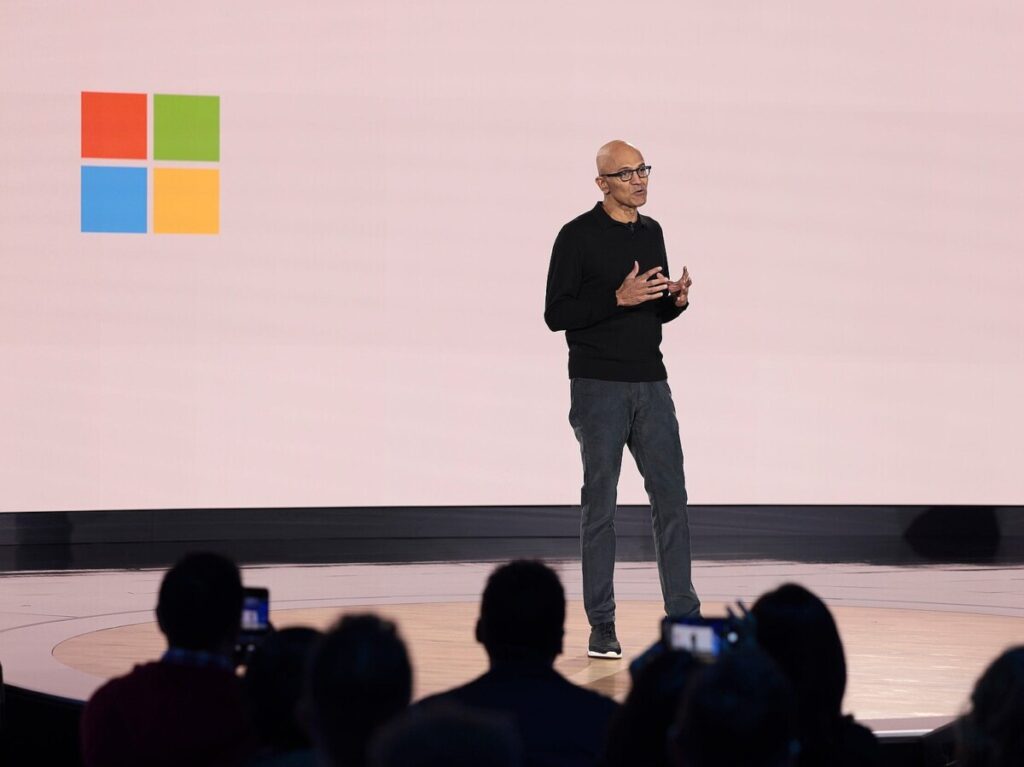
Microsoft CEO Satya Nadella
Jason Redmond/AP
Microsoft’s senior leadership team includes Satya Nadella and 16 executives.
Nadella has made changes in the past year to the company’s top ranks.
A leaked organizational chart reveals the CEO’s closest lieutenants.
Microsoft
‘s transition to AI could be one of the most pivotal moments in its 50-year history, and CEO
Satya Nadella
is making changes to the company’s top ranks to seize the moment.
A leaked organizational chart showing Nadella’s 16 direct reports, along with other internal documents, show how he’s reshuffled executives and their duties over the past year to compete in the AI race.
Here are Nadella’s direct reports:
Brad Smith, vice chair and president
Microsoft President Brad Smith testified to the Senate last week that the company’s JEDI cloud contract had been stuck because of Amazon’s legal protest, and advocated for updated protest rules.
Drew Angerer/Getty Images
Brad Smith
is the face of Microsoft when it comes to public affairs.
He’s built a reputation as “the statesman of the technology industry,” and become one of the most influential voices on tech policy, particularly on issues related to AI, cybersecurity, data privacy, and human rights.
Smith’s diplomatic approach has
at times
kept Microsoft out of regulators’ crosshairs. He runs the Corporate, External, and Legal Affairs, or “CELA,” team in charge of legal and regulatory matters, government affairs, and corporate responsibility.
Smith’s role is especially crucial for Microsoft now as the company navigates regulation, geopolitics, data-governance and reputational risks to expand its cloud and AI global footprint.
Smith is also often the executive called upon to publicly address the company’s toughest controversies, such as
internal protests over government contracts.
Kevin Scott, chief technology officer
Microsoft CTO Kevin Scott talks about the growth of AI agent use at the Build 2025 developer conference.
Microsoft
Kevin Scott is one of the most influential AI executives at Microsoft.
As chief technology officer and executive vice president of AI and research, it’s Scott’s job to
define the company’s long-term technology strategy
.
Nadella named Scott CTO in early 2017. His mandate was initially broad, and he remained relatively low-profile at Microsoft.
By the next year, he started focusing on AI and brokered Microsoft’s initial investment in OpenAI, which became
one of the most consequential partnerships
in the tech industry.
Takeshi Numoto, chief marketing officer
Takeshi Numoto, commercial chief marketing officer
Microsoft
Microsoft Chief Marketing Officer Takeshi Numoto runs the company’s global marketing efforts.
Numoto’s
bio on Microsoft’s website
calls out his role in creating new business models and modernizing Microsoft’s marketing by making it more data-driven.
Recently, Numoto and his team joined a new organization under Judson Althoff, whom Microsoft just named as its CEO of commercial business. Numoto now reports to Althoff in his duties as chief marketing officer, but to Nadella on companywide matters.
Nadella described those matters as “all-up business models, planning, consumer marketing, and corporate brand and communications,” according to an
internal memo viewed by Business Insider.
Judson Althoff, Microsoft commercial CEO
Microsoft Chief Commercial Officer Judson Althoff
Microsoft
Microsoft recently promoted
longtime sales chief
Judson Althoff to an expanded role as CEO of the company’s commercial business.
Althoff’s new organization combines sales, marketing, and operations into one unit for all of Microsoft’s commercial products. He also leads a new commercial leadership team that includes executives from engineering, sales, marketing, operations, and finance.
Althoff’s promotion is intended to give Nadella and the company’s engineering leaders more time to focus on AI, according to an
internal memo viewed by Business Insider
.
“This will also allow our engineering leaders and me to be laser focused on our highest ambition technical work—across our datacenter buildout, systems architecture, AI science, and product innovation—to lead with intensity and pace in this generational platform shift,” Nadella wrote.
Carolina Dybeck Happe, chief operations officer
Microsoft hired Carolina Dybeck Happe, previously GE’s finance chief, in August 2024 in a newly created role of chief operations officer.
Nadella explained
in an email
announcing Dybeck Happe’s hiring that her role would be to partner with Microsoft’s leadership team to accelerate the company’s AI transformation.
When Althoff was named commercial CEO, Dybeck Happe’s operations organization moved to report to Althoff.
“Carolina Dybeck Happe will continue to report to me, as she works on our overall company transformation and continues to closely partner with Judson,” Nadella
wrote in the memo
.
Amy Hood, chief financial officer
Amy Hood, chief financial officer at Microsoft.
Stephen Brashear/Getty Images
Amy Hood
is Microsoft’s longtime finance chief and an influential figure in the company’s AI strategy.
Hood works closely with Nadella and is the gatekeeper of Microsoft’s multibillion-dollar AI infrastructure buildout. The company reported a record $34.9 billion in capital expenditures during its most recent quarter and said spending will increase.
Hood also recently told employees in an
internal email viewed by Business Insider
that the current fiscal year 2026 will demand “intensity, clarity and bold execution,” signaling her role in setting the tone for Microsoft’s culture.
Scott Guthrie, Cloud + AI executive vice president
Microsoft Executive VP Scott Guthrie wearing his signature outfit at Microsoft Build 2018.
Microsoft
Scott Guthrie is one of Nadella’s top lieutenants and the executive who has led Microsoft’s cloud business since at least 2011.
Known for
his signature red polo
, Guthrie runs the Cloud + AI group, which Nadella created
through a reorganization in 2018
. That business unit is one of Microsoft’s largest and most important, including the Azure cloud-computing business.
Nadella recently tapped one of Guthrie’s reports as a new advisor to “rethink the new economics of AI,”
according to an internal memo
.
Amy Coleman, EVP, Chief People Officer
Amy Coleman, a longtime Microsoft HR executive,
took over
as the company’s chief people officer in March.
Coleman’s promotion came after nearly 2,000 employees deemed low-performers were
fired by Microsoft
as part of a overhaul of its performance review and management process. She also took the role amid an overall shift in the
tech industry
toward more rigor and less coddling of employees.
Under Coleman, Microsoft introduced
a new three-day return to office
policy. She made the case for the new policy in
a recent internal meeting reviewed by Business Insider
, saying in-person staff are “thriving” based on internal data.
Kathleen Hogan, EVP of strategy and transformation
Kathleen Hogan
Microsoft
One of Nadella’s first big leadership moves after he became CEO in 2014 was to name Hogan as Microsoft’s chief people officer.
In her more than 10 years in that role, Hogan helped Nadella craft a new workplace management system around the concept of a
“growth mindset.”
Nadella announced Hogan would leave the chief people officer position in March and take on a new role as executive vice president of the “Office of Strategy and Transformation.”
“As we’ve seen time and again throughout our 50-year history, times of great change for the world and for our industry require us to have a mindset that enables us to continually adapt and transform ourselves,” Nadella wrote
an internal email announcing the change
. “There’s no question that we are at the forefront of another such moment, with the rapid changes across every industry and business function in this AI era.”
Rajesh Jha, EVP, Experiences + Devices
Microsoft’s Rajesh Jha.
Microsoft
Rajesh Jha runs Experiences and Devices, a major unit within Microsoft responsible for products including Office, Windows, and Teams. He’s one of Nadella’s most influential lieutenants.
Jha is also one of Microsoft’s
longest-serving executives
. He rose through the ranks from software engineer to a top executive who led Office through its transition to the cloud-based Microsoft 365 suite of applications, and now into AI.
Jay Parikh, CoreAI and engineering manager
Microsoft’s Jay Parikh.
Microsoft
In January,
Nadella put Jay Parikh in charge of a new AI unit
called CoreAI, central to Microsoft’s ambition to help developers build digital assistants capable of taking over tasks from human workers.
Parikh joined Microsoft in October 2024 after running cloud-security company Lacework. He previously was vice president and global head of engineering for Meta. Mark Zuckerberg credited Parikh
for many technological achievements during his 11-year tenure
at the social-media company.
Business Insider recently wrote about
Parikh’s internal weekly update memos
, which revealed his goals for the CoreAI unit, its early accomplishments, and his advice to address what he sees as problems within the company.
Parikh’s internal org chart,
recently revealed by Business Insider
, shows who’s helping him run the new AI unit. Parikh recently shared a plan to ward off AI coding rivals by overhauling GitHub in
an internal meeting
reviewed by Business Insider.
Charlie Bell, EVP, Microsoft Security
Microsoft’s Charlie Bell
Courtesy of Microsoft
Charlie Bell
, considered a cofounder of the cloud giant
Amazon Web Services
, joined Microsoft in 2021 in
a move that shook the industry
.
Nadella put Bell in charge of a new $20 billion, 10,000-person cybersecurity group called Security, Compliance, Identity, and Management, and made security the company’s No. 1 priority.
Microsoft recently expanded its
Secure Future Initiative
, making security the top priority for every employee, including making security a metric on which employees are evaluated during
performance reviews
.
The company has had some security struggles. The Department of Homeland Security, for example, last year condemned Microsoft for what it called “a cascade of security failures” that allowed Chinese hackers to access emails from thousands of customers.
Mustafa Suleyman, Microsoft AI CEO
Mustafa Suleyman
Inflection
Last year, Microsoft appointed Mustafa Suleyman—cofounder of AI pioneer DeepMind and former head of startup Inflection AI—as CEO of a new Microsoft AI division. The organization is responsible for consumer AI products such as Microsoft’s
Copilot chatbot
and the Bing search engine.
Suleyman recently unveiled a
superintelligence team
at Microsoft focused on building a “world-class, frontier-grade research capability in-house,” he
told Business Insider in a recent interview
.
Suleyman has added nine direct reports in the past year or so, according to
internal organization charts viewed by Business Insider
. Five of those previously worked for Google or DeepMind.
Jason Zander, Microsoft Discovery & Quantum executive vice president
Microsoft’s Jason Zander.
Channel 9, Microsoft
Zander previously ran Azure since 2012, overseeing everything from product management to engineering within Azure, under Guthrie.
After that, he started running a team called Strategic Missions and Technologies. The organization was formed to house initiatives like quantum computing and space technologies. These days, Zander’s team focus includes AI.
“Our clear focus as a company is to define the AI wave and empower all our customers to succeed in the adoption of this transformative technology,” Zander wrote in
an internal email
viewed by Business Insider last year.
Zander’s current job title suggests he’s running Microsoft Discovery,
its new AI agent platform
.
Ryan Roslansky, LinkedIn CEO and EVP of Office
LinkedIn CEO Ryan Roslansky.
Yves Herman/REUTERS
Ryan Roslansky has been CEO of the Microsoft-owned professional social network LinkedIn since 2020.
Microsoft recently expanded Roslansky’s role to include Outlook, Word, Excel, PowerPoint, and the Microsoft 365 Copilot application, according to an internal announcement from Nadella in June.
Roslansky started reporting to Jha for his new duties as executive vice president of Office, and to Nadella in his capacity as LinkedIn CEO, according to organizational charts viewed by Business Insider.
Phil Spencer, Microsoft Gaming CEO
Microsoft Xbox head Phil Spencer
Getty Images/Kevork Djansezian
The gaming business became so important to the company that Nadella made gaming boss
Phil Spencer one of his direct reports in September 2017
, and the executive started regularly speaking at all-employee town hall meetings.
Spencer runs Xbox, Xbox Game Studios, ZeniMax Media, and Activision Blizzard. Those last two businesses were acquired through multibillion-dollar deals. Microsoft’s Activision Blizzard acquisition was
the largest in its history.
Have a tip? Contact this reporter via email at
astewart@businessinsider.com
or Signal at +1-425-344-8242. Use a personal email address and a nonwork device;
here’s our guide to sharing information securely
.
Read the original article on
Business Insider


