The Dayton Peace Accords at 30: An ugly peace that has prevented a return to war over Bosnia
On November 21, 1995, the Dayton Peace Accords were signed at the Wright-Patterson Air Force Base in Dayton, Ohio, marking a pivotal moment in the history of Bosnia-Herzegovina. This agreement brought an end to the brutal three-and-a-half-year war that had ravaged the country following its push for independence from Yugoslavia in 1992. The conflict was characterized by ethnic cleansing, war crimes, and immense human suffering, with over 100,000 lives lost and half of the population of 4.4 million displaced. Notably, the Srebrenica genocide in July 1995, where more than 8,000 Bosniak men and boys were murdered, underscored the war’s brutality. The Dayton Accords established a fragile peace, creating a divided Bosnia consisting of two entities: Republika Srpska, representing the Serb population, and the Bosnian Federation, primarily composed of Bosniaks and Croats. While the agreement preserved the country’s territorial integrity, it institutionalized ethnic divisions that have persisted for decades.
In the years following the agreement, Bosnia’s journey has been marked by a complex interplay of reconstruction, political stalemate, and ongoing crises. The initial decade post-Dayton was filled with hope as the international community, including U.S. and Russian forces, facilitated the return of displaced populations and the rebuilding of war-torn communities. However, the promise of a unified, multicultural society faced significant challenges. Many returnees struggled to reclaim their homes, and cross-ethnic trust remained severely fractured. As political dynamics shifted, the early optimism gave way to stagnation. By 2006, attempts to strengthen central state institutions through constitutional amendments failed, leading to a decade characterized by polarization and a lack of effective governance. The political landscape became dominated by figures like Milorad Dodik, who leveraged ethnic nationalism and challenged the authority of central institutions, resulting in a state increasingly described as “on the brink” of conflict.
Today, the legacy of the Dayton Accords is viewed as a double-edged sword. While the agreement successfully halted the immediate violence and allowed for some degree of stability, it also entrenched divisions that have hindered genuine reconciliation and progress. Ethnonationalism remains rampant, and many Bosnians continue to seek opportunities abroad, disillusioned by the political status quo. The ongoing geopolitical rift, particularly following Russia’s invasion of Ukraine, has further complicated matters, with Dodik aligning with Moscow while the Bosnian Federation leans towards the West. As Bosnia navigates these turbulent waters, the peace established at Dayton is both a testament to the resilience of its people and a reminder of the challenges that lie ahead. The Dayton Accords may have prevented a return to war, but their legacy is a country still grappling with its fragmented identity and uncertain future.
https://www.youtube.com/watch?v=MF7EbUGlaOU
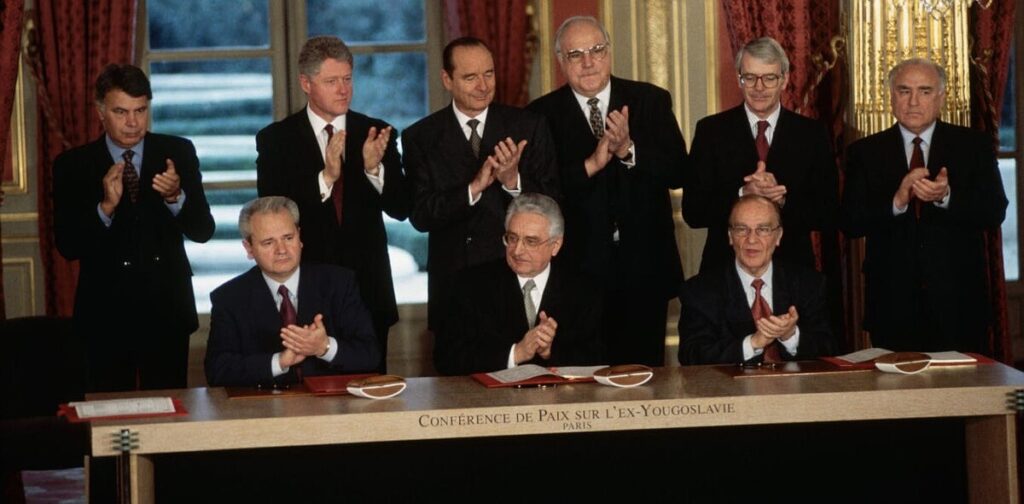
World leaders clap as, from left, Serbian President Slobodan Milosevic, Croat President Franjo Tudjman and Bosnian President Alija Izetbegovic sign the Dayton Peace Agreement.
Peter Turnley/Corbis/VCG via Getty Images
On Nov. 21, 1995, in the conference room of the Hope Hotel on the Wright-Patterson Air Force Base in Dayton, Ohio, the leaders of Bosnia-Herzegovina, Serbia and Croatia initialed an agreement that brought the three-and-a-half-year war in Bosnia
to an end
. Three weeks later, the
General Framework Agreement
, known as the Dayton Peace Accords, was signed.
The war over Bosnia was the most brutal and devastating of the wars spawned by the
dissolution of Yugoslavia
. Attacked from the moment it moved toward independence in early 1992 by militias supported by the neighboring nations of Croatia and Serbia, Bosnia was born under fire and nearly perished. Half of its population of 4.4 million were forcefully displaced, and over
100,000 people died
during the conflict.
Ethnic cleansing and war crimes marked the war, including
the Srebrenica genocide
of July 1995, in which
more than 8,000 Bosniak victims
were murdered by the army of Republika Srpska.
The peace agreed to at Dayton
left Bosnia, or Bosnia and Herzegovina as it is known in full, intact as a country but divided into two entities, Republika Srpska – a secessionist entity proclaimed by ethnonationalist Serbs in January 1992 – and the Bosnian Federation. Meanwhile, an international military force was deployed to secure the peace.
But it was an ugly peace: The patient was saved, but left deformed and weak. As scholars who have written extensively about
the Bosnian war
and
its aftermath
, we believe the legacy of the Dayton Peace Accords, 30 years on, is decidedly mixed.
The sorting of ethno-territories
Bosnia’s life after Dayton can be divided into three roughly decade-long eras: reconstruction, stalemate and permanent crisis.
The first decade was the toughest but most hopeful. With peace enforced by an international force including U.S. and Russian troops, Bosnians returned to their war-shattered country.
But restoring the country’s social fabric proved hard. While the international community aspired to
reverse ethnic cleansing
, the obstacles were immense.
A once
proudly multicultural country
was left divided into separate ethno-territories.
Under
the Dayton Accords
, Bosnians were promised the right to return home. But this was complicated by the fact that many houses were destroyed, while others were occupied by those who had forcefully displaced them.
Bosnians returning home after the war were confronted by damaged and destroyed homes.
Mike Abrahams/In Pictures Ltd./Corbis via Getty Images
By the summer of 2004, the UNHCR, the United Nations agency coordinating returns after the peace agreement, announced that it had achieved
1 million returns
. What became evident, however, is that “minority returns” – that is, people returning to places where they would be a minority community – were limited. Many returnees reacquired their old property after a struggle but promptly sold it to build a life elsewhere among people who were the same ethnicity as them.
Cross-ethnic trust was largely
shattered by wartime experiences
.
Incompatible horizons
The first decade was peak
liberal international statebuilding
. An international high representative charged with “civilian implementation” of the Dayton Accords centralized control over military and intelligence functions at the
state level
. A central state border service and investigations agency was created. So also was a central state court, state-level criminal codes and an indirect taxation authority to unify indirect tax collection and finance
state institutions
.
Bosnia’s trajectory, though, stalled in 2006 when the high representative
stepped back from state building
. In April 2006, a package of
constitutional amendments
designed to streamline Dayton by strengthening central state institutions fell two votes short in the state Parliament.
Surprisingly, the package was not blocked by parties from Republika Srpska, traditional obstructionists, but by former Prime Minister
Haris Silajdžić’s
Bosniak-dominated party. This failure set the stage for a decade of polarization and
stalemate
.
Silajdžić campaigned for abolition of the entities – Republika Srpska and the Bosnian Federation – and the creation of a single united Bosnia. Republika Srpska’s leading politician, Milorad Dodik, answered by floating the prohibited
idea of an entity independence referendum
.
With the high representative
largely passive
, Bosnia was stalemated between incompatible horizons, each side strong enough to block but too weak to prevail.
Dodik turned
referendum talk
in Republika Srpska into a steady repertoire of threat, while casting central state institutions in Sarajevo as rotten, artificial and destined to fail. In the process, Dodik and his family got rich, creating a classic
patronal power network
across Republika Srpska.
With the media thoroughly
divided by wartime allegiances
, the public sphere was filled with
incendiary rhetoric
.
The word “inat” is a shared idiom across Bosniaks, Croats and Serbs. It is stubborn uprightness, a combination of narcissism and
spite
. Politics increasingly rewarded those who could perform “inat” more vividly than their rivals.
Central state institutions in Bosnia did not collapse
but became sclerotic
. Procedures multiplied, confidence thinned and decision-making settled into a theater of anticipatory vetoes where the point was less to implement a program than to keep imagined endpoints – the creation of a unified nation on one side; an independent Republika Srpska on the other – alive and to make the other side feel the pain of their impossibility.
A country on the brink
A decade of stalemate slowly evolved into a condition of permanent crisis.
In November 2015, Bosnia’s Constitutional Court ruled that the marking of Jan. 9 as “Republika Srpska Day” – a celebration of virtual independence – was
discriminatory and illegal
under human rights law.
Dodik, the Republika Srpska’s de facto leader, responded by organizing
an extralegal referendum
whose result asserted that the Republika Srpska population wanted the date retained.
Defiance evolved into active subversion of the constitutional order and provisions of Dayton. The Republika Srpska parliament passed laws that directly challenged central state institutions built in the first postwar decade. With weak enforcement capacity, the Bosnian state was unable to command compliance.
When in 2021 a new high representative was appointed over Russian objections, Dodik rejected his authority outright. By then, Bosnia was routinely described as “
on the brink
” of war.
Russia’s full-scale invasion of Ukraine in 2022 saw
Dodik side firmly with Moscow
. He
visited Russian President Vladimir Putin in Moscow
frequently. The Republika Srpska media relayed Russian propaganda, featuring correspondents reporting live from Russia’s front lines.
Russian President Vladimir Putin meets with the president of Republika Srpska, Milorad Dodik, on Feb. 21, 2024.
Sergei Bobylyov/AFP via Getty Images
Meanwhile, people and institutions in the Bosnian Federation aligned with Ukraine and the West. A giant geopolitical rift ran through the country: two entities,
two different realities
.
In February 2025, the drama peaked when Bosnia’s Constitutional Court
barred Dodik from political life
. Predictably, he rejected the top court’s authority, and a standoff ensured. Dodik hired
figures close to the Trump administration
such as Rudy Giuliani to lobby on his behalf. By the end of October 2025, they had succeeded in getting
U.S. sanctions on Dodik
removed in exchange for him agreeing to leave the Republika Srpska presidency.
The ugly peace endures
To distant observers, Bosnia may register as a success story because it has not returned to war. But the peace forged at Dayton bound Bosnia in a straitjacket that has kept it divided since.
Ethnonationalism and crony capitalism have thrived while
many Bosnians have left
or
aspire to do so.
Yet, unloved as it may be today, the Dayton Accords preserved Bosnia. It stopped a war, enabled freedom of movement, permitted economic revival, regularized elections, revived
cultural life
and allowed more than 1 million people to exercise their right of return.
As peace agreements go, the Dayton Peace Accords wasn’t the worst – but it is far from the best.
Gerard Toal received funding from the US National Science Foundation in the past for research on Bosnia-Herzegovina.
Adis Maksić does not work for, consult, own shares in or receive funding from any company or organization that would benefit from this article, and has disclosed no relevant affiliations beyond their academic appointment.


