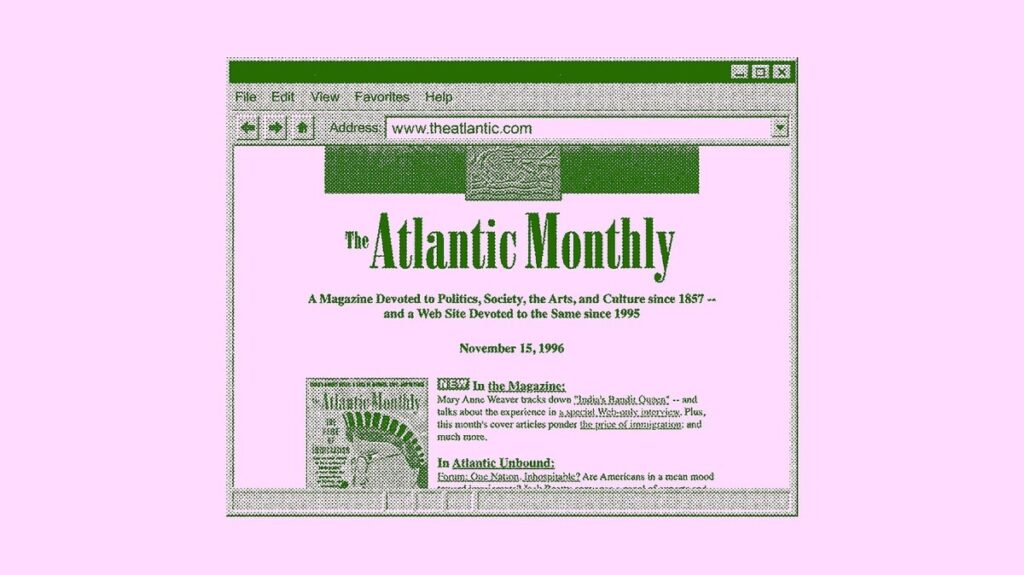
A Piece of Internet History the Internet Almost Forgot
In a reflective piece for Time-Travel Thursdays, The Atlantic revisits its own digital history, marking 30 years since the launch of its website in November 1995. This milestone is not just a celebration of the magazine’s evolution but also a commentary on the rapid transformation of the internet itself. When The Atlantic first went online, it was stepping into an era characterized by optimism and potential, a time when the internet was seen as a platform for serious discourse and intellectual exchange. Yet, as the years have passed, much of this early digital landscape has faded into obscurity, with only a few remnants of The Atlantic’s original website surviving. The irony lies in the internet’s reputation for memory; despite being a repository of vast information, it has largely forgotten the early days of its own development.
In December 1995, the year was dubbed “the Year of the Internet” by Newsweek, marking a significant shift as users began to venture beyond the confines of closed networks like AOL into the broader, more chaotic expanse of the web. This was a time when only 14% of Americans had ever been online, and the introduction of the Netscape browser opened the floodgates to a new world of information. The Atlantic, one of the oldest and most respected magazines in the U.S., embraced this change with its new website, despite skepticism about whether its long-form, intellectually rigorous content would resonate with the fast-paced, bite-sized consumption that the internet seemed to encourage. Early digital discussions, such as a forum with poet Robert Pinsky on his translation of Dante’s *Inferno*, exemplified the magazine’s commitment to fostering meaningful engagement online.
The article highlights the challenges faced by The Atlantic’s early digital team, who navigated the complexities of creating a website with limited resources and technology. Their efforts were driven by a genuine belief in the internet’s potential to connect readers with rich literary content, showcasing works like Longfellow’s translations alongside Pinsky’s modern interpretations. However, as the internet has evolved, so too have the concerns about its impact on reading and intellectual engagement. The initial hopefulness of the digital age has given way to a more skeptical view, with many lamenting the superficiality of online interactions today. As The Atlantic reflects on its past, it poses a poignant question about the future of digital discourse: can we recapture that earnestness and depth in an age where so much feels ephemeral and overwhelming?
https://www.youtube.com/watch?v=j1UhAYgNUZE
This is an edition of Time-Travel Thursdays, a journey through
The Atlantic
’s archives to contextualize the present.
Sign up here.
The Atlantic
launched its website in November 1995, 138 years after it first went into print. The magazine began in response to one
information revolution
; the website appeared at the dawn of another. Now, 30 years on from the launch, you can buy
a copy
of the first printed edition of the magazine on eBay, but you can’t find much of the original website. The internet, notable for remembering
just about
everything, seems to have forgotten that particular piece of its own history.
In some ways, it’s fitting that so few traces are left. The totality of the internet—as both a gathering of information and a way of life—has made imagining the phases of its history almost impossible. Even those who witnessed its beginning can barely remember. We may recall what the dial-up modem’s
weird dirge
sounded like, but it’s hard to quite recapture what happened after it stopped. The early evidence that does survive—the wild optimism, the comically bad predictions, the Flash art—are as easily mocked as they are forgotten. But the
scattered remnants of the
Atlantic Unbound
, as the magazine’s early digital forays were called,
point to an idealism that was genuine in its moment: a time when people believed that online space could foster serious reading and intellectual exchange.
In December 1995, that year was hailed by
Newsweek
as “the Year of the Internet,”
marking the decisive turning point in online life
. It was the year people began to move out of the closed ecosystems of services like AOL, where you logged in and didn’t venture beyond its mail services, chat rooms, and internal content. You could reach the wider internet, but doing so was clunky and limited. And few had tried: Only about 14 percent of Americans had ever been online, and a little more than
30 percent of households
owned a computer at all.
With the introduction of the Netscape browser in late 1994, ordinary people could venture into the wilderness of the open web. No one quite knew how to talk about what the internet was, mixing metaphors about the information superhighway on which you surfed.
Into this moment stepped
The Atlantic
, one of the country’s oldest magazines. When its site went live,
The Atlanta Journal
and
The Atlanta Constitution
included a notice in their printed “On the Internet” page of its Sunday edition, which included a log of “some of the newest sites on the World Wide Web”:
All Things Political
, the American Kennel Club,
George
,
Car and Driver
, and “the venerable Atlantic Monthly—established in 1857.” A media columnist at Toronto’s
Globe and Mail
questioned whether a magazine known to be “sober and intellectually challenging” was really the best fit. Noting that three of the hefty features from that month’s print magazine weighed in “at 21,919 words” total, he wondered if
The Atlantic
and
online
made the best pairing. “Surely a length more suited to reading in a bathtub,” he said, “than on a screen while the Internet meter is running.”
The actual process of taking
The Atlantic
online may feel as quaint as the notion of “the Internet meter.” As then–editorial director for new media, Scott Stossel—now the national editor of
The Atlantic
—told me, building a website involved learning the relevant code by way of the book
HTML for Dummies
. Because the graphics were basic and the bells and whistles were few, the feat of making a webpage was well within the reach of what the special-projects editor, Wen Stephenson (now a correspondent at
The Nation
), described to me as “a bunch of humanities geeks and one tech guy.” Mostly, the work involved moving and formatting large amounts of text from the magazine onto the web—something that was easy enough to do working from electronic files but harder when it came to posting treasures from the magazine’s archive. Because text-recognition software couldn’t make sense of the irregularities of 19th-century typefaces, Stossel told me the editors looked into hiring hand-typists—perhaps the Trappist monks at
Holy Cross Abbey
in Berryville, Virginia—to transcribe portions of the archive.
In the absence of more careful monastic textual-preservation practices, we are left with just one small trace of that original site to read. What survives shows how
The Atlantic
imagined the web—not just as a novelty but as an extension of its literary and intellectual commitments. In April 1995, the magazine hosted a
digital discussion
on AOL with the poet Robert Pinsky, about his
1994 translation of Dante’s
Inferno
. On the new website, any visitor could find selections of Pinsky’s text, including
audio files
of him reading aloud. They could compare Pinsky’s readings with a selection from the
Atlantic
co-founder Henry Wadsworth Longfellow’s own 1867 translation, and navigate to Longfellow’s
sonnets on translating Dante
, which he’d published in the magazine in the 1860s. If they wanted to go really deep, they could click through to the whole of Longfellow’s translation, as well as the original Italian text, both from Columbia’s
Digital Dante Project
.
Such was the promise of the internet in its infancy. Information that had once required real effort to find and transmit (as monks knew well in their painstaking labors) was now together in one place. Pinsky himself had spoken in the AOL forum about poetry as “basically a technology of the sounds of language,” one that could live across time. Here it was, available by dial-up connection on the screen of your pixelated monitor and out of your tinny speakers. If who was reading and why wasn’t entirely clear (the
Globe and Mail’s
columnist lamented that it was impossible to know “how many Web surfers” would actually read longer features), there was at least some sense that engagement was genuine and substantive.
Beginning with the magazine’s partnership with AOL (dating back to 1993) and continuing to forums hosted on the open website, readers could chat with writers about the magazine’s content. After sounding the alarm over the decline of reading in his 1994 book,
The Gutenberg Elegies
, the writer Sven Birkerts gamely came to
The Atlantic
’s
office to sit for an
AOL forum
. As Birkerts took questions (he himself tried to limit his direct interactions with a computer, Stossel told me, by dictating his answers), the pointed, thoughtful back-and-forth made it easy to see why some might well champion the digital culture Birkerts feared. Now, of course, the skeptics, like Birkerts, are the ones who appear to have been right: So much of online life feels hollow and overwhelming.
On the
earliest surviving version
of
The Atlantic
’s website—an archived page from November 1996—a jaunty inkwell-and-plume graphic sits next to a cheerful invitation: “click here to increase your literary fitness.” The link is dead, and no one can quite recall where it went—not the people who were there, not Google, and not AI (ChatGPT took a minute and 35 seconds to tell me it couldn’t come up with anything). That perfect remnant of the early internet—earnest, hopeful about where we might be going—is lost.


