Why Donald Trump Seems Taken With Zohran Mamdani
In a surprising turn of events, the much-anticipated White House meeting between New York’s newly elected mayor, Zohran Mamdani, and President Donald Trump unfolded with an unexpected air of civility and mutual admiration. This meeting, which many expected to be a fiery confrontation given their contrasting political ideologies—Mamdani, a self-proclaimed communist, and Trump, a seasoned political player—transpired instead as a showcase of good manners and cordiality. After a closed-door discussion, the two leaders emerged for a press conference where Trump, seated comfortably in the Oval Office, expressed confidence in Mamdani’s capabilities, stating, “We agree on a lot more than I would have thought.” This was a marked departure from Trump’s previous derogatory remarks about Mamdani, which included insults about his appearance and intelligence, as well as threats to defund the city if he won the mayoral race.
The press conference featured moments that felt more like a comedic skit than a serious political discourse. At one point, when asked if he considered Trump a fascist, Mamdani hesitated, prompting Trump to interject with a smile, suggesting it would be easier for Mamdani to simply say “yes.” This playful banter hinted at a surprising camaraderie that belied their stark political differences. Both men share a populist approach, with roots in Queens, and a disdain for traditional political establishments, which may have contributed to the unexpected rapport. Notably, Mamdani’s victory is seen as a significant shift in New York politics, and Trump, always keen to align himself with perceived winners, seemed to appreciate Mamdani’s confidence and charm, traits that resonated with him.
However, the meeting also serves as a reminder of the complexities of political alliances. While both leaders momentarily set aside their past hostilities, Mamdani must tread carefully in the coming months. Historical precedents, such as the 2017 negotiations between Trump and Democratic leaders Chuck Schumer and Nancy Pelosi, illustrate the potential pitfalls of underestimating Trump’s reaction to perceived slights. Despite the friendly facade, Mamdani’s future as mayor may hinge on his ability to navigate these waters delicately, avoiding any post-victory bravado that could provoke Trump’s ire. The meeting concluded with Trump expressing a willingness to support Mamdani, stating, “I’ll be cheering for him,” but the underlying tension remains, and Mamdani’s strategy will be crucial in ensuring a stable relationship with the federal government moving forward.
Today’s White House meeting between New York’s mayor-elect, Zohran Mamdani, and President Donald Trump suggests that maybe, just maybe, the U.S. government won’t go to war with its largest city. The event was much anticipated as blood sport, a showdown between a young communist and an old despot, to use their favored insults for each other.
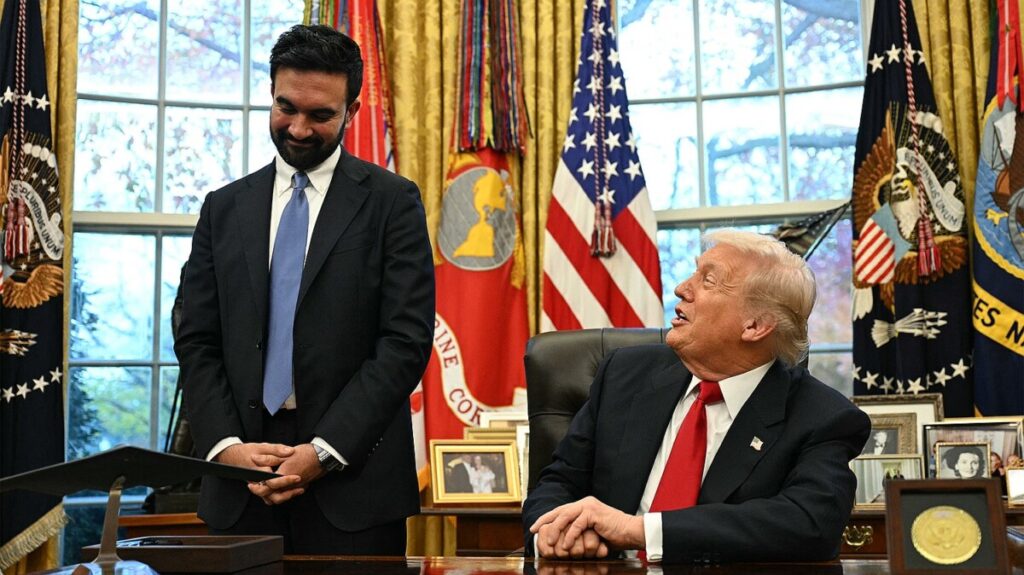
Instead, the two men put on such a show of good manners that at times I had to laugh out loud at the stagecraft. After a closed-door meeting, Trump and Mamdani summoned the press, and there was Uncle Donnie seated behind his desk in the Oval Office, beaming as his favorite nephew, Zohran, stood by his right shoulder looking dutiful.
“We agree on a lot more than I would have thought,” Trump said, peering at Mamdani. “I feel very confident that he can do a very good job.”
He is? Trump, after all, had previously
posted on Truth Social
that Mamdani “looks TERRIBLE, his voice is grating, he’s not very smart.” He had also threatened to defund the city if Mamdani became mayor. Mamdani, for his part,
said of the president
on Election Night earlier this month: “If there is any way to terrify a despot, it is by dismantling the very conditions that allowed him to accumulate power.”
[
Tom Nichols: The president is losing control of himself
]
No hint of such insults—or of attempted “dismantling”—was heard today. When a reporter asked Mamdani whether he considers the president a fascist, the mayor-elect momentarily fumbled. “I’ve spoken about—”
“That’s okay,” Trump interjected. “You could just say ‘yes.’ It’s easier—it’s easier than explaining it.” He smiled indulgently and patted Mamdani on the arm. “I don’t mind.”
This was one of several moments in the press conference that felt more like a
Saturday Night Live
skit than a newscast. But perhaps all this was not as improbable as it looked and sounded. Trump bellows and insults and demeans, but so much of that is an act, guff and bullying. His earlier talk of Mamdani as “my little communist mayor” even carried an odd hint of affection, and there was evident admiration in the way in which he spoke of Mamdani’s unlikely mayoral victory. These men are, in their very different ways, populists, Queens men, and sometimes statists; they share a disdain for political establishments. And Trump, the developer, is aware of the extremely high cost of New York real estate, a focus of Mamdani’s campaign.
Trump always and ever loves winners, whether a
Saudi crown prince
, a billionaire businessman, or, apparently, a democratic-socialist mayor fresh off an underdog win. He also admires those who
dress well
and carry themselves with confidence. Mamdani meets these requirements. He is a well-educated, well-spoken son of privilege; his parents are among the cinematic and academic elite. Several wealthy New Yorkers already talk with him entre nous. Kathryn Wylde, the long-serving president of the Partnership for New York City, a sort of oligarch’s chamber of commerce, offered advice during his campaign and
recently said
that she had voted for Mamdani.
[
Michael Powell: Zohran Mamdani is about to confront reality
]
Mamdani can at times drop his smile and sound confrontational, as he did in his Election Night speech, slamming his vanquished opponent, Andrew Cuomo, and challenging Trump directly. But his more impressive ability as a pol was on display in the weeks that followed, as he slipped into that smile of his once more and quietly went about appointing some wise old hands as mayoral aides.
This afternoon, Mamdani appeared to charm a dangerous foe and, in so doing, perhaps purchased himself a respite from Trump’s threats to send the National Guard to New York. But Mamdani should restrain his postgame talk.
In 2017, Chuck Schumer and Nancy Pelosi, then the Senate and House minority leaders, talked, joked, and negotiated hard with Trump, and they
emerged with a budget deal
so beneficial for Democrats that Republican legislators were startled and wounded. Many Democrats bragged that they’d outmaneuvered Trump, which turned out to be deeply unwise; he remains adversaries with Schumer and Pelosi to this day, of course. Trump prides himself on being a dealmaker and is acutely sensitive to any claim that he has been taken.
In the months to come, Trump could still decide to send the National Guard marching down Broadway, or direct masked Border Patrol agents to raid Roosevelt Avenue in Queens, or try to strip federal funding for housing and bridges. The best way to avoid these outcomes is for Mamdani to accept his victory quietly.
And perhaps he knows that. Mamdani appears to be preternaturally possessed. As the half-hour press conference at the White House wound down, I watched for a presidential slap, or a slip of Mamdani’s genial mask. That never came; in fact, Trump went on to say that he would feel comfortable living in Mamdani’s New York.
“I’ll be cheering for him,” Trump concluded. He shook Mamdani’s hand and, with his other hand, gave him a benevolent pat. I doubt that Mamdani needs any lessons in getting what he wants.


