Thousands of Americans in their 80s are working in professions that can be dangerous
In a compelling exploration of the challenges faced by older workers, Business Insider highlights the stories of individuals aged 80 and above who continue to engage in physically demanding and often risky jobs. Among them is Marc DuMoulin, an 80-year-old school crossing guard in Newton, Massachusetts, who, despite having been hit by a car while on duty, feels compelled to return to work due to financial necessity. DuMoulin’s experience is part of a larger trend: many older Americans find themselves in jobs that pose significant risks to their health and safety, driven not only by the need for income but also by a desire for purpose and connection. According to a Business Insider analysis of 2023 Census Bureau data, over 15,000 Americans aged 80 and older are employed as drivers or in delivery roles, while thousands more work in construction, agriculture, and ground maintenance—fields that are statistically among the most dangerous.
The article emphasizes that many of these older workers are aware of the risks associated with their jobs but choose to continue working due to financial pressures or a sense of fulfillment. For instance, Jim Franck, an 81-year-old homebuilder, finds meaning in his work despite the physical toll it takes on him. He likens his craft to art, stating, “an artist keeps painting until they drop dead.” Similarly, Ruth Harden, an 88-year-old registered nurse, continues to work in an adult day care center, driven by both necessity and a passion for her profession. The piece also notes that while older workers often have the experience to avoid minor injuries, they are at a higher risk of severe injuries and fatalities on the job. Data from the Bureau of Labor Statistics reveals that workers aged 65 and older are 2.5 times more likely to die on the job than younger workers, with a notable increase in fatalities among those over 80.
Business Insider’s coverage sheds light on the complex interplay of necessity, health, and the desire for social engagement that keeps many older Americans in the workforce. The stories of DuMoulin, Franck, and others illustrate not just the economic pressures they face but also the resilience and determination that define this growing demographic of workers. As they navigate the challenges of aging, these individuals highlight the need for better workplace safety measures and support systems tailored to older employees, ensuring they can work safely and productively as they contribute to their communities.
https://www.youtube.com/watch?v=vZYDKEhuwG4
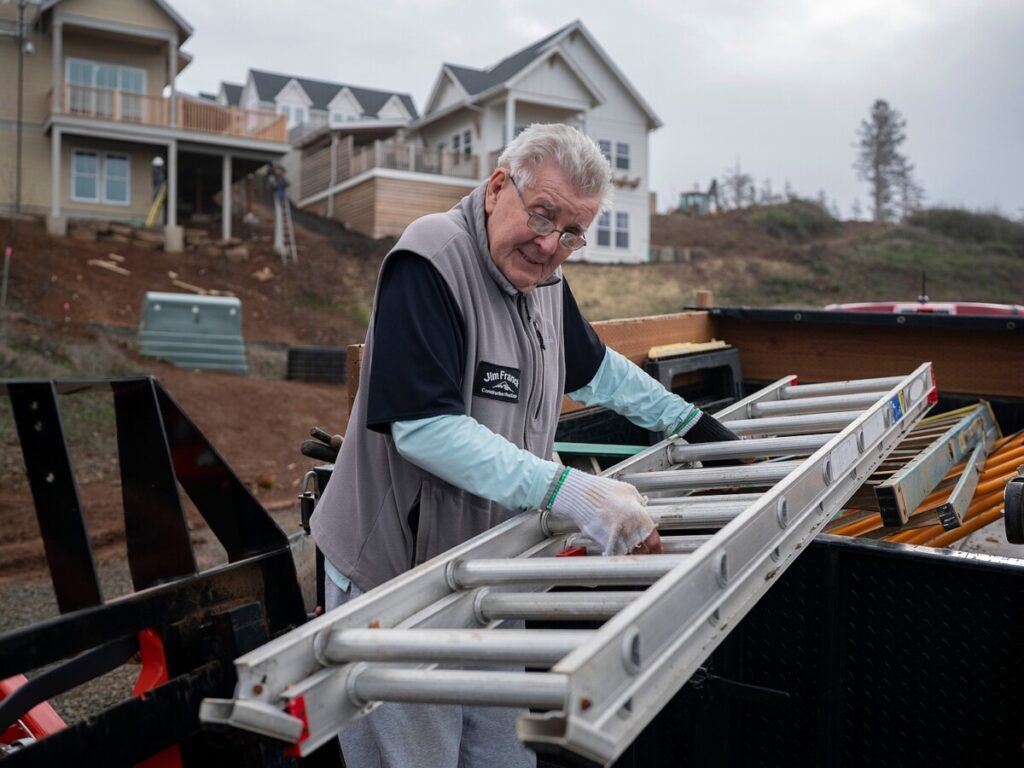
Jim Franck, 81, still works as a homebuilder and still does some more physical tasks.
Brooke Herbert for BI
Standing in the middle of the road in his bright yellow uniform, Marc DuMoulin, 80, grasps his shoulder. A sharp pain rings in the spot where, last year, he was
hit by a car
.
DuMoulin works part-time as a school crossing guard, helping elementary-aged children in Newton, Massachusetts, cross busy streets. Last fall, a driver didn’t stop when DuMoulin raised his red sign. The car hit him.
After a few days’ rest, DeMoulin said he had no choice but to get
back to work
. He needed the money.
“I will work until I won’t be able to move anymore,” DuMoulin said.
He’s one of the thousands of Americans 80 and older who work in professions that can be seen as risky or dangerous — especially for
older workers
. Business Insider has interviewed nearly 200 people in this age group to explore why they continue to work into their twilight years. Most people who spoke to Business Insider over the past year have jobs that pose little direct risk to their physical health. Some hold more
physically demanding
roles — like homebuilding, which 81-year-old Jim Franck says brings meaning to his life. Others work physically demanding jobs because they need the money.
These jobs can be dangerous — even deadly. A Business Insider analysis of 2023 Census Bureau data found that thousands of Americans 80 and older work in the top 10 most dangerous professions, as defined by government statisticians and measured by total fatal injuries. Over 15,000 work as
drivers
or make deliveries. Nearly 4,600 are ground maintenance workers. More than 2,500 are agricultural workers, and about 3,100 are
construction
laborers and helpers. Hundreds are loggers, roofers, and garbage collectors.
Business Insider’s “80 over 80” series draws on interviews with the growing group of Americans working past their 80th birthdays. They discussed their careers, retirement planning, living expenses, healthcare, and life lessons. If you are 80 and older and still work,
fill out this form
to contribute to the series
and read more here:
Workers over 80 say jobs that help their peers live longer and better are the best they can get
She’s 93 and still job searching. Why older Americans work, even if they’re sick.
Starting a business in your 80s isn’t easy — but it may be the only way to earn a living
From 6 figures to minimum wage: America’s oldest workers are taking pay cuts
These 80-somethings are using AI more than you
Older Americans in their 80s are applying for jobs — and hitting a wall
They’re in their 80s, still working, and living paycheck to paycheck
What work looks like in your 80s for half a million Americans
81 and working to survive
In interviews, more than a dozen people in these professions said they considered themselves healthy enough to
keep working
. They said they understood the risks. Some said they tried not to work in the dark, didn’t drive during peak traffic hours, and avoided lifting heavy objects.
DuMoulin became a crossing guard over five years ago. His earnings go toward rebuilding his
safety net
after spending thousands of dollars on medications and doctor visits for his vascular surgeries and chronic kidney disease. It was one of the few jobs he could find after a career with the US State Department and as a consultant. His
Social Security
isn’t enough to cover his expenses.
Walking and standing are strenuous activities, he said, and the rain or heat can worsen his symptoms. Still, DuMoulin isn’t sure he’d stop even if he could
financially make it work
. Connecting with the students, their parents, and their pets has made his 5 a.m. alarm less bothersome, he said.
“I will work until I won’t be able to move anymore,” DuMoulin said.
Even in jobs that aren’t typically considered risky for younger people, dozens of people over 80 who Business Insider interviewed said they worried about getting hurt on the job. Some
retail workers
said they feared that being on their feet all day could make them vulnerable to falling. Some
medical workers
said they worried their lives could be at risk if they had to help a patient stand up. A few other workers thought they could be targets of crimes given their age and potential vulnerability. Many said they suspected their preexisting conditions, like arthritis or vision problems, could one day cause havoc on the job.
Ruth Harden, 88, knows there are risks to being on her feet as a registered nurse for an adult day care center, a position she’s had for more than two years after years of struggling to secure work. Harden, who lives in San Diego,
can’t afford to retire
, but at her age, she’s just starting a Ph.D. program in nursing at the University of San Diego and plans to work until she can’t.
Ruth Harden, 88, said she hasn’t let her health get in the way of her nursing job.
Courtesy of Ruth Harden
“I feel better now than I’ve felt in more than 40 years, but I’ve gone through heart attack after heart attack, unable to work with many hospital bills,” Harden said. “I’ve got stiff knees, and I do use a cane occasionally, but other than that, I don’t have any problems.”
Data suggest that the
rate of minor injuries
among older workers declines slightly with age, as they are more experienced and often healthier if working past retirement age. The rate of severe injury and fatality, however, increases with age. As of 2023, workers 65 and older were 2.5 times more likely than workers of all ages to die on the job, at a rate of 8.7 per 100,000 workers, according to data from the Bureau of Labor Statistics.
A Business Insider analysis of fatality data from the Occupational Safety and Health Administration found that since the start of 2020, 67 workers age 80 and older have died from a
work-related injury
or illness, a figure that appears to have never been reported in the media because research on workers in this demographic is sparse. This is up from 40 fatalities in this demographic between 2011 and 2019. These numbers are likely an undercount, as some deaths may not be reported to OSHA.
And an analysis of the Bureau of Labor Statistics’ Census of Fatal Occupational Injuries revealed that workers 65 and older have a rising share of the total number of fatal injuries at work over the last two decades.
Among those who OSHA reported died at work: A 91-year-old man in North Dakota fell and struck his head while making a bed at a hospital. An 86-year-old woman in Tennessee was pinned underneath a dolly at a transportation company. An 83-year-old woman in Ohio died from asphyxiation after her shirt was caught in a drill bit. An 81-year-old man in Florida was stabbed at a retirement community where he was a safety officer.
In 2023, Monique Morrissey, a senior economist at the Economic Policy Institute, determined based on 2018 American Working Conditions Survey microdata that roughly half of workers aged 50 to 70 work in physically demanding jobs, while nearly half hold
high-pressure roles
, such as those with tight deadlines or fast-paced work. Many of these jobs don’t pay enough for a
proper retirement
, Morrissey told Business Insider, adding that reduced access to disability benefits and threats to long-term Social Security solvency could keep workers in riskier jobs for longer.
Sometimes, a risky job is the only one available
Lugging 16 tons of stone across the highway, Merle Heckman, 82, slams the brakes on his dump truck and honks the horn. It’s the fifth time he was cut off that day.
“Everybody’s in a hurry, nobody’s willing to wait, nobody has any patience on the highway,” Heckman says. “These drivers don’t realize that the truck weighs 11 tons, and it’s 27 tons total. You can’t stop on a dime.”
He’s been driving since 7:30 a.m. and expects to finish by 6:30 p.m. He’s grown to love the job. It
keeps his mind alert
and isn’t too physically demanding, though he never anticipated doing it.
Heckman spent most of his career in accounting and construction. A business he founded in 2003 closed in 2019 due to some poor investment choices, he said. He withdrew most of his
401(k)
savings, declared bankruptcy, and lost his home.
He couldn’t secure another accounting job, so he got a commercial driver’s license and found work delivering mulch and stone to houses in North Carolina. The $600 to $800 weekly pay helps him pay off the five-year loan on a new house.
Merle Heckman operates a dump truck at 82, often working long hours.
Courtesy of Merle Heckman
It can be difficult for someone over 80 to find a job — especially a
higher-paying
role. For many older workers, lower-paying, sometimes riskier jobs can be the only option.
James Atkinson, vice president of thought leadership at the Society for Human Resource Management, said older workers are more willing to learn and adapt quickly than many hiring professionals would believe. Only 7% of organizations have formal or informal recruiting targeted at workers 65 and older, he said.
Richard Smith, 81, drives for
DoorDash
between shifts at a campsite, where he patrols the grounds nightly and maintains security. Smith spends half the year in an RV in New Hampshire and the other half in Florida. He said he couldn’t find a six-month part-time job, so he delivers Mondays through Wednesdays in the afternoons and evenings, aiming to earn about
$100 a day
.
Richard Smith, 81, is on the road around 15 to 20 hours a week, driving for DoorDash.
Courtesy of Richard Smith
Smith, whose wife is a housekeeper, said his health is good enough that he can drive “fairly well,” but he’s uncomfortable driving fast. He hopes to continue for a few more years, given that he has less than $20,000 in his IRA and no other savings.
“There may come a period in life when we’ll have to stay in Florida all year for health reasons, and I’ll need to find a year-round job,” Smith said.
Unable to quit
After a series of rejections, Horace Cathcart, 82, found a job in 2023 that he never expected someone his age to do: an umpire for youth baseball games.
Cathcart, who lives in Washington state with his wife, worked in sales for 35 years before transitioning to a computer repairman. After a few years of retirement, he was back on the
job market
.
Horace Cathcart works as an umpire outside Seattle.
Courtesy of Horace Cathcart
He said his job is “very dangerous.” He can get hit by a ball at any time, and he sometimes has to separate fights. He’s heard of umpires getting attacked by people who disagree with their calls.
“Without this job, we’d probably be struggling,” Cathcart said. He said he earns about $50 to $90 per game. “This carries me over to the next spring.”
Siavash Radpour, an assistant economics professor who studies aging at Stockton University in New Jersey, said that as older Americans comprise more of the labor force, more may end up in physically demanding jobs.
“Historically, older workers had seniority, so they were protected against recession and layoffs, but that’s not the case anymore,” Radpour said.
John Gercher, 81, said the extra income from driving a school bus helps after a series of financial setbacks years ago left him with less savings than he had anticipated for this stage of his life.
Gercher, who lives in Pennsylvania, worked for 33 years at Xerox, and said he lost much of his savings amid the dot-com bubble. That loss, combined with his desire to travel, left him with tight
retirement savings
, though he said he doesn’t have to work anymore. He became a bus driver seven years ago when his district was desperate for drivers. He said his main reason for working is the joy of giving back to his community.
Gercher has cataracts developing, and though he has passed his vision test and physical, he doesn’t think he’ll drive past next year. The only physical limitations he’s felt at his job are checking the bus for any belongings left behind.
“I’m healthy mentally, but I don’t want to overstay my welcome, especially when transporting kids,” Gercher said.
Risky jobs can come with a thrill
Some older workers in jobs that can be seen as more dangerous say they like the work for the thrill of it — not because they necessarily need the money.
Bill Miller, 82, drives a forklift because he has “too much fun” doing it.
Katie Linsky Shaw for BI
Bill Miller, an 82-year-old real-estate broker in North Carolina, said he’s cut back on real estate because he has “too much fun driving” a forklift.
Miller doesn’t need to
work for financial reasons,
but said working has been essential to keeping his mind and body active. For 15 to 20 hours a week, Miller operates a forklift, backhoe, tractor, and scissor jack, primarily for a friend or local organizations.
“Some days, I’m loading trucks with steel with a forklift, and other days, I’m covered in grease doing manual labor,” Miller said.
For John DeBeaumont, 82, every workday is about
staying healthy
and preserving his family’s legacy.
His father opened a small ready-mix concrete company over 55 years ago. He took it over and ran it with his son until six years ago, and now serves as an advisor.
He wakes up at 4:30 a.m. and works until around noon, which can involve
physical labor
. He has struggled to find enough staff to keep his business running, but he hopes to scale back in the coming years.
“I can sell the business, but if I did that, I know a lot of people who have retired and died the next year,” said DeBeaumont, who lives in the Bay Area of California.
Dix Roberts, 88, runs Roberts Family Farms in Utah with his wife, Ruth, and their children. Roberts works to challenge himself. Ruth, 83, sells produce at farmers’ markets a few times a month.
Dix Roberts, 88, does some manual tasks around the family farm.
Courtesy of Dix Robert
“I’m doing the amount of work that I can do while feeling safe doing it,” Roberts said. “I help control the weeds, which is an easy job. I ride a four-wheeler with a 15-gallon tank on the side and a 100-foot hose.”
One wrong step can be disastrous
The potential danger in some of these jobs can be inescapable for older people.
In 2018, George Pierce, now almost 80, was working as a mechanic in Maryland, a position he had held for three decades. One day, he stumbled over a jack and injured his left knee.
The accident was responsible for the majority of his injuries, doctors determined, as he also had some preexisting conditions that contributed. He underwent a left total knee replacement two years later, followed by another reconstructive knee surgery the following year. He won nearly $83,000 in a settlement; Business Insider has reviewed the settlement documents. Money has been tight because Pierce can no longer work and struggles with daily tasks like walking or cleaning.
Pierce considered part-time work, but mobility issues have narrowed his options. He stays active to maintain his strength and budgets carefully to keep up with his bills.
“My dad always said to put something away for a rainy day because you never know what’s going to happen,” Pierce said.
Business Insider analyzed dozens of workplace compensation lawsuits filed by some of America’s oldest workers, mostly in their 70s, and some in their 80s. The cases showed that, in many instances, a slippery floor, a misplaced sign, or a dark room resulted in injuries serious enough for
major surgeries
and years of recovery. Many of these cases centered on people working in the most unsafe industries.
Experts in workplace safety and ergonomics told Business Insider that workplaces should do more to support older workers’ ability to work safely and productively. Gigi Petery, a professor at Western Kentucky University who previously worked as a manager at the National Institute for Occupational Safety and Health, said workplaces should focus on three pillars of workability: physical work environment, work organization, and individual health management.
This can be as simple as removing trip hazards, installing proper signage, and ensuring proper lighting, or more advanced changes like implementing tools that require less strength to operate, Petery said.
Jim Franck said he has no intentions of stopping his homebuilding work.
Brooke Herbert for BI
Jim Franck, the 81-year-old contractor, knows that one wrong step could put an end to his career as a
homebuilder
, but the risk hasn’t stopped him.
Franck, who lives in Oregon, has been a homebuilder for more than five decades in the US and the US Virgin Islands. He’s avoided doing too much physical labor and has taken on more of a supervisory role, but he drives a backhoe and builds decks and fireplaces, despite the soreness and back pain it can cause.
“It’s like an art to me, and an artist keeps painting until they drop dead,” Franck said.
Read the original article on
Business Insider


