Slavery’s brutal reality shocked Northerners before the Civil War − and is being whitewashed today by the White House
The Trump administration’s recent review of Smithsonian exhibits related to slavery and other historical topics has ignited a significant debate over how American history should be presented and remembered. Under the directive of an executive order titled “Restoring Truth and Sanity to American History,” the administration aims to remove what it deems “revisionist” materials that reflect negatively on the nation’s past, favoring a narrative that celebrates American achievements over the uncomfortable truths of historical injustices. This initiative echoes a long-standing conflict in American society that dates back to the 19th century, a period marked by intense debate over the morality and implications of slavery. Southern defenders of slavery argued that it was divinely sanctioned and beneficial to enslaved individuals, while abolitionists vehemently countered that slavery was a system of violence and hypocrisy that demanded public acknowledgment and condemnation.
Among the exhibits flagged for removal is a harrowing photograph known as “The Scourged Back,” which starkly depicts the scars of a formerly enslaved man, a visual testament to the brutality of slavery. Critics of the administration’s approach argue that such images and narratives are essential in confronting the historical realities of oppression and injustice. They draw parallels between the current attempt to sanitize history and the efforts of abolitionists in the 19th century, who used documented evidence and eyewitness accounts to expose the cruelties of slavery. Activists like Lydia Maria Child and Angelina Grimké emphasized the importance of presenting the harsh truths of slavery to a public that often preferred to remain ignorant or misled by pro-slavery propaganda. The abolitionist movement relied heavily on factual documentation, including testimonies of abuse, to galvanize public opinion against the institution of slavery, a strategy that remains relevant in contemporary discussions about historical memory and accountability.
The push to revise historical narratives raises critical questions about national identity and the responsibility of society to confront its past. The abolitionists understood that acknowledging the painful truths of history is vital for progress and healing. As they sought to “shock consciences” and compel Americans to confront the realities of slavery, they laid the groundwork for future generations to engage with difficult aspects of history. Today, as debates about historical representation continue, the call to “look at this” remains crucial; it serves as a reminder that understanding our past, including its injustices, is essential to fostering a more equitable future. The ongoing discourse surrounding these exhibits is not merely about historical facts but reflects broader societal values and the imperative to learn from history rather than erase it.
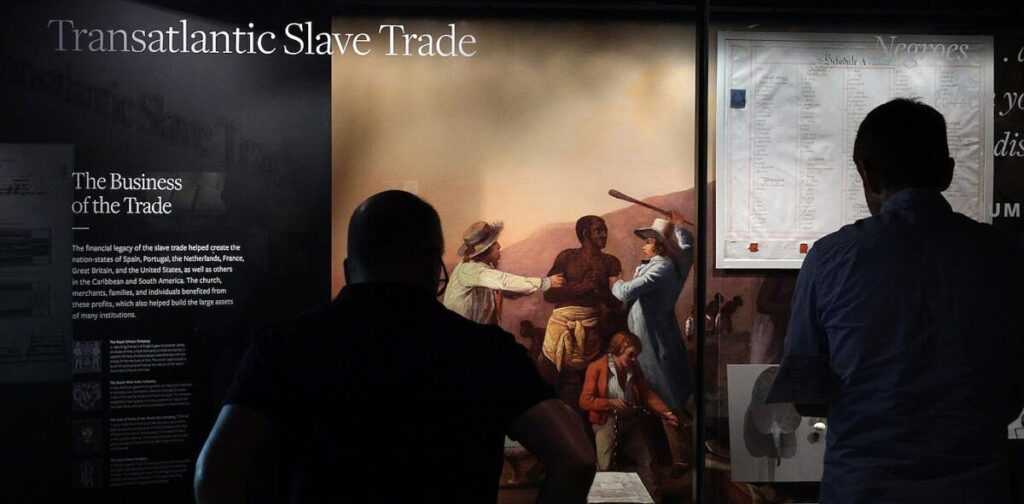
The Trump administration is reviewing Smithsonian exhibits on slavery and other topics to reflect certain values.
Alex Wong/Getty Images
Long before the first shots were fired in the Civil War, beginning early in the 19th century, Americans
had been fighting a protracted war of words
over slavery.
On one side, Southern planters and slavery apologists
portrayed the practice of human bondage
as
sanctioned by God and beneficial
even to enslaved people.
On the other side, opponents of slavery
painted a picture
of violence, injustice and the hypocrisy of professed Christians defending the sin of slavery.
But to the abolitionists, it became crucial to transcend mere rhetoric. They wanted to show Americans uncomfortable truths about the practice of slavery – a strategy that is happening again as activists and citizens fight modern-day attempts at historical whitewashing.
As a
media scholar who has studied
the history of abolitionist journalism, I hear echoes of that two-century-old narrative battle in President Donald Trump’s
effort to purge public memorials
and markers honoring the suffering and heroism of the enslaved as well as those who championed their freedom.
Celebration vs. reality
‘The Scourged Back,’ by McPherson & Oliver, is an 1863 image that depicts the scarred back of a formerly enslaved man.
Courtesy National Gallery of Art, Washington
Among the materials
reportedly flagged for removal
from history museums, national parks and other government facilities is a disturbing but powerful photograph known as “
The Scourged Back
.”
The 1863 image depicts a formerly enslaved man, his back horrifically scarred by whipping. It’s certainly hard to look at, yet to look away or try to forget it means to ignore what it has to say about the
complicated and often brutal history of the nation
.
In Trump’s view, these memorials are “revisionist” and “driven by ideology rather than truth.” In an executive order named
Restoring Truth and Sanity to American History
, Trump said public materials should “focus on the greatness of the achievements and progress of the American people.”
Essentially, the president appears to want a history that
celebrates American achievement
rather than being forced to look at “The Scourged Back” and other historical realities that document aspects of the American story that don’t warrant celebration.
Combating ignorance of slavery’s horrors
Thinking back to the decades leading up to the Civil War, facts were the weapon abolitionists wielded in their fight against the distortions of pro-slavery forces. It was an uphill battle in the face of indifference by many in the North. After a visit to Massachusetts in 1830, abolitionist writer William Lloyd Garrison
blamed such attitudes
on “exceeding ignorance of the horrors of slavery.”
It is not surprising that in the early 19th century many Americans would have had limited knowledge of slavery. Travel was arduous, time-consuming and expensive, and most Northerners had little firsthand exposure to slave societies. Abolitionists argued that those who did visit the South were often shielded from the harsher realities of slavery. This extended to the media ecosystem, which lacked any real national news organizations.
Moreover, Southern plantation owners carried out a robust propaganda effort to extol the beneficence of their economic system. In
letters
,
pamphlets
and books, they argued that slavery was beneficial to all and that the enslaved were happy and well-treated. They also attacked their opponents as evil and dishonest.
As abolitionist Lydia Maria Child
wrote in 1838
: “The apologists of Southern slavery are accustomed to brand every picture of slavery and its fruits as exaggeration or calumny.”
Don’t look away
Thus, the challenge for abolitionists was to show slavery as it really was – and to compel people to look. An emphasis on hard evidence took firm hold in the wave of abolitionism in the 1830s.
Activists didn’t yet have photography, so they relied on accounts from eyewitnesses and formerly enslaved people, official reports and even some plantation owners’ own words in
Southern newspaper advertisements seeking the return of runaways
.
“Until the pictures of the slave’s sufferings were drawn up and held up to public gaze, no Northerner had any idea of the cruelty of the system,” abolitionist Angelina Grimké wrote in her famous “
Appeal to the Christian Women of the South
” in 1836.
“It never entered their minds that such abominations could exist in Christian, Republican America; they never suspected that many of the gentlemen and ladies who came from the South to spend the summer months in travelling among them, were petty tyrants at home,” Grimké wrote.
In pamphlets and newspapers, Grimké and others laid down a documentary record of the abuses of slavery, naming names and emphasizing legal evidence of their claims.
In my research
, I have argued that while abolitionists didn’t invent the journalistic exposé, they did develop the first fully articulated methodology for confronting abuses of power through carefully documented facts – laying the groundwork for later generations of investigative reporters and fact-checkers.
Most critically, what they did is point a finger at injustice and demand that America not look away. In its first issue, in 1835, the newspaper Human Rights emphasized “the importance of first settling what slavery really is.” Inside, it included a series of advertisements documenting slave sales and rewards for runaways reprinted from Southern newspapers.
The headline: “
LOOK AT THIS!!
”
Tried and acquitted
Angelina Grimké was an abolitionist writer.
Library of Congress
One of the most remarkable efforts in this abolitionist campaign was a 233-page pamphlet called “
American Slavery As It Is: Testimony of a Thousand Witnesses
.” Published in 1839 by Theodore Dwight Weld along with his wife, Angelina Grimké, and her sister, it was an exhaustively documented exposé of floggings, torture, killings, overwork and undernourishment.
One example involved a wealthy tobacconist who whipped a 15-year-old girl to death: “While he was whipping her, his wife heated a smoothing iron, put it on her body in various places, and burned her severely. The verdict of the coroner’s inquest was, ‘Died of excessive whipping.’ He was tried in Richmond and acquitted.”
It is difficult reading, to be sure, and certainly the kind of material that might foster “a national sense of shame,” as Trump’s executive order claims. But getting rid of the evils of slavery meant first acknowledging them. And the second part – critical to avoiding the mistakes of the past – is remembering them.
‘Consciences shocked’
So how effective was this abolitionist campaign to lay bare the terrible facts about slavery?
At least some readers of “
American Slavery As It Is
” had their consciences shocked.
One New Hampshire newspaper reacted this way
: “We thought we knew something of the horrid character of slavery before, but upon looking over the pages of this book, we find that we had no adequate idea of the number and enormity of the cruelties which are constantly being perpetrated under this system of all abominations.”
And
one famous reader was Harriet Beecher Stowe
, who drew on the book as inspiration for “Uncle Tom’s Cabin,” published more than a decade later.
The 1830s reflected the height of the abolitionist movement in books, pamphlets and newspapers. While the activism continued in the 1840s and 1850s, ultimately it took secession and civil war to finally end slavery. But, of course, it didn’t take long for the country to fall into a prolonged period of formal and informal segregation in both the North and the South, many vestiges of which remain.
That reality of a history that doesn’t proceed along a straight path to justice underscores the importance of preserving, remembering and teaching difficult parts of the past such as “The Scourged Back.”
On the title page of “
American Slavery As It Is
,” Weld and the Grimkés printed a quote from the biblical book of Ezekiel: “Behold the wicked abominations that they do.” It was a command to the nation to look without flinching at what it was, and it is as pertinent today as it was then.
This article was corrected to include the correct image of Angelina Grimké.
Gerry Lanosga does not work for, consult, own shares in or receive funding from any company or organization that would benefit from this article, and has disclosed no relevant affiliations beyond their academic appointment.


