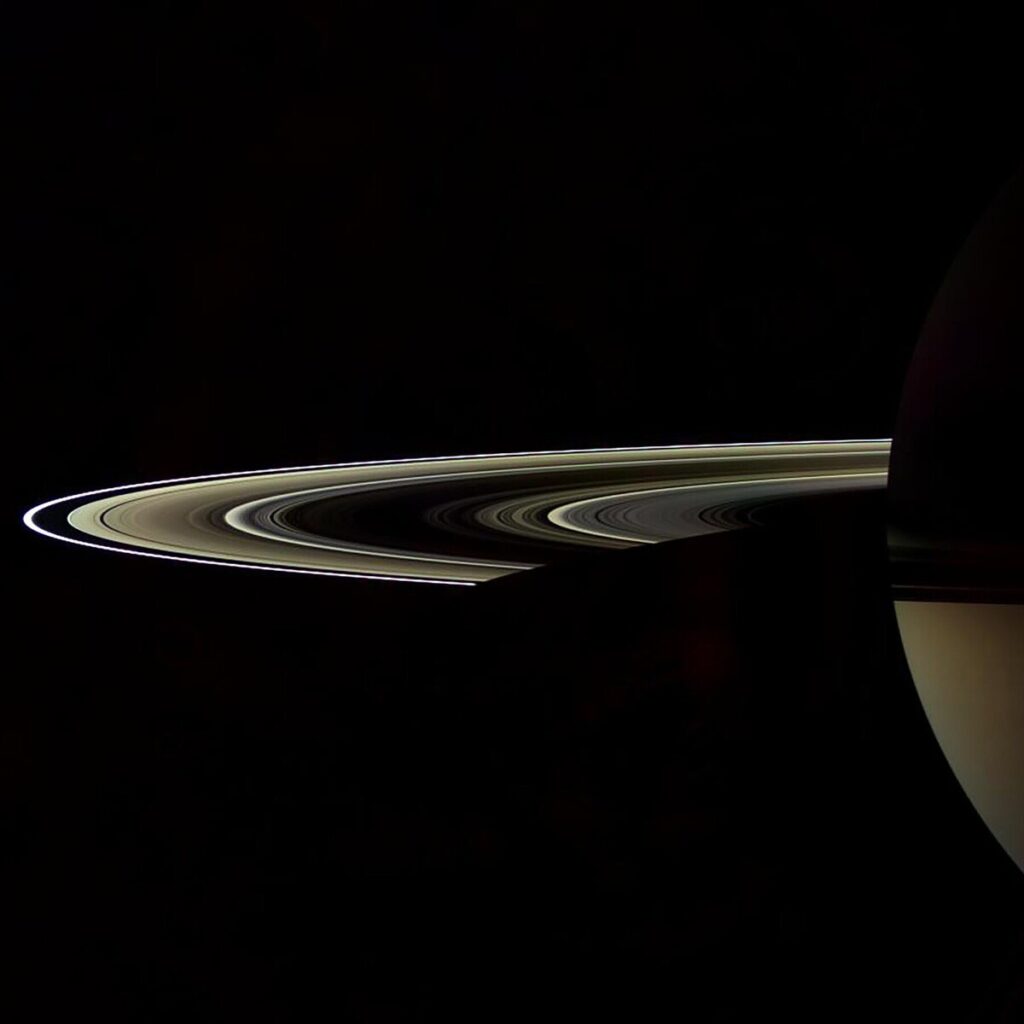
Saturn’s Rings Seem as if They’re About to Disappear: Here’s Why
On Sunday, skywatchers will have a unique opportunity to witness Saturn’s rings in a rare and fleeting phenomenon that will render them nearly invisible from Earth. This celestial event occurs when Saturn and the Sun align in such a way that the planet’s iconic rings, which are typically visible through telescopes and even with the naked eye under optimal conditions, will be edge-on to our line of sight. This alignment, known as a ring plane crossing, happens approximately every 15 years, and it provides a striking reminder of the dynamic nature of our solar system.
The Cassini spacecraft, which orbited Saturn from 2004 until its mission concluded in 2017, provided us with unprecedented insights into the planet’s rings. Cassini’s detailed observations revealed that Saturn’s rings are not solid but rather composed of countless small particles, ranging from tiny dust grains to large chunks of ice. These particles reflect sunlight, giving the rings their brilliant appearance. However, during this specific alignment, the rings will appear as a thin line, making them challenging to spot without the aid of a telescope. This event serves as a fascinating reminder of the intricate dance between celestial bodies and the ever-changing perspectives we have of them from Earth.
For amateur astronomers and enthusiasts, this is an excellent opportunity to engage with the cosmos. While the rings may be difficult to discern, the event is a perfect occasion to discuss and appreciate the science behind Saturn’s rings and the discoveries made by the Cassini mission. As Saturn’s rings become nearly invisible, it highlights the importance of ongoing exploration and study of our solar system, reminding us of the wonders that lie beyond our planet. So, mark your calendars for Sunday and prepare for a moment of cosmic alignment that underscores the beauty and complexity of the universe we inhabit.
Saturn’s rings, observed by the Cassini spacecraft. They will be all but invisible when viewed from Earth on Sunday.