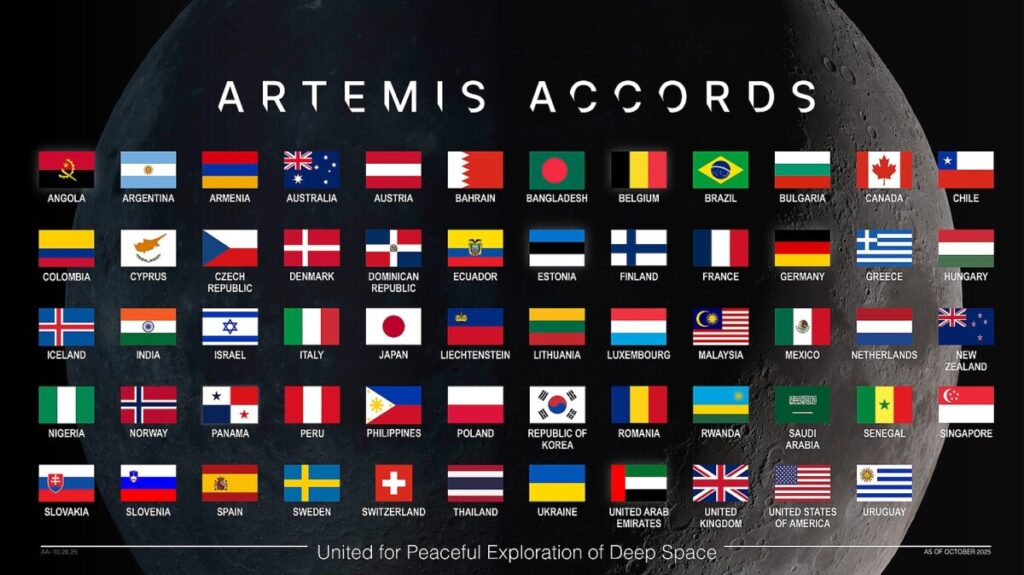
NASA Celebrates Five Years of Artemis Accords, Welcomes 3 New Nations
In October 2023, NASA celebrated the fifth anniversary of the Artemis Accords, a pivotal framework aimed at fostering international cooperation for the peaceful exploration of space. The recent addition of Hungary, Malaysia, and the Philippines has brought the total number of signatory nations to 59, underscoring a growing global commitment to responsible space exploration. Acting NASA Administrator Sean Duffy highlighted the significance of these new signatories, stating that their involvement reinforces a collective dedication to safe and transparent practices in space, especially in an era where the potential for militarization of outer space looms large. This coalition is seen as a cornerstone for what many hope will be a new Golden Age of space exploration, characterized by collaboration rather than competition.
The signing of the Artemis Accords by Malaysia and the Philippines coincided with President Trump’s visit to Kuala Lumpur for the annual Association of Southeast Asian Nations Summit, showcasing the geopolitical importance of space diplomacy. Hungary’s Foreign Minister Péter Szijjártó signed the accords during an official visit to Washington, shortly after Hungarian astronaut Tibor Kapu made headlines with his mission aboard a SpaceX Dragon spacecraft to the International Space Station. This progression reflects not only Hungary’s aspirations in space exploration but also the broader international trend of countries recognizing the value of collaboration in advancing scientific and exploratory goals.
Since their inception on October 13, 2020, the Artemis Accords have expanded significantly from an initial group of eight founding nations to a robust coalition of nearly sixty. This growth illustrates a heightened global interest in lunar activities and the sustainable use of space resources. Recent meetings, such as the Artemis Accords Principals’ Meeting co-chaired by NASA, Australia, and the UAE in Sydney, have focused on critical issues like non-interference in space activities, orbital debris mitigation, and the interoperability of systems to enhance safety and efficiency. With plans for future workshops aimed at promoting data transparency, NASA and its partners are laying the groundwork for a cooperative approach to lunar exploration, the Mars missions, and beyond. As more nations express interest in signing the accords, the framework is poised to play a crucial role in shaping the future of international space exploration.
For more information on the Artemis Accords, visit [NASA’s official page](https://www.nasa.gov/artemis-accords).
NASA
October marked the fifth anniversary of NASA and the original founders signing the Artemis Accords, as well as the recognition of Hungary, Malaysia and the Philippines joining the expanding coalition dedicated to the peaceful exploration of space. The number of countries involved now totals 59.
“NASA welcomes the newest signatories, whose participation strengthens the global commitment to responsible exploration,” said acting NASA Administrator Sean Duffy. “Their decision to sign the Artemis Accords affirms a shared commitment to safe, transparent, and peaceful exploration — at a time when others seek to weaponize the final frontier. Together we are building the foundation for the Golden Age of space exploration.”
Both Malaysia and the Philippines signed the Artemis Accords as part of President Trump’s visit to Kuala Lumpur for the annual Association of Southeast Asian Nations Summit. The separate signings were
announced
by the White House on Oct. 26.
Foreign Minister Péter Szijjártó of Hungary signed the Artemis Accords on Oct. 22 while in Washington during an official visit, in the lead up to President Trump’s meeting with Prime Minister Viktor Orbán.
Hungary’s signing came three months after Hungarian to Orbit (HUNOR) astronaut Tibor Kapu
launched to space
in a mission aboard a SpaceX Dragon spacecraft to the International Space Station. The private astronauts, part of the NASA-supported Axiom Mission 4 crew, spent about two weeks conducting science, outreach, and commercial activities, alongside NASA astronauts.
Five years of progress
On Oct. 13, 2020, during the first Trump Administration, the United States, led by NASA and the U.S. Department of State, joined with seven other founding nations to establish the Artemis Accords, responding to the growing interest in lunar activities by both governments and private companies.
Since then, the Artemis Accords have grown into an international coalition. What began with a handful of founding nations has multiplied with seven countries signing in 2025 alone. The surge in participation highlights an increased global commitment to shaping a safe, peaceful, and prosperous future in space.
In September, NASA co-chaired the
Artemis Accords Principals’ Meeting in Sydney
alongside the space agencies of Australia and the United Arab Emirates. The gathering brought together dozens of signatory nations to deepen dialogue and strengthen shared commitments to the sustainable and responsible use of space. Global space leaders discussed the following topics:
Non-interference in each other’s space activities, including transparency on expected launch dates, general nature of activities, and landing location
Orbital debris mitigation
Interoperability of systems for safer and more efficient operations
Release of scientific data
At the meeting, NASA committed to hosting an Artemis Accords workshop in 2026 for signatories focused on transparency and the sharing of data. The agency has taken additional steps since the accords were established to release more information about lunar missions, promoting openness and preventing harmful interference.
The progress made by signatories, and their continued commitment to implementing the accords’ principles, is essential to advancing sustainable exploration of the Moon under the Artemis campaign, Mars, and beyond. Following a call to Artemis Accords signatories, four CubeSats from South Korea, Saudi Arabia, Argentina, and Germany,
will fly
on Artemis II.
More nations are expected to sign the accords in the months and years ahead, as NASA and its partners continue to advance the principles of the accords.
Learn more about the Artemis Accords at:
https://www.nasa.gov/artemis-accords
Share
Details
Last Updated
Nov 20, 2025
Location
NASA Headquarters
Related Terms
Artemis Accords
Artemis 2
General
Office of International and Interagency Relations (OIIR)


