Farmers – long Trump backers – bear the costs of new tariffs, restricted immigration and slashed renewable energy subsidies
In recent years, U.S. farmers, particularly those growing soybeans, have found themselves increasingly at odds with the policies of the Trump administration, which have begun to threaten their livelihoods. Historically, farmers have maintained a strong allegiance to Trump, even in the face of economic pressures from tariffs, trade wars, and labor shortages. However, as the administration embarks on a second term, the impact of renewed tariffs, visa restrictions for farm workers, reduced subsidies, and favoritism toward South American agricultural competitors is starting to reshape the agricultural landscape. For instance, the ongoing U.S.-China trade conflict has once again placed soybean exports at risk, with China suspending import licenses for major U.S. exporters in response to new tariffs. This has resulted in U.S. soybean prices plummeting to levels 40% to 50% lower than pre-2018 rates, leaving farmers with record volumes of unsold crops and little hope for government bailouts, which are less forthcoming this time around.
Labor shortages further complicate the situation for American farmers. With approximately 42% of U.S. crop workers lacking legal status, stricter immigration policies and slow visa processing have exacerbated the labor crisis, coinciding with rising production costs. Many farmers are increasingly reliant on the H-2A guest worker program, which, while providing a legal pathway for seasonal labor, imposes significant financial burdens that small family farms struggle to bear. As these economic pressures mount, farmers have begun to question the value of their loyalty to Trump, particularly in light of recent actions perceived as undermining their interests, such as a $20 billion currency-swap deal with Argentina, a direct competitor in the soybean market. This sentiment was echoed by the head of the American Soybean Association, who publicly urged the White House for support, stating, “We’ve had your back. We need you to have ours now.”
Moreover, the Trump administration’s shift in focus away from traditional agricultural subsidies towards renewable energy projects has left many farmers in a precarious position. While wind and solar projects have provided much-needed income to rural areas, a recent policy change has put billions in rural renewable energy investments on hold, jeopardizing a crucial revenue stream for many farmers. As the agricultural community grapples with these challenges, the question arises: will cultural loyalty to Trump continue to outweigh the tangible economic losses? While a complete collapse of rural support for Trump is unlikely, the visible strain on this alliance suggests that the second trade war could lead to a significant political shift in rural America, as farmers increasingly demand pragmatic trade policies and labor reforms to safeguard their futures.
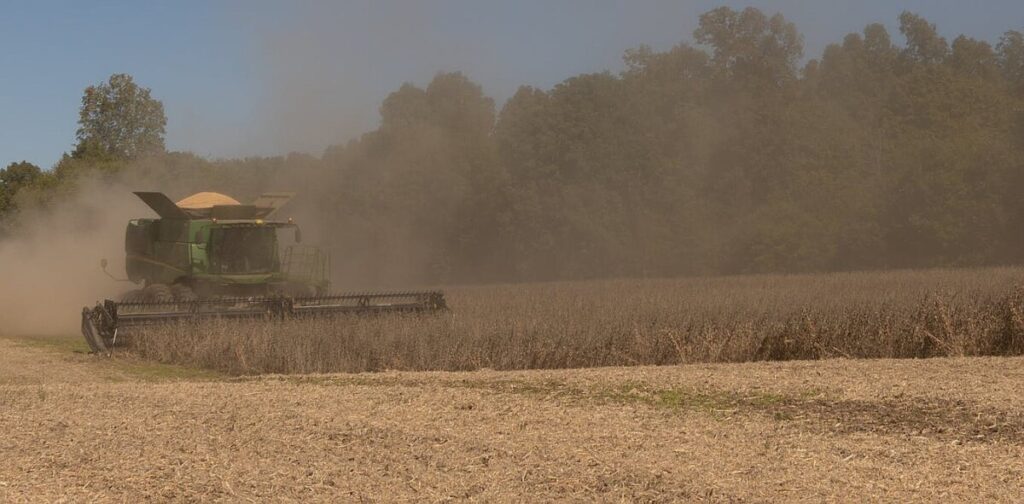
U.S. farmers, including those who grow soybeans, are under pressure from various Trump administration policies.
Jan Sonnenmair/Getty Images
Few political alliances in recent American history have seemed as solid as the one between Donald Trump and the country’s farmers. Through three elections,
farmers stood by Trump
even as tariffs, trade wars and labor shortages squeezed profits.
But Trump’s second term may be different.
A new round of administration policies now cuts deeper into farmers’ livelihoods – not just squeezing profits but reshaping how farms survive – through renewed
tariffs on agricultural products
,
visa restrictions on farm workers
,
reduced farm subsidies
and
open favoritism
toward South American agricultural competitors.
In the past, farmers’ loyalty to Trump has overridden economics. In our study of the 2018–19 trade war between the U.S. and China, we found that
farmers in Trump-voting counties kept planting soybeans
even though the trade war’s effects were clear: Their costs would rise and their profits would fall. Farmers in Democratic-leaning counties, by contrast, shifted acreage toward alternatives such as corn or wheat that were likely to be more profitable. For many pro-Trump farmers,
political belief outweighed market logic
– at least in the short term.
Today, the economic effects of policies affecting farmers are broader and deeper – and the resolve that carried farmers’ support for Trump through the first trade war may no longer be enough.
Tariffs: The familiar pain returns
The revived U.S.-China trade conflict has again placed soybeans at its center. In March 2025,
Beijing suspended import licenses
for several major U.S. soybean exporters following new U.S. tariffs on Chinese goods. Trump countered with a new round of reciprocal tariffs, broadening the list of Chinese imports hit and raising rates on already targeted goods.
An October 2025 deal promised
China would buy 25 million metric tons of U.S. soybeans
a year, but relief has proved mostly symbolic.
Before the 2018-19 trade war, China regularly imported 30 million to 36 million metric tons of U.S. soybeans annually — more than one-third of all American soybean exports. Now, Beijing has signed
long-term contracts with Brazil and Argentina
, leaving U.S. producers with shrinking overseas demand for their crops.
Prices remain roughly 40% to 50% below pre-2018 levels, and farmers are
storing record volumes of unsold soybeans
.
In 2019, the federal government cushioned those losses with
over $23 billion in bailout payments
to farmers. This time, Republican leaders show
little appetite for another bailout
. Meanwhile, the U.S. Department of Agriculture’s
funds for farm relief are running low
, leaving farmers with lower prices and less support.
Immigrants are a key labor force on U.S. farms.
Visions of America/Joe Sohm/Universal Images Group via Getty Images
Labor: Fewer hands, higher costs
Farms are also short of workers.
Roughly 42% of U.S. crop workers
lack legal status, according to the National Agricultural Workers Survey.
Tougher immigration enforcement and slower visa processing
have thinned the labor pool just as production costs are surging. Hired-labor expenses rose 14.4% from 2021 to 2022 and
another 15.2% the following year
, and costs such as
fertilizer
,
equipment and parts
climbed sharply.
Many growers are turning to the
H-2A guest worker program
– a legal pipeline for seasonal foreign labor that has quadrupled in size over the past decade. But it is expensive: Farms must pay the
adverse effect wage rate
, a federally set pay rate that is
more than twice
the
regular federal minimum wage
. And farms must provide every H-2A worker with
free housing and free transportation
to and from the U.S., as well as from their housing to the worksite. Large agribusinesses can absorb those costs; small family farms often cannot.
As exports collapsed in late September 2025, the head of the American Soybean Association wrote a public letter to the White House begging for help, saying, “We’ve had your back.
We need you to have ours now
.” The hard-line immigration policy approach that
rallies rural voters
is also pushing smaller farms to the brink – forcing them to ask what their loyalty still buys.
U.S. President Donald Trump met Argentinian President Javier Milei at the White House in October 2025.
AP Photo/Alex Brandon
Subsidies and symbolism: The Argentina shock
The question of the value of farmers’ loyalty sharpened in the fall of 2025 when the U.S. Treasury approved a
$20 billion currency-swap deal with Argentina
– supporting the country’s president, Javier Milei, a political ally of Trump, while the country remains a direct agricultural competitor.
U.S. farmers, already frustrated by low prices and visa delays, took it as an insult. Argentina is among the world’s largest soybean exporters, and U.S. farm groups asked why the federal government would
underwrite a competitor
while trimming support for American producers at home.
The tension deepened when Trump floated the idea of buying Argentinian beef for U.S. markets – a remark one Kansas rancher called “
an absolute betrayal
.” The plan may be economically minor, but
symbolically it pierced the “America First” narrative
that had helped hold the farm vote together.
Solar panels can help cut energy costs for farm operations, such as dairies.
Shawn Patrick Ouellette/Portland Press Herald via Getty Images
Clean energy: The new rural subsidy under threat
For decades, the farm vote relied on
federally funded support programs
– crop insurance, price guarantees and disaster assistance – which account for a significant share of net farm income. Over the past five years, a quieter lifeline has emerged: renewable energy.
Wind and solar projects
have brought jobs, tax revenue and
steady lease payments
to rural counties that have been losing both population and farm income for decades. Iowa now gets about
63% of its electricity from wind
, while Texas, Oklahoma and Kansas have seen significant growth.
That momentum has stalled. In August 2025, a
U.S. Treasury Department policy change
froze billions in rural investment
in renewable energy projects. Industry trackers report that prolonged uncertainty has pushed
many Midwestern renewable projects into limbo
.
For farmers, this isn’t an abstract climate debate —
it’s a lost income stream
.
Leasing land for turbines or solar panels
brought in tens of thousands of dollars a year and
kept many family farms afloat
.
The freeze wipes out one of the few growth engines in rural America and highlights an irony at the heart of Trump’s message: The administration that
promises to protect the heartland
is dismantling the clean energy investments that were finally helping it diversify.
During his 2024 presidential campaign, Donald Trump promised support to U.S. farmers, alongside future EPA head Lee Zeldin.
Win McNamee/Getty Images
Politics: How deep does loyalty run?
As our research found, during the first trade war, Trump-voting counties
absorbed heavy financial losses without changing course
. That loyalty was propped up by subsidies – and by hope. This time, neither cushion is secure.
Many farmers still share Trump’s skepticism of Washington and global elites. But shrinking federal backing, tighter labor and a competitor’s bailout cut close to home. The question now is whether cultural identity can keep outweighing material loss – or whether the second trade war will signal a deeper political shift.
No sudden collapse of rural support for Trump is likely; cultural loyalty doesn’t fade overnight. But strain is visible. Farm groups are quietly
pressing for pragmatic trade policy and visa reform
, and several Republican governors now lobby for
labor flexibility rather than tougher enforcement
.
If the first Trump trade war tested farmers’ wallets, this one tests their faith – and faith, once shaken, is far harder to restore.
The authors do not work for, consult, own shares in or receive funding from any company or organization that would benefit from this article, and have disclosed no relevant affiliations beyond their academic appointment.


