Why rural Maine may back Democrat Graham Platner’s populism in the Senate campaign − but not his party
In the evolving landscape of American politics, the Democratic Party is once again searching for a candidate who can resonate with rural voters. In the 2024 elections, hopes were pinned on Minnesota Governor Tim Walz, a candidate seen as embodying the “Midwestern nice” ethos. However, the anticipated breakthrough did not materialize, prompting the party to shift its focus to Maine’s Graham Platner—a tattooed veteran and oyster farmer whose unconventional image and relatable background might appeal to the working-class voters the party has struggled to reach. Platner’s candidacy is marked by a distinctive style; he favors sweatshirts over suits and speaks candidly about the grievances of rural communities, positioning himself as a potential blue-collar savior against long-time Republican incumbent Senator Susan Collins.
Despite Platner’s promising persona, challenges loom large. His background, including being the grandson of a prominent architect and having attended the elite Hotchkiss School, presents a complicated narrative that could alienate some voters. The Democratic primary electorate is concentrated in southern Maine, particularly in affluent areas like Greater Portland, which is a stark contrast to the rural regions where Platner seeks support. Historically, these rural areas have shifted toward Republican candidates, as evidenced by Collins’ success in 2020, where she won in small towns that had previously anchored the Maine Democratic Party. This demographic shift underscores the difficulty Platner faces in appealing to a base that is often skeptical of the Democratic narrative, which they perceive as disconnected from rural realities.
While Platner’s campaign is fueled by national funding, an interesting divergence from past candidates is emerging. A significant portion of his contributions comes from outside the traditional urban centers, suggesting some grassroots support in rural areas. His economic populism addresses the frustrations of rural voters regarding corporate consolidation and rising costs, aligning with their progressive instincts on issues like taxation and health care. However, the challenge remains: can Platner effectively navigate the complex dynamics of rural politics while carrying the Democratic brand, which many rural voters view with skepticism? His campaign not only tests his ability to communicate effectively with rural Maine but also raises a broader question about whether the Democratic Party can genuinely engage with rural America or merely rent its authenticity. As Platner moves forward, the stakes are high—not just for his candidacy but for the future of the Democratic Party’s relationship with rural voters.
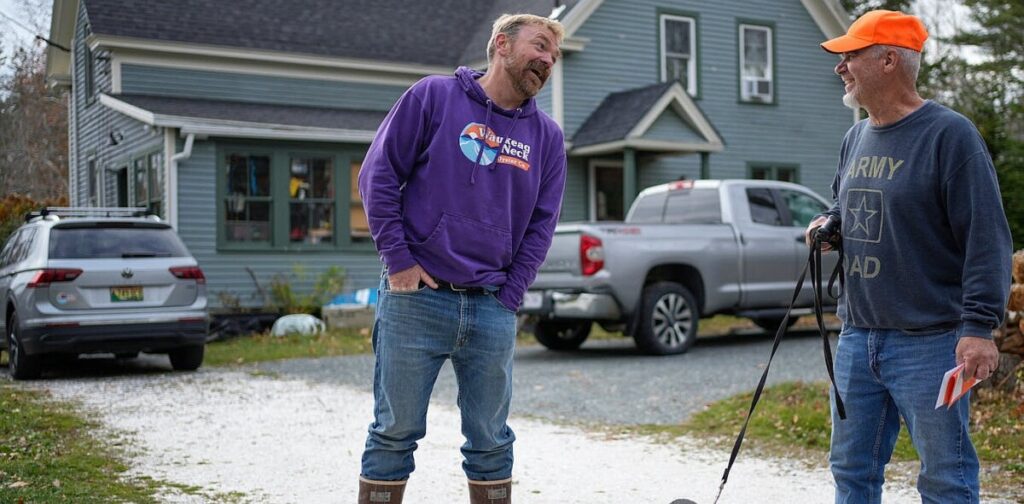
Graham Platner, left, Democratic candidate for U.S. Senate, chats with his neighbor, Denis Nault, on Nov. 3, 2025, in Sullivan, Maine.
AP Photo/Robert F. Bukaty
Every few years, Democrats try to convince themselves they’ve found the one – a candidate who can finally speak fluent rural, who looks and sounds like the voters they’ve lost.
In 2024,
that hope was pinned on Tim Walz
, the flannel-wearing, “Midwestern nice” governor whose small-town roots were supposed to unlock the rural Midwest for a Harris–Walz victory.
It did not
.
Now those expectations have migrated to New England, onto
Graham Platner – the tattooed veteran and oyster farmer from Maine
who swears from the stump, wears sweatshirts instead of suits, and, some believe, could be the party’s blue-collar savior against Sen. Susan Collins, the Republican incumbent running her sixth campaign for U.S. Senate.
I study rural politics and live in rural Maine
. I’m skeptical whether Platner can reach the independents and rural moderates Democrats need. But I also see why people think he might: He’s speaking to grievances that are real, measurable and decades in the making.
Platner represents Democrats’ anxieties about class and geography – a projection of the authenticity they hope might reconcile their national brand with rural America. On paper, he’s the kind of figure they imagine can bridge the divide: a plainspoken Mainer.
But his story cuts both ways. He’s the grandson of
a celebrated Manhattan architect
,
his father is a lawyer
and his mother is a
restaurateur whose business caters to summer tourists
. He attended the
elite Hotchkiss
School.
It’s a life of silver spoons and salt air. That tension mirrors the Democratic party itself,
led and funded by urban professionals
who are increasingly aware of just how far they
strayed from their working-class roots
.
If Platner is to prevail, he must assemble a coalition that expands beyond what the party has become – concentrated in urban and coastal enclaves,
financed nationally
and
culturally distant from much of rural America
.
Yet Platner’s immediate hurdle isn’t rural Maine at all. It is the Democratic primary, and those voters do not live where his campaign imagery is set.
Crowd members at a town hall meeting in the southern Maine town of Ogunquit listen to U.S. senatorial candidate Graham Platner on Oct. 22, 2025.
Sophie Park/Getty Images
Opportunity zone
In 2024, nearly 6 in 10 registered Democrats in Maine
lived south of the state capital Augusta
. That part of the state would not constitute an urban metropolis anywhere else in the U.S., but it is a drastically different world than the one Platner is fighting for.
The party’s gravitational center sits in Cumberland and York counties: Greater Portland and the southern coastal strip. That electorate is more
educated
,
affluent
and
urban
than the state as a whole, clustered in Portland’s walkable neighborhoods, college towns such as Brunswick and artsy coastal communities that swell with summer tourists.
Southern Maine – closer in feel to Boston’s suburbs than to the paper mills and potato fields up north – is where Democrats are already strong. Collins’ vulnerability lies instead among independents in small cities and towns, in deindustrialized and rural counties
drifting rightward for two decades
.
The
2020 U.S. Senate race
– one that nearly every analyst, myself included,
thought Collins was doomed to lose
to Democrat Sara Gideon – makes that reality clear.
Collins outperformed Donald Trump in every county
. She built commanding margins in rural Maine, offsetting Democratic gains in Portland and the southern coast. Her real breakthrough came in the kinds of small towns where Trump lost and she won or closed the margin: Ellsworth, Brewer, Machias, Gardiner and Winterport.
Those former mill towns and service hubs
once anchored the Maine Democratic Party
. They’re home to exactly the kinds of voters who, in principle, might give someone like Platner a hearing: not deeply ideological, modestly skeptical of both parties and wary of national polarization.
But they are also the voters least represented in the Democratic primary electorate or the donor class fueling Platner’s campaign.
Doing it as a Democrat
According to the
most recent Federal Election Commission figures
, only about 12% of Platner’s haul has even come from inside Maine. The nationalization of campaign finance is
becoming more common for U.S. Senate candidates
.
But there are two differences worth noting.
Platner’s in-state share is higher and more geographically diffuse than Gideon’s 2020 campaign. Then, in what became
Maine’s most expensive Senate race
, just 4% of Gideon’s war chest was homegrown. Most of that Maine money was heavily concentrated in Portland and the southern coastal corridor.
While 64% of Gideon’s Maine total fundraising amount came from the three southernmost counties, 88% of Platner’s current in-state funding is from outside the urban-suburban core of southern Maine.
That divergence matters. It suggests that while Platner’s campaign is still fueled by national money, its local base – however small – extends beyond the usual Portland orbit.
And there is a reason Platner’s message has not been dead on arrival.
The economic populism he’s advancing speaks directly to the material frustrations many rural residents express – frustration with corporate consolidation, rising costs and the feeling that prosperity never reaches their communities.
The
2024 Cooperative Election Study
shows that rural independents and moderates often share progressive instincts on precisely these issues: Large majorities of rural, moderate/independent New Englanders support higher taxes on the wealthy and expanded health coverage. Platner is emphasizing those issues – corporate power, health costs, infrastructure, wages – where the urban–rural divide is narrowest.
Platner may be closing that gap. In an October 2025 survey, 58% of likely
Democratic primary voters named him
as their first choice for the 2026 Senate nomination. While that support has likely changed in the aftermath of
two controversies
– his chest tattoo that resembled a Nazi icon and recent posts on Reddit, including one in which he says rural people “actually are” “stupid” and “racist” – that poll’s most notable finding is the consistency of support across income and education levels.
Still, while his message may bridge income and education, the biggest obstacle facing Platner is the simplest one: He’s trying to do all of this as a Democrat.
Republican U.S. Sen. Susan Collins speaks on Nov. 4, 2020, in Bangor, Maine, after Democratic challenger Sara Gideon called her to concede.
AP Photo/Robert F. Bukaty
Hearing, not speaking
Being anchored in metropolitan and professional networks
far removed from rural life
shapes not only what Democrats stand for but how they speak, focusing on moral and cultural commitments that resonate nationally but feel abstract in smaller, locally based communities.
That’s why even an economically resonant message struggles once it meets the national brand.
Rural independents and moderates often agree with Democrats on taxes, health care and wages. Those alignments fade when policy is framed through the institutions and moral language of a party many no longer see as compatible with rural ways of living.
It’s not clear yet how Platner will respond on issues that don’t poll well in rural Maine – environmental regulation, gun control or immigration – where loyalty to the national agenda has
undone many would-be reformers before him
.
And that schism is not because rural voters misunderstand their “self-interest” or because racial dog whistles have led them astray. It is hostility toward a party that, with rare exception, sees the future as something rural America must adapt to,
not something it should help define
.
That is the danger of treating biography as the solution to a decades-long realignment. Platner might be as close as Democrats have come in years to a candidate who can talk credibly to rural voters about power, place and policy. But he still has to do it while wearing the “scarlet D” – the weight of a party brand built over generations.
Whether he wins or loses, his campaign already points to a deeper question: Can Democrats do more than rent rural authenticity? Put more bluntly, the real test is not whether Platner can speak to rural Maine, it is whether his party can finally learn to hear it.
Nicholas Jacobs does not work for, consult, own shares in or receive funding from any company or organization that would benefit from this article, and has disclosed no relevant affiliations beyond their academic appointment.


