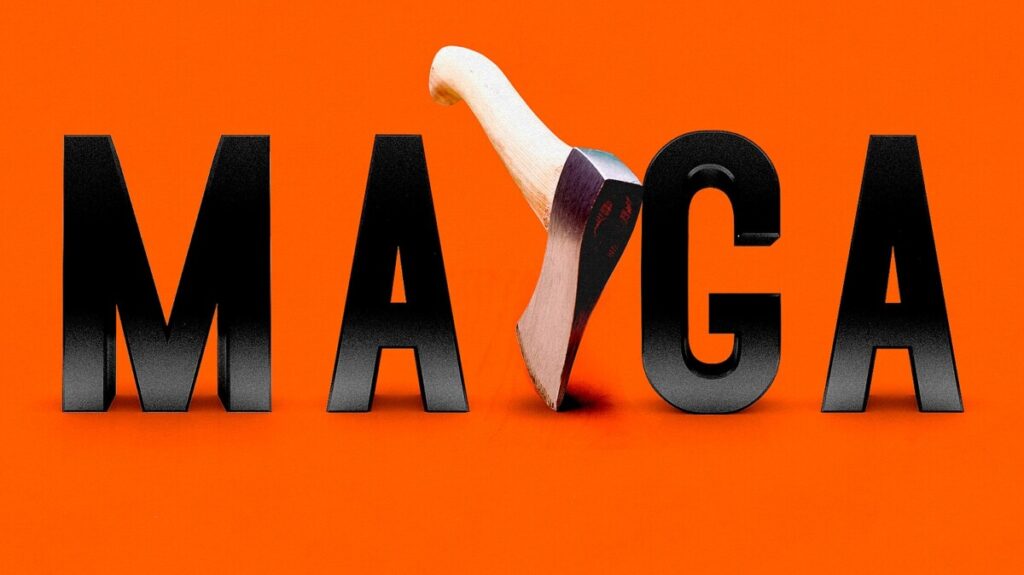
The Growing Fissures in MAGA World
As Donald Trump’s presidency nears its conclusion in January 2029, tensions are rising within the Republican Party, signaling a potential shift in the political landscape. Traditionally, Trump has dominated elected Republicans, but recent events indicate a growing restlessness among party members. Notably, rebellious Republicans have successfully pushed for the release of the “Epstein files,” a move that defies Trump’s attempts to suppress them. This development, along with increasing critiques from staunch Trump allies, suggests a brewing conflict over the future direction of the GOP post-Trump. Representative Marjorie Taylor Greene, once a fervent supporter of Trump, has emerged as a vocal critic, challenging him on various fronts, including foreign policy and his handling of healthcare negotiations. Greene’s transformation from a loyalist to a critic reflects a broader trend of discontent within the party, hinting at a fracture among Trump’s base.
The Republican Party is grappling with internal divisions that extend beyond individual personalities, encompassing ideological rifts as well. Issues such as anti-Semitism and economic populism have become contentious topics, further complicating the party’s unity. For instance, prominent conservative figures like Tucker Carlson have faced backlash for their associations with extremist views, leading to resignations within organizations like the Heritage Foundation. Meanwhile, economic policies that align with Trumpism, such as protectionism and immigration restrictions, are still not universally accepted within the party. This growing factionalism is evident in the strategic moves by figures like Senator Ted Cruz, who has selectively criticized Trump while positioning himself as a potential leader for a post-Trump Republican Party. Cruz’s approach—balancing loyalty to Trump with a critique of certain policies—highlights the delicate dance many Republicans are performing as they navigate the party’s uncertain future.
Looking ahead, the question looms: how will Trump’s legacy shape the Republican Party after his presidency? While some conservatives believe that a well-chosen successor could unify the party, the reality remains that Trump’s influence will likely persist, casting a long shadow over the 2028 primaries. Figures like J.D. Vance are seen as potential bridges between traditional conservatism and the newer, more populist strains of the party. However, Vance, despite his political acumen, lacks Trump’s unique charisma and connection with the base. As the Republican Party faces the possibility of a tumultuous transition, the dynamics of loyalty, dissent, and ideological purity will be critical in determining its future trajectory. The parallels to historical political upheavals, such as the Democratic Party’s struggles in 1968, suggest that the GOP may also face significant challenges as it seeks to redefine itself in a post-Trump era.
https://www.youtube.com/watch?v=kNxsy1W5eiE
The reality that Donald Trump’s presidency will end in January 2029 is already making Republicans restless. Normally, Trump angers, exhausts, and eventually prevails over elected Republicans—not vice versa. Just this week, though, rebellious Republicans forced the release of the so-called Epstein files in defiance of Trump, who had spent months trying to suppress them before
abruptly reversing course
. Plenty of other cracks are showing too: Staunch allies of the president are mouthing critiques that would have been unfathomable a year ago. These disputes are the prelude to an ugly battle over the post-Trump Republican Party.
[
Mark Leibovich: Donald Trump is a lamer duck than ever
]
Consider the recent journey of Representative Marjorie Taylor Greene, a former Trump ultra-loyalist who one year ago was comparing him to Jesus Christ (“The man that I worship is also a convicted felon. And he was murdered on a Roman cross.”). The Georgia Republican has been one of the prime agitators for the release of the Epstein files, leading to a spat with Trump, who rebranded her as Marjorie “Traitor” Greene. And Greene has been tangling with Trump in other ways. She criticized the
bailout of Argentina
, denounced Trump’s bombing of
Iranian nuclear facilities
, and argued during the government shutdown that the administration should negotiate with Democrats on
health-care subsidies
. She also said that the president was taking too many foreign trips, reneging on his promise to put America first. “I would love to see Air Force One be parked and stay home,” she
told CNN
. Trump says that Greene is angry over his refusal to endorse her for a Senate seat or for the governorship of Georgia. But if you see her as an avatar for the “America First” base—conspiratorial QAnon leanings and all—her character arc does not bode well for the president.
In other corners of MAGA-dom, factional divides are showing. One is over how—or whether—to police anti-Semitism. Last month, Tucker Carlson, the prominent conservative pundit, posted a friendly interview with Nick Fuentes, a white nationalist who has previously said things such as “
I love Hitler
.” Kevin Roberts, the president of the Heritage Foundation, then inflamed matters further by posting a video
defending
Carlson’s decision, prompting resignations from the organization’s board. Under Roberts, Heritage has anxiously tried to adapt to the changes in conservatism, reinventing itself from a think tank centered on Reaganism to one centered on Trumpism.
Roberts’s intervention shows a shift in the Republican Party’s once-steadfast Zionism. Rod Dreher, a conservative commentator who now lives in Hungary, wrote an
essay
earlier this month about a recent visit to Washington, D.C., recounting how appalled he was that, according to estimates that he deemed credible, 30 to 40 percent of young Republican staffers in Washington are Fuentes fans. The number may be exaggerated, but the trend of indulging fringe-right views is hard to dispute. Conservatives are also divided in their views of economic populism. The innovations of MAGA-nomics—protectionism, immigration restriction, industrial policy—are not yet Republican orthodoxy and might not last after Trump leaves office.
As much as the president would like to believe that he will seek a constitutionally prohibited third term (to the point of displaying Trump 2028
hats
in the Oval Office), he has recently
acknowledged
that “it’s pretty clear: I’m not allowed to run.” Republicans are one year from a midterm election that, by the usual patterns of American politics, is likely to go poorly for them; the Republican presidential primary will commence shortly thereafter. The second term that seemed so yawning at the start of the year looks much shorter now.
This explains the jockeying of Ted Cruz, the Republican senator from Texas who placed second in the bitter 2016 primary against Trump. Cruz has broken with the White House selectively and strategically. He has sharply criticized Carlson and Fuentes for spreading anti-Semitism (whereas Trump has tried to dismiss the controversy). He characterized tariffs as economically harmful. And when threats from Brendan Carr, the Federal Communications Commission chair, got the comedian Jimmy Kimmel pulled from television briefly over a politically offensive monologue, Cruz called those actions “
dangerous as hell
.” Despite his past rivalry with Trump, the Texas senator has so far avoided attracting the White House’s ire, in part because he also makes sure to lavish praise
such as
“I love President Trump. I’m his strongest supporter.” If Cruz runs for president again, he will do so as an Israel-supporting, tariff-skeptical constitutional conservative—a triangulation between the pre-Trump and post-Trump Republican Party.
Some prominent conservatives acknowledge the heightened factionalism but think that a well-chosen successor may hold it together as well as Trump has. “The political Right is fracturing,” Christopher Rufo
wrote
in
City Journal
, “but one figure already has the authority, familiarity, and political skill to manage these divisions: J. D. Vance.” Rufo argues that Vance should learn from Richard Nixon, who, as Dwight Eisenhower’s vice president in the 1950s, helped unify the right, which included conspiratorial elements such as the John Birch Society. (Less felicitous for Vance is that Nixon lost the 1960 presidential election and his 1962 bid for California governor and then needed six more years of plotting to win the White House.) The MAGA intelligentsia—the national conservatives, the post-liberals, the scholars at the Claremont Institute, the monarchist bloggers such as Curtis Yarvin—would line up behind Vance.
[
George Packer: The talented Mr. Vance
]
The vice president, a Yale Law School graduate and an ex–venture capitalist who is both antiglobalist and a consummate meritocrat, is unsurprisingly the best student of MAGA political theory to hold elected office. One of the intellectual rifts in Trump world is between traditionalists such as Steve Bannon, who are nostalgic for the past, and tech oligarchs such as Elon Musk, who want to rush headlong into the future. Some see Vance, who once worked for Peter Thiel, as capable of bridging this divide. But Vance lacks Trump’s charismatic—and sui generis—hold over the Republican base. In the Ohio Republican Senate primary in 2022, he was in
third place
until Trump’s endorsement lifted him to first.
Looming over all this is the question of when, and whether, Trump will let go. The president kept the role of party kingmaker after he left office in 2021, not least because of the possibility that he would run again. Trump’s personalist connection with the Republican base—and the decade-long reshaping of the party in his image—could enable him to wield considerable authority over the 2028 primary; he might rage at hints of intra-party dissent even if his administration is unpopular with the country at large.
If so, he would resemble Lyndon Johnson, another president used to domination, who, after he halted his 1968 reelection campaign, still overshadowed his party’s eventual nominee, Vice President Hubert Humphrey, and saddled him with the administration’s unpopular Vietnam policy. We don’t know what Trump’s Vietnam would be (Venezuela? Tariffs?). But we know that the Democratic crack-up of 1968 was both ugly and self-destructive: Humphrey lost to Nixon. The Republican crack-up of 2028 might be just as bad.


