What is Fusarium graminearum, the fungus a Chinese scientist pleaded guilty to smuggling into the US?
In a significant legal development, Yunqing Jian, a Chinese plant scientist at the University of Michigan, pleaded guilty on November 12, 2025, to charges of smuggling a harmful crop-damaging fungus, *_Fusarium graminearum_*, into the United States. Jian, alongside another scientist, drew national attention following her arrest in June 2025, which raised concerns about the implications of introducing this toxic pathogen. Under her plea agreement, she received a sentence of time served and is expected to be deported. In her court statement, Jian expressed that her intentions were to research ways to protect crops from disease, highlighting the complex motivations behind her actions.
The case has brought to light the serious threat posed by *_Fusarium graminearum_*, a common fungal pathogen responsible for Fusarium head blight, or scab, which affects staple crops such as wheat, barley, corn, and rice. The U.S. Department of Agriculture estimates that this pathogen costs American farmers over $1 billion annually due to significant crop losses. For instance, in 2024, scab was responsible for a reduction of approximately 31 million bushels of wheat, equating to a 2% loss in the U.S. wheat crop. The fungus produces mycotoxins, particularly a vomitoxin that can adversely affect both human health and livestock, leading to gastrointestinal issues and immune system damage. This risk necessitates strict regulations on the importation and movement of plant pathogens, governed by the U.S. Department of Agriculture’s Animal and Plant Health Inspection Service.
Farmers face ongoing challenges in managing *_Fusarium graminearum_* infections, especially during the flowering stage of crops when conditions such as rainfall and humidity are favorable for the fungus’s spread. Integrated management strategies are essential, including the use of resistant crop varieties, timely fungicide applications, and proper crop rotation and tillage practices. Recent advancements in predictive modeling by teams from various universities aim to provide farmers with early warning systems, helping them to mitigate the risks of scab and protect their yields. As the agricultural community continues to grapple with the implications of this pathogen and the legal ramifications of its smuggling, the importance of robust biosecurity measures becomes increasingly clear in safeguarding the nation’s food supply.
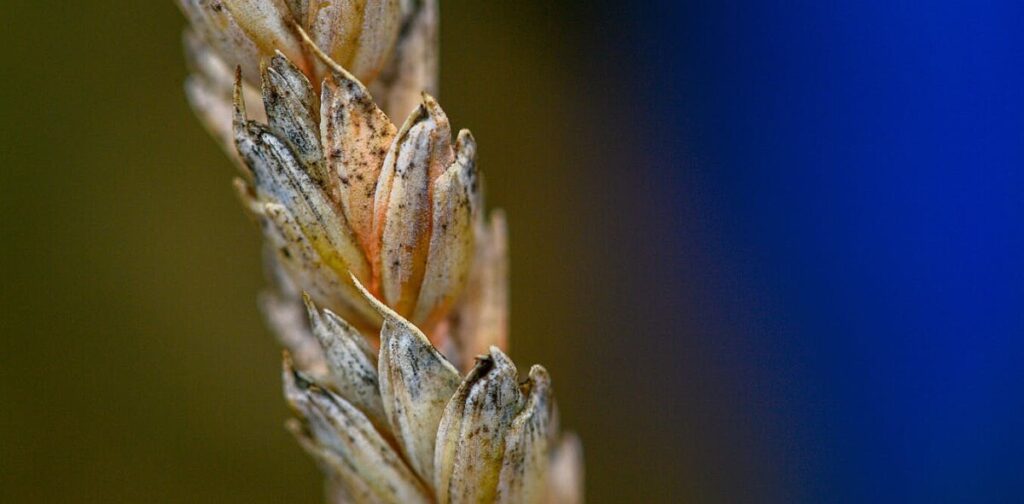
Wheat infected by *_Fusarium_*, a toxic fungus, has kernels that appear white with orange at the base.
Klaus-Dietmar Gabbert/picture alliance via Getty Images
A Chinese plant scientist at the University of Michigan who
drew national attention
in June 2025 when she was arrested and accused along with another Chinese scientist of smuggling a crop-damaging fungus into the U.S.
pleaded guilty
on Nov. 12, 2025, to charges of smuggling and making false statements to the FBI. Under her plea agreement, Yunqing Jian, 33, was sentenced to time served and
expected to be deported
. She
wrote in a statement for the court
that she was working on ways to protect crops from disease.
Her arrest put a spotlight on Fusarium graminearum, a harmful pathogen. But while its risk to grains such as wheat, corn and rice can be alarming, Fusarium isn’t new to American farmers. The U.S. Department of Agriculture estimates it costs wheat and barley farmers
more than $1 billion a year
.
Tom Allen
, an extension and research professor of plant pathology at Mississippi State University, explains what Fusarium graminearum is and isn’t.
What is
Fusarium graminearum
?
Fusarium graminearum
is a common fungal plant pathogen that creates problems for farmers across the U.S.
It causes a disease in barley and wheat called
Fusarium
head blight, or scab
. It can also damage rice and rot corn ears and stalks. In severe cases, scab could cut a farm’s yield by 45%.
Scab has been responsible for some of the greatest annual
crop losses
in the U.S. In 2024, estimates from extension and research plant pathologists suggested scab reduced the U.S. wheat crop by
approximately 31 million bushels
or roughly 2%.
When compared with other wheat diseases that harm the head and kernels, scab is by far the most concerning because it occurs across wide areas and affects the crop at advanced growth stages.
Why is
Fusarium graminearum
a concern?
As a plant pathogen, the fungus responsible for scab produces a
mycotoxin
in grain that can harm humans and livestock. In addition, when wheat grain used for seed is infested with the fungus, the seeds are less likely to germinate and produce new plants in the next growing season.
The mycotoxin is widely
categorized as a vomitoxin
. It can induce vomiting if ingested in high enough concentrations, but prolonged exposure can also cause gastronintestinal damage,
harm the immune system
and inflame the central nervous system.
In animals, repeated exposure to the mycotoxin in food can decrease their growth and weight, and livestock can
develop an immune response
to the toxin that can harm their ability to reproduce.
The U.S. Food and Drug Administration has
issued advisory levels
, basically limits for the amount of mycotoxin considered a health hazard in grain products.
Since barley and wheat are important as food for humans and livestock, harvested grain is
routinely tested
when farmers bring their crops to grain elevators for sale. Entire loads of grain may be rejected if they’re found to have mycotoxin concentrations above the FDA limits.
Wheat
can be treated
to remove scabby kernels. If mycotoxin levels aren’t too high, it could also be used for livestock feed. The advisory threshold for the mycotoxin is higher for adult cattle and chickens, at 10 parts per million, than it is for humans, at 1 ppm.
What does the law say about importing and moving plant pathogens?
These risks are why importing and even moving plant pathogens within the U.S. is regulated by the U.S. Department of Agriculture’s Animal and Plant Health Inspection Service, or USDA-APHIS, through the
Plant Protection Act of 2000
.
Federal law restricts the movement of plant pathogens, including bacteria, fungi and viruses, even for research purposes, as well as their release into the environment. A scientist who wants to move a plant pathogen, either within the U.S. or from outside the U.S., must go through a permitting process with
USDA-APHIS
that can take up to six months to complete.
A sign at a Colombian airport warns about the spread of a type of
Fusarium
that affects bananas and plantains.
Jeffrey Greenberg/Universal Images Group via Getty Images
The goal of these rules is to reduce the risk of introducing something new that could be even more destructive for crops.
Even with
Fusarium graminearum
, which has appeared on every continent but Antarctica, there is potential for introducing new genetic material into the environment that may exist in other countries but not the U.S. and could have harmful consequences for crops.
How do you manage
Fusarium graminearum
infections?
Fusarium graminearum
infections generally occur during the plant’s flowering, rainfall and periods of
high humidity
during early stages of grain production.
Wheat in the southern U.S. is conducive to infection during the spring. As the season progresses, the
risk from scab progresses north
through the U.S. and into Canada as the grain crops mature across the region, with continued periods of conducive weather throughout the summer.
How Fusarium graminearum risk progressed in 2025. Yellow is low risk, orange is medium risk, and red is high risk.
Fusarium Risk Tool/Penn State
Between seasons,
Fusarium graminearum
survives on barley, wheat and corn plant residues that remain in the field after harvest. It reproduces by producing microscopic spores that
can then travel long distances
on wind currents, spreading the fungus across large geographic areas each season.
In wheat and barley, farmers can suppress the damage by spraying a fungicide onto developing wheat heads when they’re most susceptible to infection. Applying fungicide
can reduce scab and its severity
, improve grain weight and reduce mycotoxin contamination.
However, integrated approaches to manage plant diseases are generally ideal, including planting barley or wheat varieties that are resistant to scab and also using a carefully timed fungicide application, rotating crops, and tilling the soil after harvest to reduce residue where
Fusarium graminearum
can survive the winter.
Even though fungicide applications may be beneficial, fungicides offer only some protection and can’t cure scab. If the environmental conditions are extremely conducive for scab, with ample moisture and humidity during flowering, the disease will still occur albeit at reduced levels.
A discussion of
Fusarium
head blight in the northern Plains. Andrew Friskop/NDSU Extension.
Plant pathologists are making progress on early warning systems for farmers. A team from Kansas State University, Ohio State University and Pennsylvania State University has been developing a computer model to predict the risk of scab. Their wheat disease
predictive model
uses historic and current environmental data from weather stations throughout the U.S., along with current conditions, to develop a forecast.
In those areas that are most at risk, plant pathologists and commodity specialists encourage wheat growers to apply a fungicide during periods when the fungus is likely to grow to reduce the chances of damage to crops and the spread of mycotoxin.
Tom W. Allen does not work for, consult, own shares in or receive funding from any company or organization that would benefit from this article, and has disclosed no relevant affiliations beyond their academic appointment.


