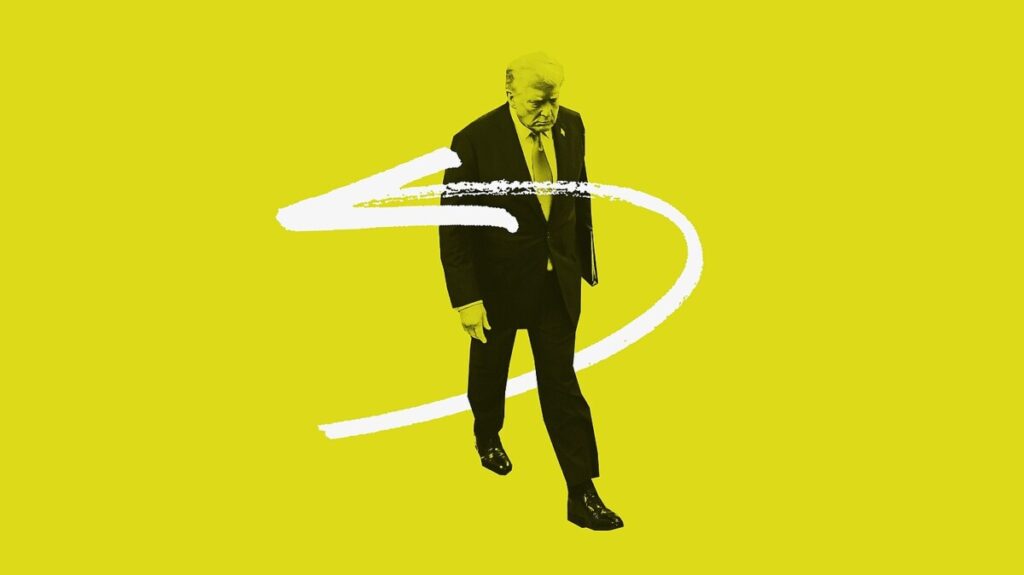
The Trump Steamroller Is Broken
In a striking parallel to his tumultuous first term, President Donald Trump’s second term is increasingly marked by chaos and political vulnerability. Just ten months in, the Trump administration faces significant challenges reminiscent of 2017, including internal strife, rebellious lawmakers, and a decline in public support. Once viewed as a political steamroller, Trump’s grip appears to be loosening, emboldening both Democrats and dissenting Republicans. The recent off-year elections served as a wake-up call for the GOP, as voters expressed dissatisfaction with Trump’s hard-line policies and economic management. This discontent has fueled a rare rebellion among Republican lawmakers, who are now willing to publicly defy Trump, a trend that could have serious implications for the party heading into the crucial midterm elections.
One of the most notable instances of Republican defiance occurred when a group of lawmakers, including prominent Trump allies, voted to release Department of Justice records related to Jeffrey Epstein, despite Trump’s anger and attempts to downplay the issue. This rebellion reflects a broader sentiment within the party, as lawmakers grapple with the fallout of Trump’s controversial decisions and the perception that he has strayed from his economic promises. Moreover, Trump’s recent reversal on tariffs—lifting them on essential goods like bananas and beef—signals a shift in strategy, following criticism of rising prices and inflation that have plagued American consumers. These developments illustrate a growing rift between Trump and his party, as GOP members increasingly feel the pressure to distance themselves from his more extreme positions.
As the administration grapples with these challenges, it has also seen a resurgence of the internal chaos that characterized Trump’s first term. While efforts were made to maintain a sense of professionalism and stability, recent events have revealed cracks in this facade. From the Supreme Court’s skepticism regarding Trump’s tariffs to a federal judge’s rebuke of redistricting efforts in Texas, the administration faces significant legal and political hurdles. Additionally, infighting among Trump’s advisors and public criticism from within the party suggest that the once-unified front is beginning to fracture. With the midterms approaching, Trump’s ability to maintain control over his party and respond effectively to voter concerns will be crucial. As Republican loyalty wanes, the implications for Trump’s political future and the GOP’s direction remain uncertain, raising questions about whether he can reclaim the dominance he once held.
https://www.youtube.com/watch?v=46t76eopQl0
P
resident Donald Trump’s
administration has been embroiled in scandal and sloppiness. His own party has defied his political pressure. His senior staff has been beset by infighting. He has sparred with reporters and offered over-the-top praise to an authoritarian with a dire human-rights record. A signature hard-line immigration policy has polled poorly. And Republicans have begun to brace themselves for a disastrous midterm election.
That was 2017. But it’s also 2025.
Ten months into the president’s second term, Trump 2.0 is for the first time starting to resemble the chaotic original. And that new sense of political weakness in the president has not just emboldened Democrats who have been despondent for much of the past year. It’s also begun to give Republicans a permission structure for pushing back against Trump and jockeying for power with an eye to the elections ahead.
This was not the plan. Trump and his inner circle used their four years out of office to create a policy blueprint—drawn substantially from Project 2025—and form a disciplined team of true believers who used their experience with the levers of power to dominate their political opposition. The beginning of Trump’s second term was marked by an unprecedented display of executive authority, as the president dominated a subservient Congress and defied the courts, brought to heel some of the nation’s most formidable institutions and wealthiest people, fulfilled long-held conservative wishes to dramatically shrink the size and influence of the federal government, reoriented the nation’s relationship with the rest of the world, and rammed through legislation that benefited the rich over the working class and the poor. Trump has been a steamroller.
But that has begun to change. Voters punished Trump’s party in this month’s elections, seeming to condemn his presidential overreach and the abandonment of his central campaign promise to rehabilitate the nation’s economy. A rare Republican rebellion on Capitol Hill rattled the West Wing and embarrassed the president. And although the White House likes to project a political image of never surrendering, a pair of retreats in the past few days has punctured Trump’s aura of invincibility.
F
ew things have frustrated
Trump like his inability to make Jeffrey Epstein go away. The disgraced sex offender and financier, of course, has been dead for six years. But questions about the powerful men with whom he associated—and the mystery around his death in prison, which was ruled a suicide—created a conspiracy theory in the MAGA base that has overwhelmed the White House. Trump angrily
ordered his supporters
to let the matter go this past summer but was largely ignored. And then, last week, four GOP lawmakers—some of whom have been among Trump’s most ardent acolytes—triggered a full House vote to release Department of Justice records related to Epstein.
[
Read: Epstein returns at the worst time for Trump
]
Revolt was in the air. One of those defiant lawmakers, the MAGA icon Representative Marjorie Taylor Greene, did not buckle, even as Trump called her a traitor. “Let me tell you what a traitor is,” she responded yesterday. “A traitor is an American that serves foreign countries and themselves.” GOP leadership signaled to the White House that most lawmakers could not put their name to a vote to protect a pedophile and that the measure would pass easily, two officials told me on the condition of anonymity to discuss private conversations. Trump was furious, but he didn’t want to be seen as getting rolled by his own party.
Trying to save face, he begrudgingly posted on social media that he would support Republicans who voted to release the files. The measure passed the House yesterday 427–1. It then cleared the Senate by unanimous consent. Trump announced tonight he had signed it. (Questions persist as to whether the Justice Department may try to block the release of some or all of the files, citing a need to protect an ongoing investigation of prominent Democrats that it launched last week at Trump’s request.)
The other Trump walk-back came far less dramatically, buried in the text of an executive order released late Friday. But it was no less noteworthy. Trump, as is often said, has few constant ideological stances, yet one is that tariffs will spur economic growth and benefit the consumer. In a tacit admission that tariffs have, in fact, caused prices to rise (as most economists have long said), the administration quietly lifted tariffs on goods such as bananas, beef, and coffee.
The reversal came days after Republicans were swept in off-year elections in places such as Virginia, New Jersey, and
New York City
. Voters made clear that the GOP was not fulfilling its promises on affordability that helped Trump get elected last year. A number of Republican lawmakers loudly insisted that Trump needs to refocus on prices and inflation—defiance reminiscent of when senators voted down the White House–led efforts to repeal the Affordable Care Act in 2017.
C
haos within the White House
was the norm during Trump’s first term. This time around, the president’s team has prioritized professionalism and tried to minimize turnover. Senior-level firings have been rare, and even the president’s deposed national security adviser, Mike Waltz, was given a soft-landing spot as ambassador to the United Nations. Trump’s first administration was plagued by sloppiness; the original travel ban, Trump veterans will remember with a shudder, was hastily scrawled by Stephen Miller and Steve Bannon and not properly reviewed by government attorneys before it was enacted. (It was promptly tossed out by a federal court.) This time, Trump aides vowed they would be methodical and efficient, and for months, they faced little resistance as they rolled out the president’s agenda.
But that sense of disorder has returned, and the losses have begun to pile up. Just in the past two weeks: Trump’s prized tariffs were greeted with great skepticism by the Supreme Court, with the justices appearing unsympathetic to the notion that the president could usurp what is normally congressional power on the back of a flimsy declaration of a national emergency. The president’s campaign of retribution may have hit a snag when a federal judge found that the case put forth by Trump’s handpicked interim U.S. attorney, Lindsey Halligan, was marred by a series of errors that could lead to the dismissal of the criminal case against former FBI Director James Comey.
And yesterday, a Trump-appointed federal judge issued a rebuke of the methodology used by Republicans in Texas to redistrict the state’s congressional map. (The judge wrote in his opinion that it was “challenging to unpack” all of the “factual, legal, and typographical errors” in a Justice Department letter that claimed that the original districts were to be eliminated because they were created solely on the basis of race.) Trump, desperate for his party to keep control of both houses of Congress next fall, had pushed for a number of GOP-led states to create more Republican seats, but he took a loss in Texas and has been rebuffed by Indiana, meaning that the Democrats—who responded to the Texas push by successfully creating friendly districts in California and may follow suit in Virginia and Maryland—could end up besting the Republicans at their own game. The administration is confident that the Supreme Court will take up the Texas case and ultimately approve the new districts.
[
Read: ‘None of this is good for Republicans’
]
There have been other recent flashbacks to Trump’s first term. Much like in 2018, the president and the Republicans were on the losing end of a government shutdown. Infighting was frequent during the first Trump administration, as aides tried to knife one another in the press to improve their standing with the boss. There has been less internal dysfunction this time around—especially after
Elon Musk departed DOGE
—but last week, Health and Human Services Secretary Robert F. Kennedy Jr. had to publicly ask his supporters to stop criticizing White House Chief of Staff Susie Wiles for allegedly blocking his MAHA agenda. And yesterday, the president ignored the CIA’s conclusion that Saudi Crown Prince Mohammed bin Salman played a role in the murder of the
Washington Post
columnist Jamal Khashoggi—much as in Helsinki in 2018, when Trump famously sided with Vladimir Putin over U.S. intelligence agencies on Russian election interference. When an ABC News reporter asked about Khashoggi in front of MBS, Trump threatened to revoke the network’s broadcast license.
The White House spokesperson Kush Desai told me in a statement that the past two weeks have brought nothing but victories. “President Trump and the Administration have been delivering results since Day One, and the past two weeks have objectively been a continuation of this winning streak for the American people,” he said. But White House aides have privately admitted that this month has been the most challenging stretch of Trump’s second term.
Other Republicans have begun to notice. Some of Trump’s closest allies have warned him about polls that show the public is unhappy with some of his extreme moves, including cheering on
masked ICE raids
and
demolishing the East Wing
of the White House. Trump has so far been unwilling to do much to take on—or even acknowledge—the problem of affordability, but aides say that plans will be unveiled soon. Meanwhile, an urgency has set in: The calendar churns even for a president who has wielded power in extraordinary ways. Each day closer to next year’s midterms is a reminder that Trump is a
lame duck
whose time governing with Republicans in charge at either end of Pennsylvania Avenue could soon be coming to a close. Even before then, his sway within his own party appears to be ebbing. One official who worked in both Trump administrations told me, “The president has had absolute loyalty from Republicans this year.” But, the official added, “losing that would be the first step toward losing power—and relevancy.”


