Microsoft CEO Satya Nadella taps advisor to ‘rethink’ the company’s business for the AI era, internal memo shows
In a strategic move to navigate the rapidly evolving landscape of artificial intelligence (AI), Microsoft CEO Satya Nadella has announced a major initiative to rethink the company’s business model for the AI era, drawing parallels to the transformative shift the company experienced during the early days of cloud computing. According to an internal memo obtained by Business Insider, Nadella has appointed Rolf Harms, a key figure in Microsoft’s cloud strategy, as an advisor on “AI economics.” Harms, who coauthored the influential 2010 white paper “Economics of the Cloud,” played a pivotal role in reshaping Microsoft’s approach to cloud services at a time when the future of the technology was uncertain. Nadella emphasized the need for a similar cultural and operational overhaul as Microsoft aims to establish itself as a leader in AI, stating, “We need to rapidly rethink the new economics of AI across the company — just as we once did with the cloud.”
The urgency for this reevaluation comes amid growing skepticism in the tech industry regarding the financial viability of substantial investments in AI infrastructure. Earlier this year, Microsoft scaled back its AI spending, raising concerns about whether the hefty investments would yield the anticipated returns. However, in a recent pivot, the company has renewed its commitment to AI with significant partnerships, including new deals with OpenAI and Anthropic. Nadella’s memo highlights the parallel between the current AI landscape and the early cloud era, where significant investments were made despite doubts about customer adoption. Harms’ previous work in the cloud sector effectively laid the groundwork for Microsoft’s eventual success, demonstrating how large-scale cloud services could save businesses money despite initial hesitations about security and reliability.
As Harms takes on this expanded role, his focus will encompass not just AI infrastructure but also the broader implications of AI across various platforms and applications. Nadella’s vision for a “new AI factory” reflects a desire to create a comprehensive ecosystem of AI tools and services, akin to the Copilots that have become integral to Microsoft’s offerings. With Harms’ insights and experience, Microsoft aims to navigate this transformative shift, ensuring it remains at the forefront of AI innovation while adapting to the evolving economic landscape. The memo underscores the necessity of a proactive mindset, with Nadella urging his team to confront the challenges of this new era head-on, just as they did with cloud computing.
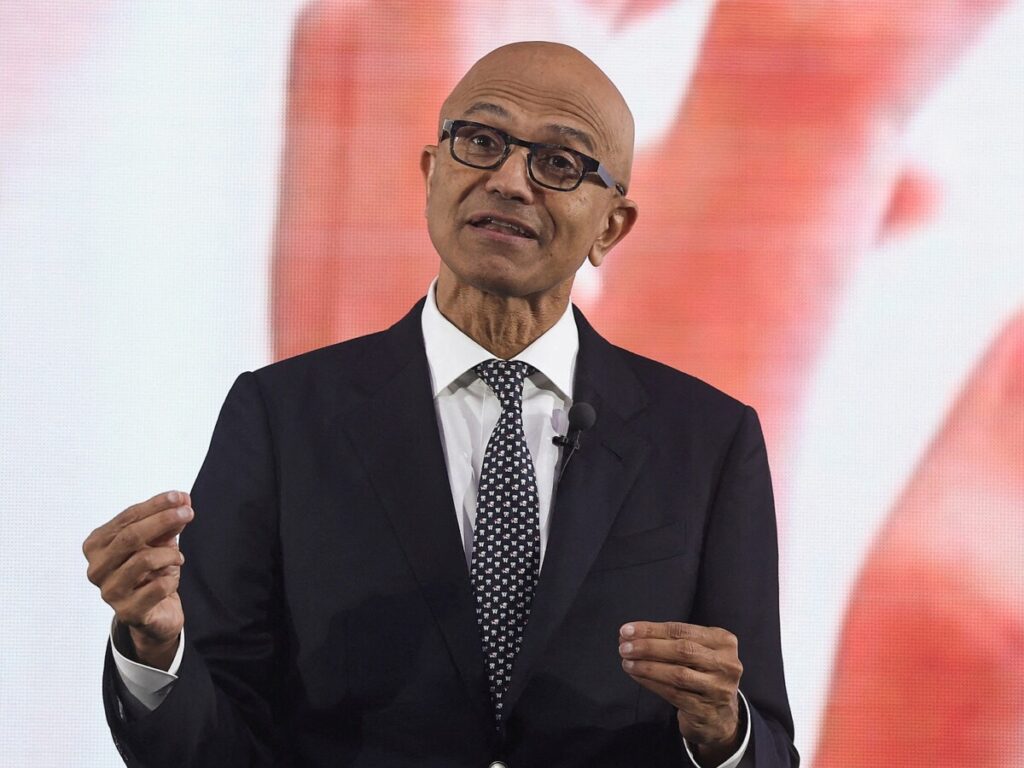
Chalinee Thirasupa/REUTERS
Satya Nadella thinks Microsoft needs a reboot for AI just like it did in the early cloud days.
Nadella tapped a new advisor to “rethink the new economics of AI,” according to an internal memo.
This advisor previously helped force a cultural reckoning at Microsoft when cloud computing emerged.
Satya Nadella
believes
Microsoft
needs to completely rethink its business model for the AI era, and he’s turning to an executive who influenced the company’s cloud reboot 15 years ago.
Nadella tapped Rolf Harms as an advisor on
AI
economics to help with the ambitious plan, according to a memo the CEO sent top Microsoft executives this month.
Harms wrote the white paper
“Economics of the Cloud”
in 2010 that helped force a cultural reckoning at Microsoft and pave the way for the company’s cloud-computing success.
“We need to rapidly rethink the new economics of AI across the company — just as we once did with the cloud,” Nadella wrote this month in his message, a copy of which was obtained by Business Insider. “This platform shift is all about building a new AI factory and family of Copilots and agents that drive diffusion and usage across the full stack.”
AI companies are facing
mounting questions
over whether
massive infrastructure investments
will pay off. Microsoft took its
foot off the AI spending pedal
earlier this year, helping to stoke these concerns. However, in recent weeks, the company has doubled down again through huge new deals with OpenAI and
Anthropic
.
The dynamics were similar in the early days of the cloud. Back then, big tech companies spent heavily to build data centers even though the payoff was uncertain, as some observers worried whether customers would adopt the new technology.
The 2010 missive Harms coauthored “had profound impact on how we completely rethought our business models,” Nadella wrote in the early November memo to Microsoft executives.
The white paper was considered a watershed moment in cloud computing, and helped make the case for Microsoft’s investments by crunching the numbers to show why customers would eventually use large-scale cloud services to save money despite concerns about security and availability.
At the time, people at Microsoft complained to Harms that he was “throwing bombshells into their org,” according to Nadella.
“His response was, ‘they’re already there, I’m just helping you find them,'” Nadella wrote. “And this is the same mindset we need to take today as our business becomes much more capital and knowledge intensive.”
AI will require a similar reboot, the CEO wrote, and he’s expanding Harms’ role to include working closely with Nadella and Microsoft’s top executives, advising them on how to adapt to the new economics of AI, from infrastructure to platform technology and applications.
Harms was a director of corporate strategy when he coauthored the 2010 paper. Business Insider featured him in a
2021 article
on the power players helping Microsoft with AI.
Now Harms works under Cloud + AI boss Scott Guthrie as a corporate vice president. Harms will continue to report to Guthrie.
Harms’ “new scope will extend beyond AI Infra as we take a new approach and gain a clear understanding of how existing categories will be transformed and new categories will be birthed as we navigate this shift,” according to Nadella’s memo.
Microsoft did not comment when asked about the memo.
Have a tip? Contact this reporter via email at
astewart@businessinsider.com
or Signal at +1-425-344-8242. Use a personal email address and a nonwork device;
here’s our guide to sharing information securely
.
Read the original article on
Business Insider


