Webb First to Show 4 Dust Shells ‘Spiraling’ Apep, Limits Long Orbit
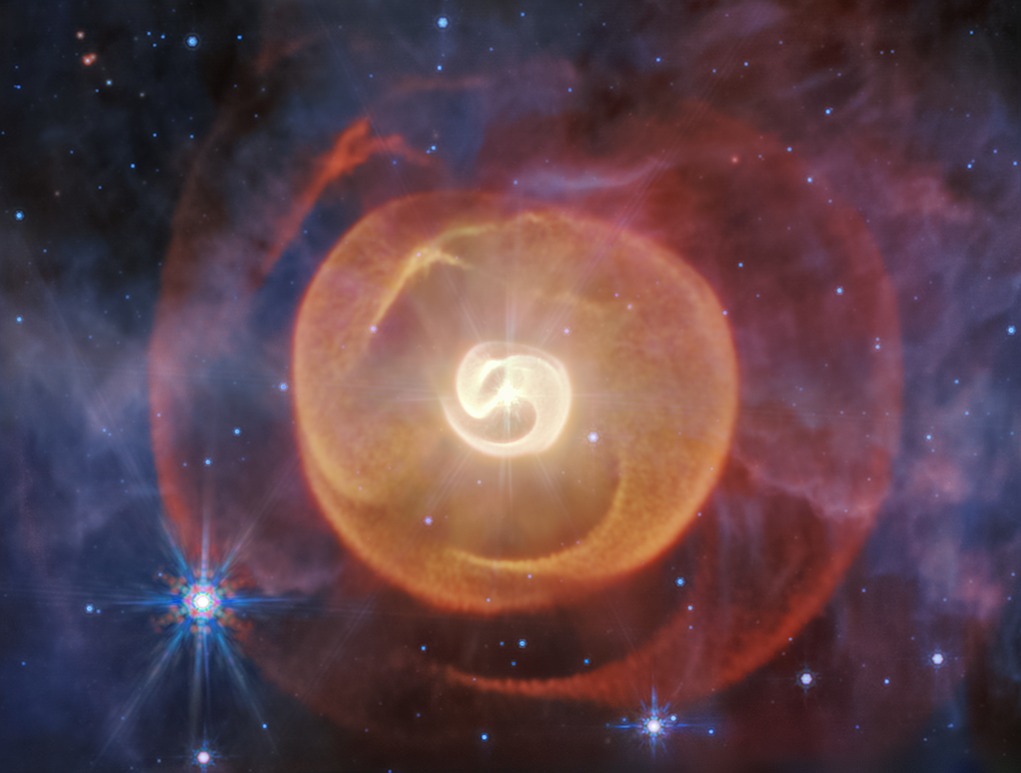
NASA’s James Webb Space Telescope (JWST) has achieved a remarkable milestone by capturing the first-ever mid-infrared images of the Apep star system, revealing four intricate dust shells spiraling around a pair of Wolf-Rayet stars. This groundbreaking observation marks a significant advancement in our understanding of these massive stars, which are known for their rapid evolution and dramatic stellar winds. Prior to Webb’s observations, only a single dust shell had been detected by other telescopes, leading scientists to hypothesize the existence of additional shells that remained elusive until now. The new data not only confirms the presence of four dust shells but also clarifies the gravitational relationship of the three stars within this system, which includes a massive supergiant star that interacts with the Wolf-Rayet stars, creating unique structures in the dust.
The intricate dynamics of the Apep system are fascinating. The two Wolf-Rayet stars, each estimated to be between 10 and 20 times the mass of the Sun, orbit each other every 190 years, spending 25 of those years in close proximity. During this time, their powerful stellar winds collide and mix, resulting in the ejection of carbon-rich dust at incredible speeds of 1,200 to 2,000 miles per second. The third star, a supergiant, plays a critical role by “slicing” through the dust shells, creating distinctive cavities that are visible in Webb’s imagery. This interaction not only highlights the complexity of stellar evolution but also provides a rare glimpse into the life cycle of massive stars, which are known to end their lives in spectacular supernova explosions.
Researchers Yinuo Han and Ryan White, who led the study published in *The Astrophysical Journal*, emphasized the importance of Webb’s observations, likening the experience to “walking into a dark room and switching on the light.” The data collected by Webb has provided unprecedented clarity on the dust distribution and the orbital mechanics of this unique system. As scientists continue to analyze this data, they hope to uncover more about the distance of the Apep stars from Earth and further explore the implications of their eventual supernova events. With only about a thousand Wolf-Rayet stars estimated to exist in our Milky Way galaxy, the Apep system stands out as a rare example, making these findings not only significant for understanding stellar life cycles but also for the broader study of cosmic evolution.
Explore Webb
Science
James Webb Space Telescope (JWST)
Webb First to Show 4 Dust…
Webb
News
Latest News
Latest Images
Webb’s Blog
Awards
X (offsite – login reqd)
Instagram (offsite – login reqd)
Facebook (offsite- login reqd)
Youtube (offsite)
Overview
About
Who is James Webb?
Fact Sheet
Impacts+Benefits
FAQ
Webb Timeline
Science
Overview and Goals
Early Universe
Galaxies Over Time
Star Lifecycle
Other Worlds
Science/Engineering Explainers
Observatory
Overview
Launch
Deployment
Orbit
Mirrors
Sunshield
Instruments & ISIM Module
Instrument: NIRCam
Instrument: MIRI
Instrument: NIRSpec
Instrument: FGS/NIRISS
Optical Telescope Element
Backplane
Spacecraft Bus
Multimedia
About Webb Images
Images
Videos
What is Webb Observing?
3d Webb in 3d Solar System
Podcasts
Webb Image Sonifications
Webb’s First Images
Team
International Team
People Of Webb
More
For the Media
For Scientists
For Educators
For Fun/Learning
5 min read
Webb First to Show 4 Dust Shells ‘Spiraling’ Apep, Limits Long Orbit
5 Min Read
Webb First to Show 4 Dust Shells ‘Spiraling’ Apep, Limits Long Orbit
Webb’s mid-infrared image shows four coiled shells of dust around a pair of Wolf-Rayet stars known as Apep for the first time. Previous observations by other telescopes showed only one. Webb’s data also confirmed that there are three stars gravitationally bound to one another.
Credits:
Image: NASA, ESA, CSA, STScI; Science: Yinuo Han (Caltech), Ryan White (Macquarie University); Image Processing: Alyssa Pagan (STScI)
NASA’s James Webb Space Telescope has delivered a first of its kind: a crisp mid-infrared image of a system of four serpentine spirals of dust, one expanding beyond the next in precisely the same pattern. (The fourth is almost transparent, at the edges of Webb’s image.) Observations taken prior to Webb only detected one shell, and while the existence of outer shells was hypothesized, searches using ground-based telescopes were unable to uncover any. These shells were emitted over the last 700 years by two aging Wolf-Rayet stars in a system known as
Apep
, a nod to the Egyptian god of chaos.
Webb’s image combined with several years of data from the European Southern Observatory’s Very Large Telescope (VLT) in Chile narrowed down how often the pair swing by one another: once every 190 years. Over each incredibly long orbit, they pass closely for 25 years and form dust.
Webb also confirmed that there are three stars gravitationally bound to one another in this system. The dust ejected by the two Wolf-Rayet stars is “slashed” by a third star, a massive supergiant, which carves holes into each expanding cloud of dust from its wider orbit. (All three stars are shown as a single bright point of light in Webb’s image.)
Image A: Wolf-Rayet Apep (MIRI Image)
Webb’s mid-infrared image shows four coiled shells of dust around a pair of Wolf-Rayet stars known as Apep for the first time. Previous observations by other telescopes showed only one. Webb’s data also confirmed that there are three stars gravitationally bound to one another.
Image: NASA, ESA, CSA, STScI; Science: Yinuo Han (Caltech), Ryan White (Macquarie University); Image Processing: Alyssa Pagan (STScI)
“Looking at Webb’s new observations was like walking into a dark room and switching on the light — everything came into view,” said Yinuo Han, the lead author of a
new paper in The Astrophysical Journal
and postdoctoral researcher at Caltech in Pasadena, California. “There is dust everywhere in Webb’s image, and the telescope shows that most of it was cast off in repetitive, predictable structures.” Han’s paper coincides with the publication of Ryan White’s
paper in The Astrophysical Journal
, a PhD student at Macquarie University in Sydney, Australia.
Han, White, and their co-authors refined the Wolf-Rayet stars’ orbit by combining precise measurements of the ring location from Webb’s image with the speed of the shells’ expansion from observations taken by the VLT over eight years.
“This is a one-of-a-kind system with an incredibly rare orbital period,” White said. “The next longest orbit for a dusty Wolf-Rayet binary is about 30 years. Most have orbits between two and 10 years.”
When the two Wolf-Rayet stars approach and pass one another, their strong stellar winds collide and mix, forming and casting out heaps of carbon-rich dust for a quarter century at a time. In similar systems, dust is shot out over mere months, like the shells in
Wolf-Rayet 140
.
High-speed ‘skirmish’
The dust-producing Wolf-Rayet stars in Apep aren’t exactly on a tranquil cruise. They are whipping through space and sending out dust at 1,200 to 2,000 miles per second (2,000 to 3,000 kilometers per second).
That dust is also very dense. The specific makeup of the dust is another reason why Webb was able to observe so much more: It largely consists of amorphous carbon. “Carbon dust grains retain a higher temperature even as they coast far away from the star,” Han said. While the exceptionally tiny dust grains are considered warm in space, the light they emit is also extremely faint, which is why it can only be detected from space by Webb’s
MIRI (Mid-Infrared Instrument)
.
Slicing dust
To find the holes the third star has cut like a knife through the dust, look for the central point of light and trace a V shape from about 10 o’clock to 2 o’clock. “The cavity is more or less in the same place in each shell and looks like a funnel,” White said.
“I was shocked when I saw the updated calculations play out in our simulations,” he said. “Webb gave us the ‘smoking gun’ to prove the third star is gravitationally bound to this system.” Researchers have known about the third star since the
VLT
observed the brightest innermost shell and the stars in 2018, but Webb’s observations led to an updated geometric model, clinching the connection. (See the system in 3D by watching the visualization below.)
Video A: Wolf-Rayet Apep Visualization
To view this video please enable JavaScript, and consider upgrading to a web browser that
supports HTML5 video
This scientific visualization models what three of the four dust shells sent out by two Wolf-Rayet stars in the Apep system look like in 3D based on mid-infrared observations from NASA’s James Webb Space Telescope. Apep is made up of two Wolf-Rayet binary stars that are orb…
Image: NASA, ESA, CSA, STScI; Simulation: Yinuo Han (Caltech), Ryan White (Macquarie University); Visualization: Christian Nieves (STScI); Image Processing: Alyssa Pagan (STScI)
“We solved several mysteries with Webb,” Han said. “The remaining mystery is the precise distance to the stars from Earth, which will require future observations.”
Future of Apep
The two Wolf-Rayet stars were initially more massive than their supergiant companion, but have shed most of their mass. It’s likely that both Wolf-Rayet stars are between 10 and 20 times the mass of the Sun, and that the supergiant is 40 or 50 times as massive compared to the Sun.
Eventually, the Wolf-Rayet stars will explode as supernovae, quickly sending their contents into space. Either may also emit a gamma-ray burst, one of the most powerful events in the universe, before possibly becoming a black hole.
Wolf-Rayet stars are incredibly rare in the universe. Only a thousand are estimated to exist in our Milky Way galaxy, which contains hundreds of billions of stars overall. Of the few hundred Wolf-Rayet binaries that have been observed to date, Apep is the only example that contains two Wolf-Rayet stars of these types in our galaxy — most only have one.
The James Webb Space Telescope is the world’s premier space science observatory. Webb is solving mysteries in our solar system, looking beyond to distant worlds around other stars, and probing the mysterious structures and origins of our universe and our place in it. Webb is an international program led by NASA with its partners, ESA (European Space Agency) and CSA (Canadian Space Agency).
To learn more about Webb, visit:
https://science.nasa.gov/webb
Related Information
Read more:
Webb Watches Carbon-Rich Dust Shells Form, Expand in Star System
Read more:
Webb Reveals Shells of Dust Surrounding Brilliant Binary Star System
Explore more:
ViewSpace
Star Death: Cassiopeia A
Explore more:
ViewSpace
Variable stars: V838 Mon
More Webb News
More Webb Images
Webb Science Themes
Webb Mission Page
Related For Kids
What is the Webb Telescope?
SpacePlace for Kids
Related Images & Videos
Wolf-Rayet Apep (MIRI Image)
Webb’s mid-infrared image shows four coiled shells of dust around a pair of Wolf-Rayet stars known as Apep for the first time. Previous observations by other telescopes showed only one. Webb’s data also confirmed that there are three stars gravitationally bound to one another.
Wolf-Rayet Apep (MIRI Compass Image)
This image of the Wolf-Rayet binary Apep, captured by the James Webb Space Telescope’s MIRI (Mid-Infrared Instrument), shows compass arrows, scale bar, and color key for reference.
Wolf-Rayet Apep Visualization
This scientific visualization models what three of the four dust shells sent out by two Wolf-Rayet stars in the Apep system look like in 3D based on mid-infrared observations from NASA’s James Webb Space Telescope. Apep is made up of two Wolf-Rayet binary stars that are orb…
Share
Details
Last Updated
Nov 19, 2025
Location
NASA Goddard Space Flight Center
Contact
Media
Laura Betz
NASA’s Goddard Space Flight Center
Greenbelt, Maryland
laura.e.betz@nasa.gov
Claire Blome
Space Telescope Science Institute
Baltimore, Maryland
Hannah Braun
Space Telescope Science Institute
Baltimore, Maryland
Related Terms
James Webb Space Telescope (JWST)
Nebulae
Stars
Related Links and Documents
The science paper by Y. Han et al.
The science paper by R. White et al.
Keep Exploring
Related Topics
James Webb Space Telescope
Space Telescope
Stars
Stars Stories
Universe


