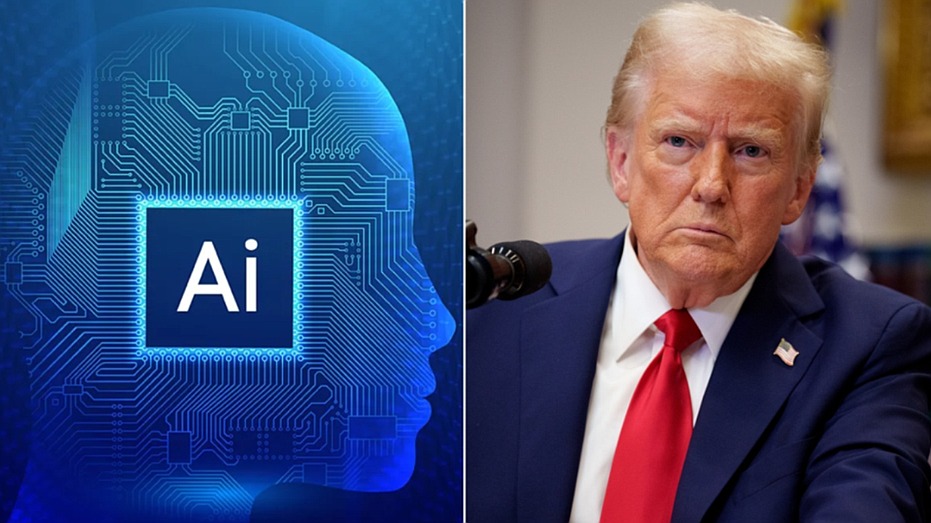
Trump calls for federal AI standards, end to state ‘patchwork’ regulations ‘threatening’ economic growth
In a recent post on Truth Social, former President Donald Trump has called for an end to what he describes as excessive state-level regulations on artificial intelligence (AI), warning that such measures could jeopardize the U.S. economy. He criticized the emergence of “Woke AI,” a term he uses to highlight concerns that some states are embedding ideologies, such as diversity, equity, and inclusion (DEI), into AI systems. Trump emphasized the need for a unified federal standard to replace the current “patchwork” of regulations across various states, arguing that these inconsistencies threaten to stifle innovation and investment in AI, which he claims is a crucial driver of economic growth. He stated, “Investment in AI is helping to make the U.S. Economy the ‘HOTTEST’ in the World,” underscoring his belief that a cohesive approach is necessary for maintaining the country’s competitive edge in the global AI race.
The timing of Trump’s remarks coincides with discussions among House Republican leaders about potentially including language in the National Defense Authorization Act to preempt state regulations on AI. House Majority Leader Steve Scalise has voiced concerns about “regulatory chaos” stemming from disparate state rules, advocating for a streamlined federal approach. This aligns with Trump’s broader AI initiative, “Winning the AI Race: America’s AI Action Plan,” which aims to establish guidelines that prevent federal agencies from adopting AI systems that prioritize ideological agendas over accuracy. However, not all Republicans share Trump’s viewpoint. Florida Governor Ron DeSantis has expressed concerns that overriding state authority could benefit big tech companies while undermining state-level protections against issues like political censorship and data privacy violations.
In a broader context, Trump’s push for federal oversight comes at a time when significant investments in AI are being discussed, including a commitment from Saudi Crown Prince Mohammed bin Salman to increase investments in the U.S. economy to nearly $1 trillion. Meanwhile, Democratic Senator Elizabeth Warren has raised alarms about the potential for taxpayer funds to be used to support AI firms like OpenAI, suggesting that such entanglement could lead to risky financial situations where taxpayers might bear the burden of bailouts. This ongoing debate reflects the complexities of balancing innovation with regulation in a rapidly evolving technological landscape, highlighting the need for careful consideration of the implications of both state and federal policies on the future of AI in the U.S.
https://www.youtube.com/watch?v=6rGZxWs-TA0
President
Donald Trump
has demanded an end to excessive state-level regulation of artificial intelligence (AI) and warned that state rules will end up threatening the U.S. economy.
In a post shared to Truth Social on Tuesday, Trump also slammed “Woke AI” and referred to a “patchwork” of state regulations in the AI space.
“Investment in AI is helping to make the
U.S. Economy
the ‘HOTTEST’ in the World,” Trump wrote.
“But
overregulation by the States
is threatening to undermine this Major Growth Engine. Some States are even trying to embed DEI ideology into AI models, producing ‘Woke AI’ (Remember Black George Washington?). We MUST have one Federal Standard instead of a patchwork of 50 State Regulatory Regimes.”
AMERICA’S SECRET WEAPON TO CRUSH CHINA IN THE GLOBAL AI RACE
Trump made his comments as
House Republican
leaders signaled they may try to include AI preemption language in the annual National Defense Authorization Act.
This
would block states
from bringing in their own AI rules and protections.
House Majority Leader
Steve Scalise
, R-La., said Monday that GOP leaders are considering the measure to prevent what he called “regulatory chaos” as states advance their own rules.
Trump’s push for a unified national framework is in line with his broader “Winning the
AI Race
: America’s AI Action Plan.”
Under
executive orders
issued in July, federal agencies must avoid procuring AI systems that “sacrifice truthfulness and accuracy to ideological agendas,” adhere to “Unbiased AI Principles” and support the fight against AI-generated deepfakes through the “Take It Down Act.”
AMERICA’S SECRET WEAPON TO CRUSH CHINA IN THE GLOBAL AI RACE
Vice President
JD Vance
echoed Trump’s stance at February’s Artificial Intelligence Action Summit.
“We believe that excessive regulation of the AI sector could kill a transformative industry just as it’s taking off,” Vance said.
Not all Republicans are on board. Florida Gov.
Ron DeSantis
shared a post to X Tuesday and warned that overriding state authority would serve as a “subsidy to Big Tech” and “prevent states from protecting against online censorship of political speech, predatory applications that target children, violations of intellectual property rights and data center intrusions on power/water resources.”
MEET THE EX-BIDEN APPOINTEE WHO COULD BE MAJOR FORCE AGAINST TRUMP’S AI AGENDA: ‘DOOMSAYER’
Trump’s Truth Social post also came after Saudi Crown Prince Mohammed bin Salman committed during Tuesday’s visit to the White House to increasing his planned investment in the U.S. economy to nearly $1 trillion over the next year.
Sen. Elizabeth Warren, D-Mass., raised concerns Tuesday about the government’s potential use of taxpayer funds to support OpenAI and other AI firms.
“OpenAI’s actions suggest that it may be pursuing a deliberate strategy to entangle itself with the federal government and the broader economy, so the government has no choice but to step in with public funds,” she said in a letter.
“We have seen this before: take on enough debt, make enough risky bets, and then demand a taxpayer bailout when those bets go south, so the economy does not crash.”